3.11 - Uses of Plant Hormones
Auxins used to control plant growth
Auxins are plant hormones used commercially in three main ways to control plant growth.
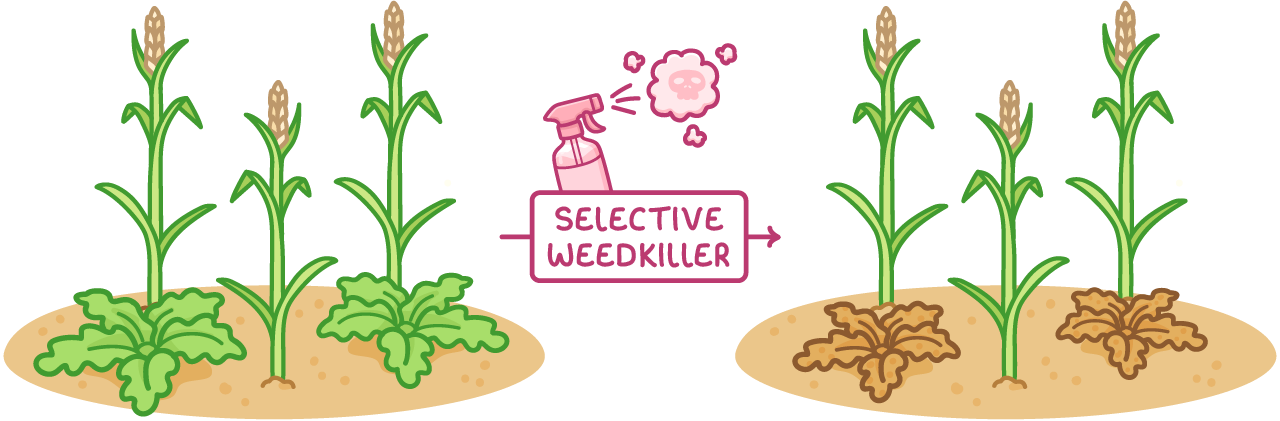
Selective weedkillers
- Also called selective herbicides.
- Most weeds in a field of crops or in a lawn are broad-leaved, whereas grasses and cereal crops are narrow-leaved.
- A selective weedkiller containing auxins disrupts the normal growth patterns of the broad-leaved weeds and kills them.
- The narrow-leaved grasses and crops are left untouched.
Rooting powder for cuttings
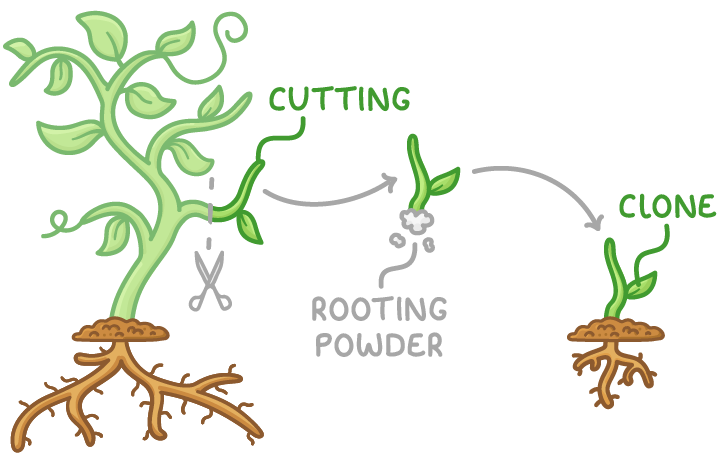
- A cutting is a part of a plant that has been cut off it, such as the end of a branch with a few leaves.
- Normally a cutting pushed into soil will not grow.
- Dipped in rooting powder (which contains auxins), it produces roots rapidly and grows into a new plant.
- This lets growers quickly produce many clones (exact copies) of a good plant.
Tissue culture
- A few cells are taken from a plant.
- Auxins are added to a growth medium along with nutrients.
- The auxins stimulate the cells to divide and form both roots and shoots, growing into new plants.
Gibberellins - Effects and commercial uses
- Plant hormones are chemicals that control how a plant grows.
- Gibberellins stimulate three things: seed germination (a seed starting to grow into a plant), stem growth, and flowering.
- They make stems grow by stem elongation, helping plants grow tall.
- Gibberellins and auxins can work together to have a large effect on growth - for example, helping a plant grow very tall.
- Many seeds won't germinate until they've been through certain conditions, such as a period of cold or dryness - a state called dormancy. Gibberellins break dormancy and allow the seeds to germinate.
Ending seed dormancy
- Treating dormant seeds with gibberellins makes them germinate at times of year when they normally wouldn't.
- It also helps make sure all the seeds in a batch germinate at the same time.
Controlling flowering
- Some plants only flower in certain conditions, such as longer days or lower temperatures.
- Treating them with gibberellins makes them flower without that change in their surroundings, and can produce bigger flowers.
- Gibberellins can also be used the other way - to reduce the number of flowers a plant forms.
- With fewer flowers, fewer fruits develop, so each fruit can grow larger and better.
Growing seedless fruit
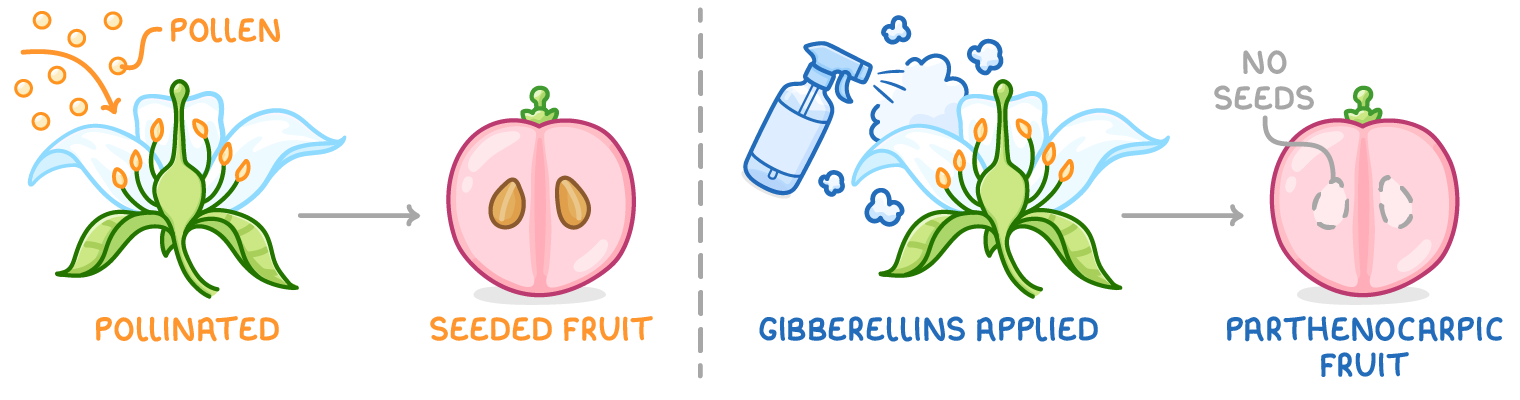
- Fruit normally grows only on a flower that has been pollinated - without pollination, no fruit or seeds form.
- Applying gibberellins (sometimes with auxins) to unpollinated flowers of certain plants makes the fruit grow while the seeds do not.
- Fruit grown this way, with no seeds, is called parthenocarpic fruit - seedless grapes and some seedless citrus fruits are produced like this.
- Gibberellins can also increase the size of fruit, so smaller seedless varieties grow as large as normal seeded ones.
Ethene - Effects and commercial uses
- Plant hormones are chemicals that control how a plant grows.
- Ethene is a gas produced by plants, including ageing leaves.
What ethene does in the plant
- It stimulates the cells that connect a leaf to the rest of the plant to expand. This breaks the cell walls and causes the leaf to fall off.
- It stimulates the enzymes inside fruit that cause the fruit to ripen.
Controlling fruit ripening
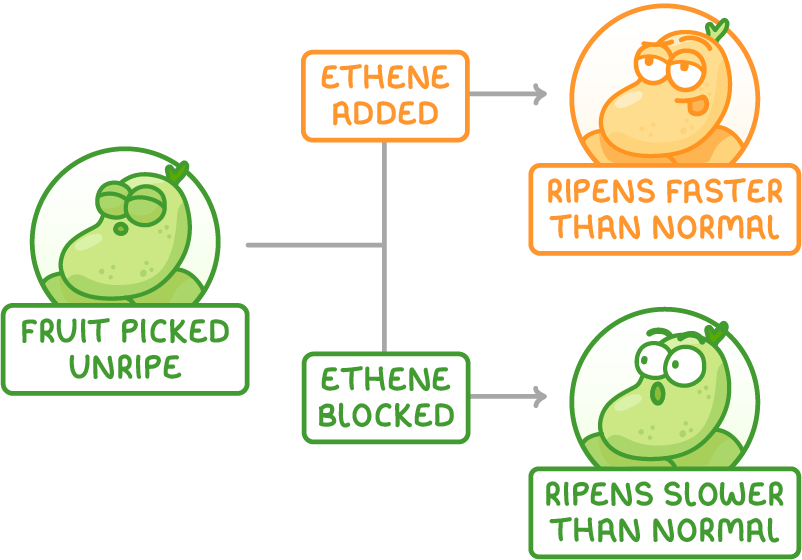
- The ripening effect is used commercially to control when fruit ripens.
- Ripening can be sped up either while the fruit is still on the plant or during transport to the shops:
- Fruit is picked while still unripe, when it is firmer and less easily damaged.
- Ethene gas is added on the way to the supermarket, so the fruit ripens and is perfect just as it reaches the shelves.
- Ripening can also be delayed while fruit is in storage, by:
- Adding chemicals that block ethene's effect on the fruit.
- Reducing the amount of ethene the fruit produces.
- Using chemicals that react with ethene to remove it from the surrounding air.
Dropping leaves before harvest
- Ethene is used to make the leaves drop off a crop such as cotton before it is harvested.
- This makes collecting the seeds or fruit easier.
TermDefinition
AuxinA plant hormone made in the tips of shoots and roots that controls cell elongation.
CloneAn organism that is genetically identical to another organism, such as its parent.
GibberellinA plant hormone that stimulates seed germination, stem growth and flowering.
DormancyA state where a seed will not germinate until it has experienced certain environmental conditions.
Parthenocarpic fruitSeedless fruit that has developed from an unpollinated flower.
EtheneA plant hormone gas that causes leaves to fall and stimulates enzymes to ripen fruit.
Key points to remember
How were these notes?