6.15 - Plant Diseases
Plant diseases and their signs
- Plants can be infected by the same types of pathogens as animals: viruses, bacteria, and fungi.
- They can also be infested and damaged by larger organisms such as insects.
Three pathogens specific to plants
- Tobacco mosaic virus (a virus) - Gives a mottled, discoloured pattern on the leaves of many plants.
- Erysiphe graminis (a fungus) - Causes powdery mildew of barley, producing white, fluffy patches on the leaves. These stop the leaves photosynthesising properly, lowering the crop yield.
- Agrobacterium tumefaciens (a bacterium) - Lives freely in some soils and on plant roots, and causes crown gall disease. When the bacteria get into a plant, they make growths (tumours) called galls form on the roots, stems, and branches. These galls damage the plant's tissues and restrict the flow of water through it, so the plant weakens and may eventually die.
Common signs of disease
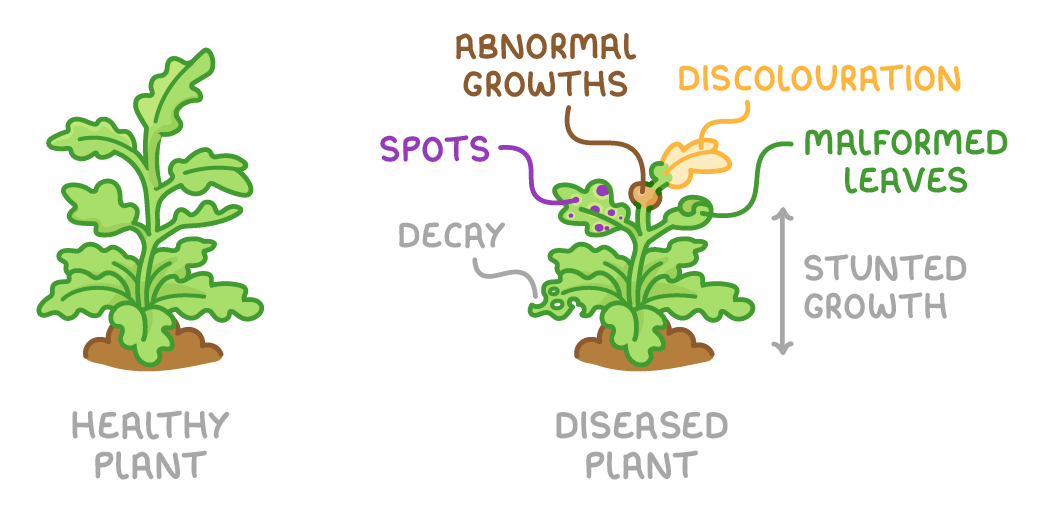
It's usually fairly clear when a plant has a disease, because diseased plants show characteristic signs:
- Stunted growth
- Spots on the leaves
- Patches of decay or rot
- Abnormal growths such as lumps
- Malformed stems or leaves
- Discolouration
Different diseases produce different combinations of these signs, which is what makes it possible to tell one disease from another.
Detecting and identifying plant disease
- A plant pathologist is an expert in plant disease.
- Detection usually starts with observation in the field, and moves to the laboratory when field observation isn't enough.
Detecting disease in the field
- The pathologist recognises the signs and matches them to a disease - for example by looking them up in a gardening manual or website:
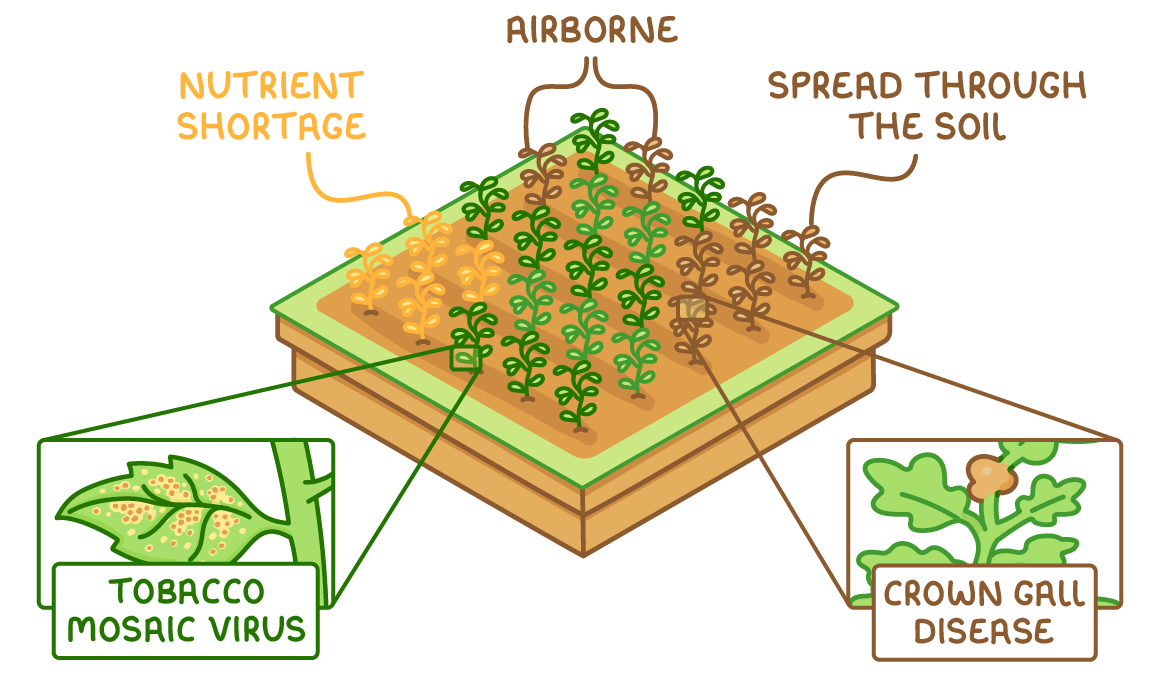
- Growths on the stems might point to crown gall disease.
- Mottled leaves might point to tobacco mosaic virus.
- The distribution of diseased plants is a clue to the pathogen, because different pathogens spread in different ways:
- Patches of diseased plants suggest a pathogen spread through the soil.
- Plants diseased at random suggest an airborne pathogen.
- A sign such as yellow leaves may not be caused by a pathogen at all, but by an environmental problem such as a nutrient shortage. This can be ruled out by changing the conditions - e.g. adding nutrients to the soil - and seeing whether the symptoms improve.
Identifying the pathogen in the laboratory
- When field observation isn't enough, an infected sample is taken to a laboratory to identify the pathogen accurately.
- A microscope can be used to look at the sample in more detail, and to tell apart pathogens that look alike (such as similar-looking fungi) and can't be distinguished by eye.
Two laboratory methods identify a pathogen from molecules unique to it:
- Detecting the pathogen's antigens - Antigens are the unique molecules on a pathogen's surface. Antibodies that bind to a particular pathogen's antigen show it's present. The ELISA test uses such antibodies linked to an enzyme that gives a colour change when the antigen is found.
- Detecting the pathogen's DNA - A technique such as the polymerase chain reaction (PCR) copies pathogen DNA from the sample many times over, until even a small amount can be detected - identifying exactly which pathogen is present.
Physical plant defences
- Plants don't have an immune system of specialised cells and antibodies like animals do.
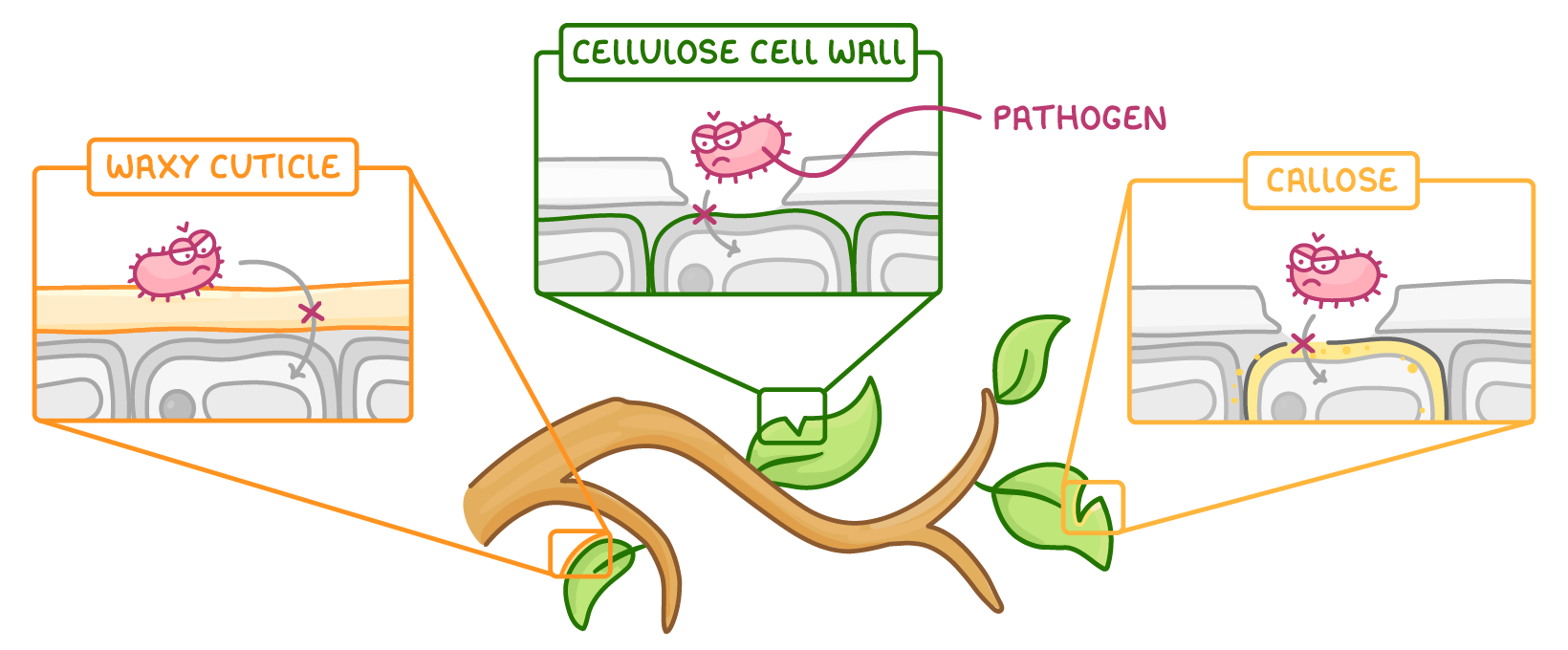
- Instead, they protect themselves partly with physical defences - barriers that stop pathogens getting into the plant in the first place.
The three physical barriers
- Waxy cuticle - A tough covering over most leaves and stems. It blocks pathogens from entering and stops water collecting on the leaf, lowering the risk of infection by pathogens carried in water.
- Cellulose cell wall - Beneath the cuticle, every plant cell is surrounded by a cell wall made of cellulose. This forms a further barrier against any pathogen that gets past the cuticle.
- Callose - If a pathogen breaks through, some plants deposit callose between the cell wall and the cell membrane, strengthening the wall where it's under attack.
Chemical plant defences
As well as physical barriers, many plants make chemical defences - substances that kill pathogens or deter the animals that would eat the plant.
Antimicrobial chemicals
- Some plants produce antimicrobial chemicals (also called antibacterials or antiseptics), which kill or stop the growth of bacteria and fungi.
- Examples: mint and witch hazel.
- Some plants also make saponins, which are thought to destroy the cell membranes of fungi.
Poisons that deter herbivores
- Other plants produce poisons to deter herbivores (animals that would eat them).
- Tobacco plants, foxgloves, and deadly nightshade all make poisonous chemicals.
- The poison digitalis comes from the foxglove.
TermDefinition
GallA growth or tumour on a plant's roots, stems or branches. Some are caused by bacteria, as in crown gall disease.
Plant pathologistAn expert in plant disease.
Antimicrobial chemicalA substance produced by a plant that kills or stops the growth of bacteria and fungi.
HerbivoreAn animal that eats plants.
Key points to remember
How were these notes?