3.4 - The Brain
The brain's main regions
- The brain is made up of billions of interconnected neurones. It controls and coordinates everything the body does.
- Different regions of the brain carry out different functions.
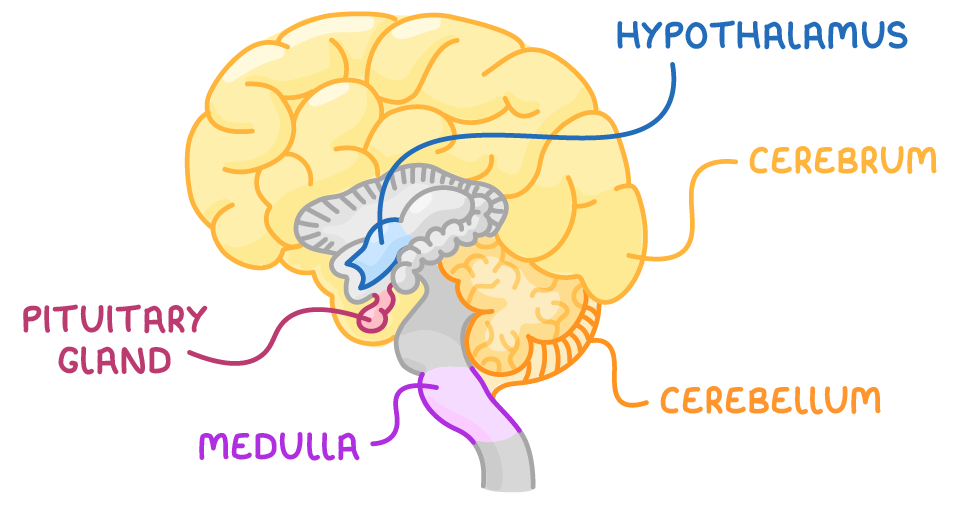
The five main regions and their functions
- Cerebrum - The outer, wrinkly part of the brain, responsible for the most complex behaviours, including consciousness, intelligence, memory, and language
- Hypothalamus - Maintains body temperature at its normal level, acting as the body's thermostat; also produces hormones that control the pituitary gland
- Pituitary gland - A small gland that produces many important hormones, including some that control other glands in the body, releasing them into the blood
- Medulla - Controls the unconscious activities of the body - the things done automatically, without having to think about them - such as breathing and heart rate
- Cerebellum - Responsible for muscle coordination, controlling smooth, coordinated movement
TermDefinition
CerebrumThe large, outer part of the brain responsible for complex behaviours such as consciousness, intelligence, memory, and language.
HypothalamusA region of the brain that maintains body temperature and produces hormones that control the pituitary gland.
Pituitary glandThe master gland at the base of the brain, which secretes several hormones, including some that make other glands release their own hormones.
MedullaA structure in the brain that controls unconscious activities such as breathing and heart rate.
CerebellumA folded structure in the brain responsible for muscle coordination.