10.12 - Conditions Needed for Seed Germination
The experiment
Aim
To find out which conditions a seed needs in order to germinate, by taking away water, oxygen, or a suitable warm temperature in turn and seeing whether the seeds still germinate.
Background
- Germination is when a seed starts to grow into a seedling.
- A seed needs water, which switches on the enzymes inside it that break down its stored food for growth.
- It needs oxygen, because it releases the energy for growth by aerobic respiration.
- It needs a suitable warm temperature, so its enzymes work fast enough.
- You can't see these processes inside the seed, but you can see whether it germinates when one condition is missing.
- So in this practical you take away one condition in each tube and count how many seeds germinate. A tube where the seeds don't germinate shows a condition they need.
Variables
- Independent variable - Which single condition is taken away from the tube (water, oxygen, or warmth).
- Dependent variable - Whether the seeds germinate, and how many.
- Control variables - The type and number of seeds, the length of time they're left, and every condition apart from the one taken away in that tube.
Method
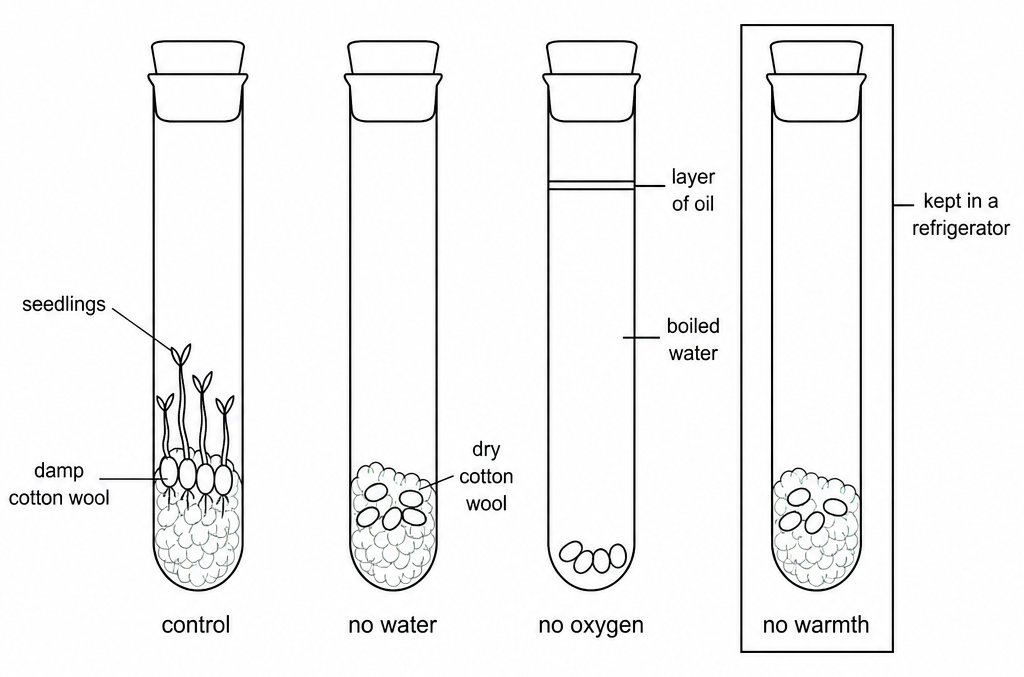
- Set up four tubes - Put the same number of cress or bean seeds into each of four boiling tubes.
- Tube 1, the control - Put the seeds on damp cotton wool, in the air, at room temperature (about 20 °C).
- Tube 2, no water - Put the seeds on dry cotton wool, in the air, at room temperature.
- Tube 3, no oxygen - Put the seeds on damp cotton wool, cover them with cooled boiled water, and add a thin layer of oil on top. Keep it at room temperature.
- Tube 4, no warmth - Put the seeds on damp cotton wool, in the air, and stand the tube in a fridge (about 4 °C).
- Count the seeds that germinate - Leave all four tubes for about a week, then record how many seeds have germinated in each. Only the control, which has all three conditions, should germinate.
Safety
- Seeds - Wash your hands after handling them, because bought seeds are often coated with a fungicide.
- Boiled water - Let it cool before you pour it over the seeds, so you're not handling a scalding liquid.
- The fridge tube - Label it, so nobody mistakes it for food.
Common exam questions
Question 1
Why is one tube set up with all the conditions present?
It's the control. It shows the seeds can germinate when they have everything, so if a tube with one condition taken away fails to germinate, that missing condition is needed.
Question 2
Why is the water in the no oxygen tube boiled first, and why is oil added on top?
Boiling drives the dissolved oxygen out of the water, and the layer of oil stops oxygen from the air dissolving back in. Together they make sure the seeds have no oxygen.
Question 3
The seeds in the fridge didn't germinate, but the seeds in the control did. What does this show?
Seeds need a suitable warm temperature to germinate. The fridge tube had water and oxygen, so the cold was the only thing missing.
Question 4
Do seeds need light in order to germinate?
No. Most seeds germinate without light, because the young plant uses the food stored inside the seed rather than making its own by photosynthesis.