3.4 - Mineral Requirements
Nitrate ions for amino acids and proteins
- Plants make glucose by photosynthesis, but they also need certain mineral ions, which they take up from the soil.
- One of the most important is the nitrate ion.
Why plants need nitrate ions
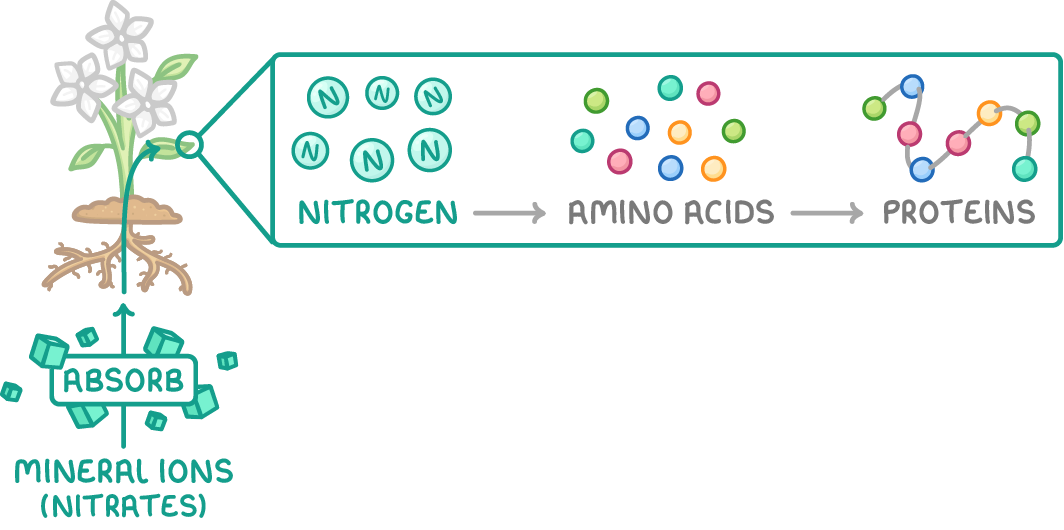
- Nitrate ions contain nitrogen.
- The plant uses this nitrogen to make amino acids, which are then joined together to build proteins.
- Proteins are needed for cell growth, so a steady supply of nitrate ions is essential for the plant to grow and develop properly.
How nitrate ions are absorbed
- Nitrate ions are dissolved in the water in the soil.
- The plant absorbs them through its root hair cells.
- The concentration of nitrate ions is usually higher inside the root than in the soil around it.
- Because of this, the root hair cells take them up by active transport, against the concentration gradient.
Magnesium ions for chlorophyll
- Plants take up magnesium ions from the soil.
- They're needed in much smaller amounts than nitrate, but are just as essential.
- Magnesium ions are used to make chlorophyll - the green pigment found in chloroplasts that absorbs light energy for photosynthesis.
- Without enough magnesium, a plant can't make the chlorophyll it needs to photosynthesise properly.
Mineral deficiency symptoms
- Plants absorb mineral ions from the soil through their roots.
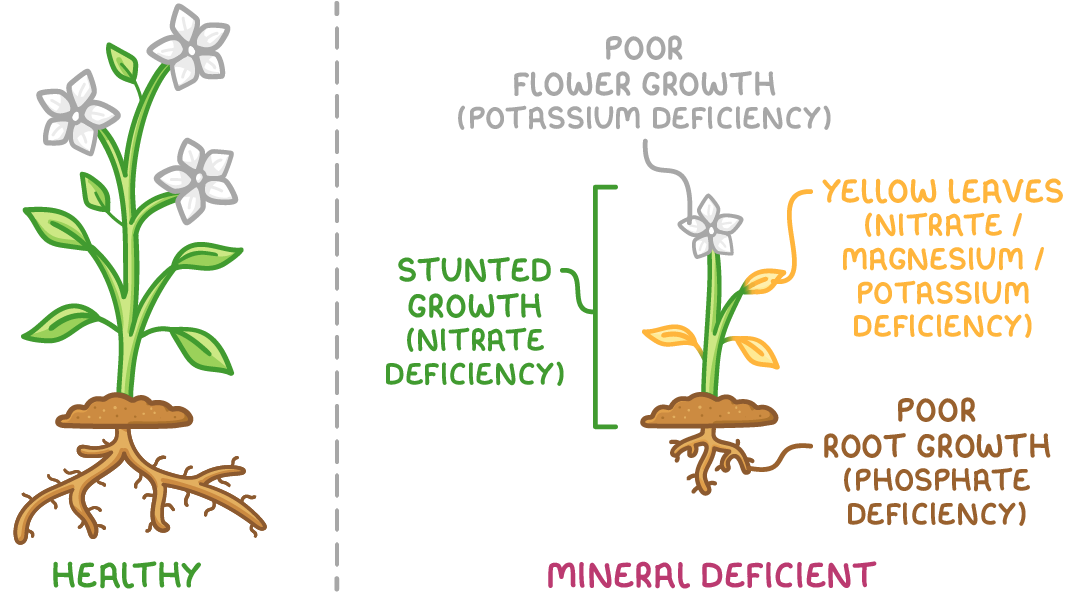
- If a plant cannot get enough of a particular mineral ion, it shows deficiency symptoms - visible signs that something is missing - and its growth suffers.
Symptoms of each mineral shortage
- Nitrate ions - Needed to make protein. A shortage means poor, stunted growth and yellowing of older leaves.
- Magnesium ions - Needed to make chlorophyll. A shortage causes leaves to turn yellow.
- Potassium ions - A shortage causes yellowing of the leaves and poor flower and fruit growth.
- Phosphate ions - A shortage causes poor root growth.
TermDefinition
Deficiency symptomA visible sign in a plant that it is not getting enough of a particular mineral ion.