7.3 - Flowers & Pollination
Anatomy of the flower
- A flowering plant carries its male and female reproductive parts together inside the flower.
- Two further structures sit around these reproductive parts: one protects the flower and the other attracts insects.
The male part - The stamen
The stamen is the male part, made of two pieces:
- Anther - Contains the pollen grains, which produce the male gametes
- Filament - The stalk that holds the anther up
The female part - The carpel
The carpel is the female part, made of four structures working together:
- Stigma - The sticky tip that pollen grains attach to
- Style - The rod-like section that supports the stigma and connects it to the ovary; a pollen tube later grows down through it
- Ovary - Contains the ovules
- Ovules - Each ovule holds a female gamete
Protective and attractive structures
- Sepals - Green and leaf-like; enclose and protect the flower while it is still a bud
- Petals - Modified leaves, often large and brightly coloured to attract insects in towards the anthers and stigmas inside

Self- and cross-pollination
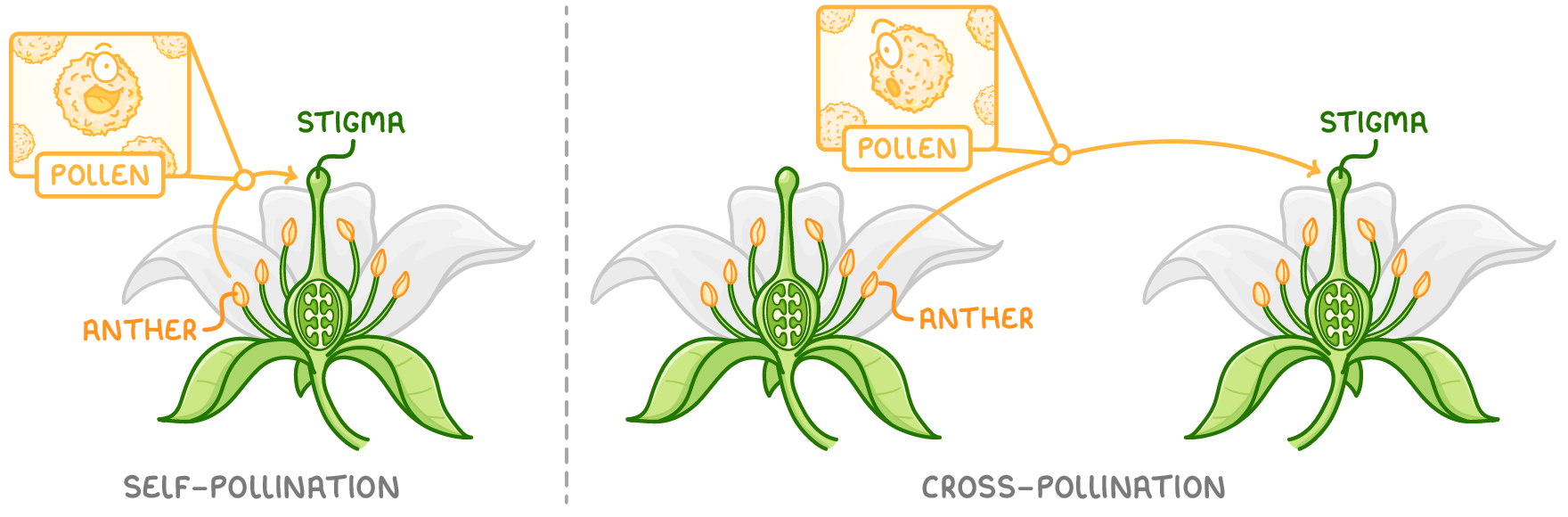
- Pollination is the transfer of pollen grains from an anther to a stigma - bringing the male part of the plant into contact with the female part.
- Once a pollen grain lands on a stigma, the plant can go on to reproduce.
- Pollination is only this transfer of pollen onto the stigma. It is not fertilisation, which happens later and deeper inside the flower.
Two routes for pollen
Pollen can reach a stigma by one of two routes, each named for where the pollen comes from:
- Self-pollination - Pollen is transferred from an anther to a stigma on the same flower, or to a stigma on a different flower of the same plant.
- Cross-pollination - Pollen is transferred from an anther on one plant to a stigma on a flower of a different plant of the same species.
Adaptations for insect and wind pollination
- Insect-pollinated flowers are adapted to attract insects and load pollen onto them.
- Wind-pollinated flowers don't need to attract animals - they're adapted to release pollen into moving air and catch pollen blowing past.
Comparing the two types of flower
| Feature | Insect-pollinated | Wind-pollinated |
|---|---|---|
| Petals | Large and brightly coloured, to draw insects in towards the anthers and stigmas | Small and dull - no need to attract insects |
| Scent and nectaries | Has scent and nectaries (glands that secrete a sugary liquid called nectar) to attract insects | No strong scent and no nectaries |
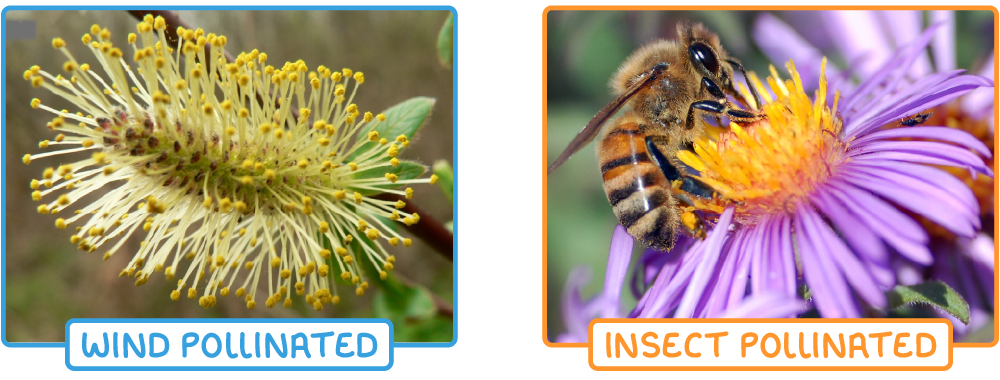
| Anthers | Inside the flower | Hang outside on long filaments, so the wind blows the loose pollen away |
| Stigma | Sticky, so pollen carried in on a visiting insect sticks to it | Large and feathery, often hanging outside - a wide surface to trap pollen carried past on the wind |
Pollen built for two ways of travelling
The two kinds of flower make pollen suited to two different ways of travelling, so the grains look different:
- Insect-pollinated pollen - Produced in fairly small amounts. Grains are large, sticky, and often spiky or sculptured on the surface, so they cling to a visiting insect's body.
- Wind-pollinated pollen - Produced in very large amounts. Grains are small, light, and smooth, so they're easily lifted and carried long distances by moving air.
The size, quantity, and surface texture together tell you which pollination method a flower or pollen grain uses. The photographs below show a real flower of each type.
TermDefinition
StamenThe male part of a flower, made up of an anther and a filament.
CarpelThe female part of a flower, made up of a stigma, style, ovary and ovules.
PollinationThe transfer of pollen grains from an anther to a stigma.
Self-pollinationThe transfer of pollen from an anther to a stigma on the same flower or the same plant.
Cross-pollinationThe transfer of pollen from an anther on one plant to a stigma on a different plant of the same species.
NectaryA gland in a flower that secretes a sugary liquid called nectar.