9.1 - Food Security
Fertilisers
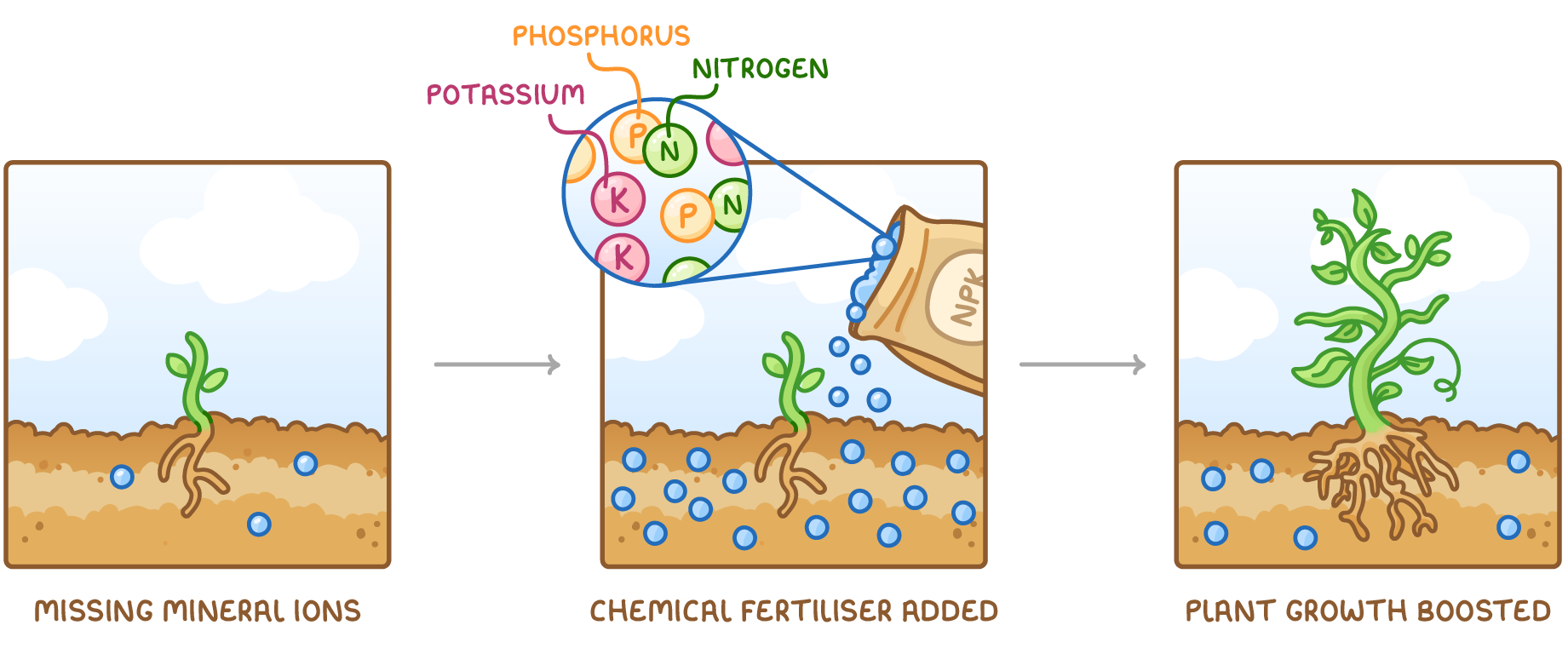
- Plants need mineral ions from the soil to grow properly - in particular nitrogen, phosphorus, and potassium.
- When a crop grows, it takes these mineral ions out of the soil, leaving the soil short of them for the next crop.
Replacing lost mineral ions
- Farmers add chemical fertiliser to replace the missing mineral ions.
- This boosts plant growth, which raises the crop yield.
- Fertiliser is usually rich in nitrogen, phosphorus, and potassium (NPK) - the ions a growing crop needs most.
Pesticides and bioaccumulation
- Pesticides are a form of chemical pest control - sprayed onto crops to kill the pests that damage them.
- Fewer plants are lost, so the yield rises.
Types of pesticide
- Insecticides - Kill insects
- Herbicides - Kill weeds
- Fungicides - Kill fungi
Drawbacks of pesticides
- Often poisonous to humans, so they must be used carefully to keep the amount left in food below a safe level.
- Many harm wildlife that aren't pests, such as bees and ladybirds. This can leave less food for animals higher up the food chain.
Bioaccumulation
- Some pesticides are not broken down and persist in the bodies of organisms that take them in.
- When a sprayed plant is eaten, the pesticide passes into the animal, then into whatever eats that animal.
- At each stage up the food chain, the concentration of pesticide in the organisms increases.
- Eventually organisms at the top can receive a lethal dose.
- This build-up of a toxic substance in living organisms along a food chain is called bioaccumulation.
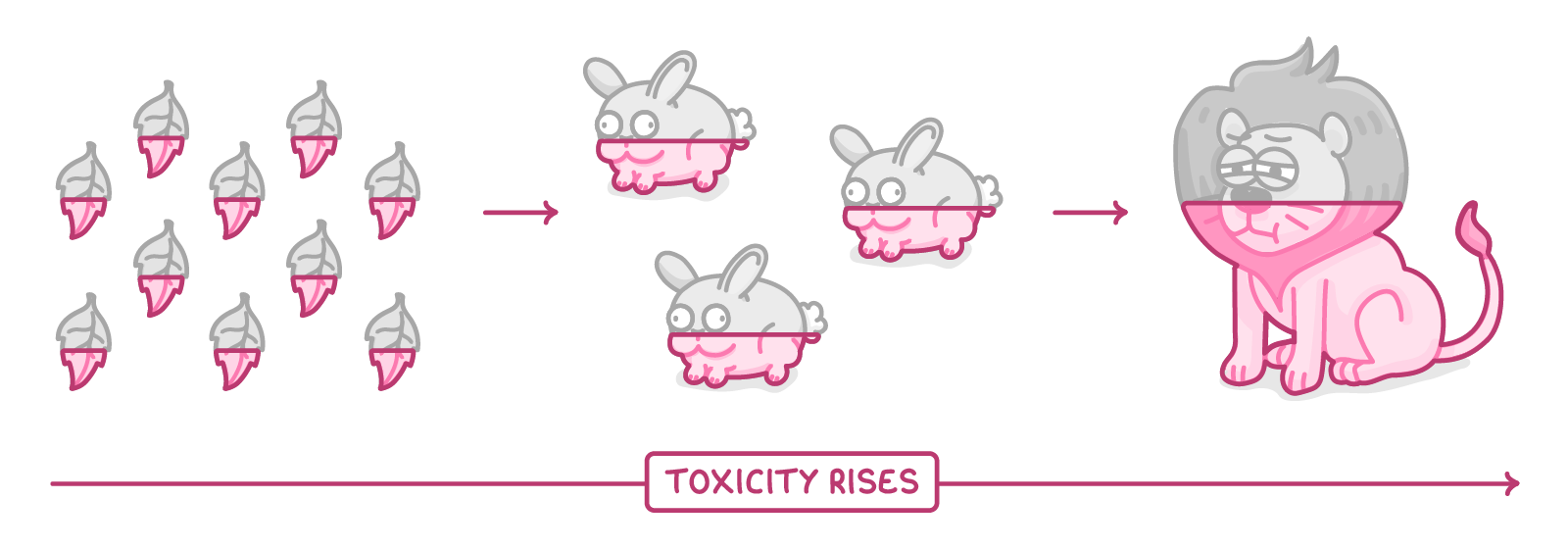
Pink shows the pesticide, more concentrated at each step up the food chain.
Biological control
- Biological control is an alternative to chemical pesticides: instead of spraying poison, farmers use other living organisms to reduce the numbers of a pest.
- This is done either by encouraging organisms already in the area or by adding new ones.
Types of helpful organism
- Predators - Such as ladybirds that eat aphids
- Parasites - Such as flies whose larvae develop on or in a host insect and eventually kill it
- Disease-causing organisms - These infect the pest
Advantages over pesticides
- No chemicals used - Means less pollution and less risk to people eating the food
- No toxic chemicals passing along food chains
- Longer-lasting effect - Spraying often has to be repeated, but biological control can last longer
The risk of introducing new organisms
Biological control does carry a risk: introducing a new organism into an ecosystem can cause problems of its own.
Example: cane toads were brought into Australia to eat the beetles damaging crops, but the toads became a major pest themselves - they poison the native animals that try to eat them.
Glasshouses and polytunnels
- A glasshouse is a large greenhouse. A polytunnel is a big tube-shaped structure made from polythene.
- Both grow crops inside a controlled, enclosed space rather than out in the open.
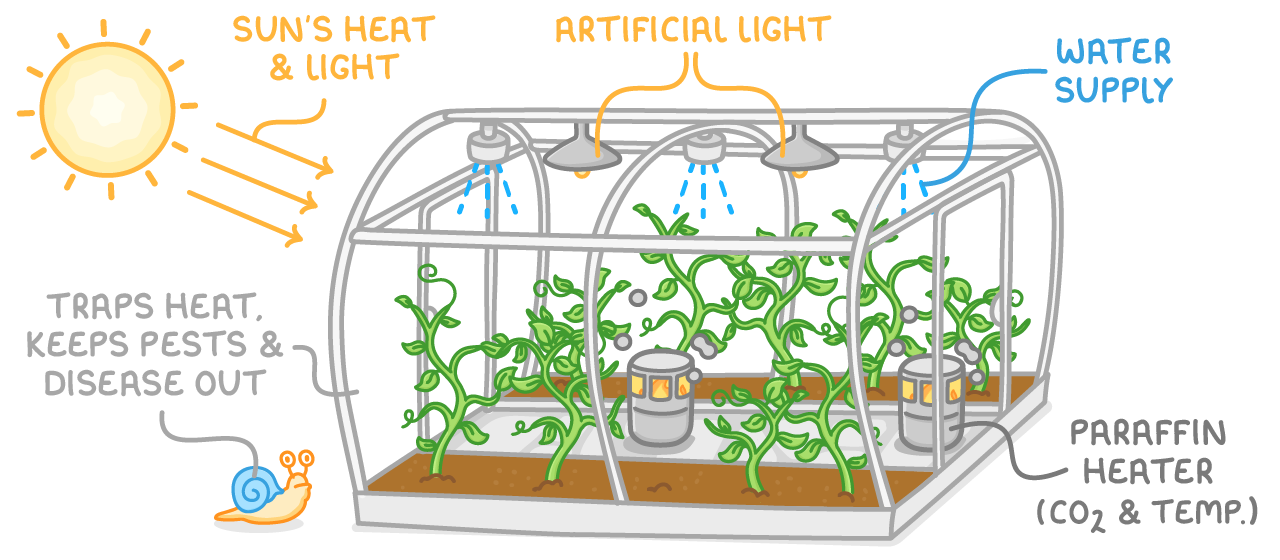
- Enclosing the plants lets the farmer control several of the things that affect how well a crop grows.
What a farmer can control inside
- Pests and diseases - Easier to keep plants free from these when they're shut inside.
- Water - The water supplied to the crop can be controlled.
- Light - Artificial light can be supplied after the Sun goes down, giving plants more time to photosynthesise.
- Temperature - The structure traps the Sun's heat to keep plants warm, and in winter a heater can hold the temperature at the ideal level.
Boosting the rate of photosynthesis
- The rate of photosynthesis depends on how much light, carbon dioxide, and warmth a plant has.
- Inside the glasshouse the farmer can deliberately raise the carbon-dioxide concentration and the temperature to make the crop grow faster.
- A paraffin heater does both at once: burning the paraffin warms the glasshouse and gives off carbon dioxide as a by-product.
- With more light, a higher temperature, and a higher carbon-dioxide concentration, the rate of photosynthesis goes up - so the plants make more food and grow bigger and faster.
The effect on yield
- Controlling all these conditions together keeps the crop growing well all year round.
- As a result, the yield is higher than it would be growing the same plants out in the open.
TermDefinition
BioaccumulationThe build-up of a toxic substance in living organisms along a food chain, because it is not broken down or excreted.
Biological controlUsing a living organism, such as a predator or parasite, to reduce the numbers of a pest or pathogen.