7.20 - Mutations
What a mutation is and how it changes the protein
- A mutation is a random change to the sequence of bases in DNA.
- Mutations happen continuously and arise spontaneously - for example when DNA isn't copied perfectly as a cell prepares to divide.
- A mutation produces a genetic variant - a different form of the gene, also called a new allele - and can sometimes be passed from parent to offspring.
How a mutation changes the protein
- The order of bases in a gene sets the order of amino acids in the protein it codes for, read three bases at a time - each triplet codes for one amino acid.
- A mutation that changes the base sequence can change which amino acids are joined, and so change the protein that's built.
- A protein folds into a particular shape that depends on its amino-acid sequence, and that shape lets it do its job.
- So changing the amino acids can change the shape, and so change how well the protein works - its activity might increase, decrease, or stop altogether.
Effect on the phenotype ranges from none to large
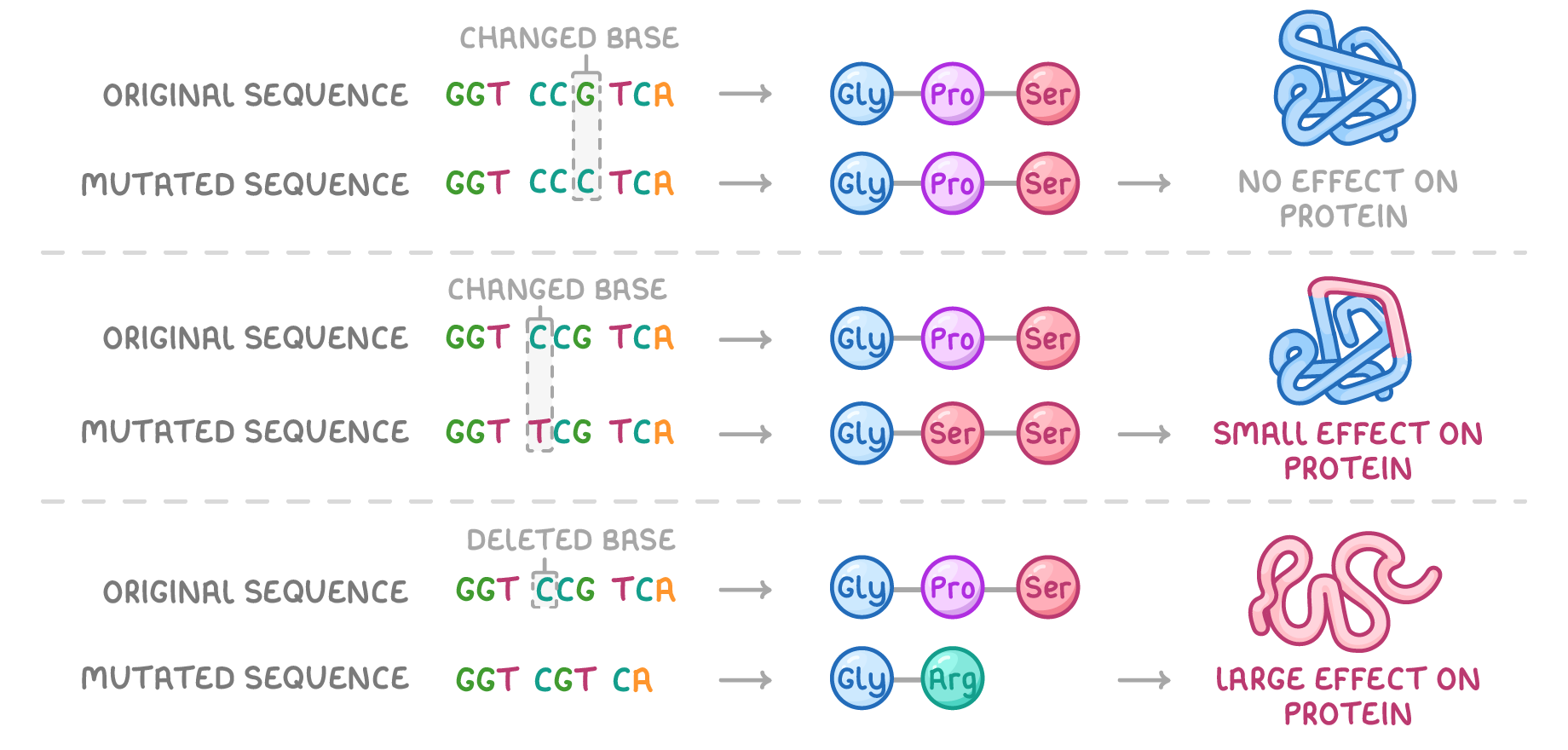
A mutation often changes nothing, because:
- The changed triplet may still code for the same amino acid.
- The change to the protein may be too small to alter its shape and function.
- The mutation may fall in a part of the DNA that does not do an important job, or sit in a recessive allele masked by a dominant one.
Other outcomes:
- Small effect - Alters a characteristic only slightly.
- Large effect - Occurs when a key protein is badly disrupted or not made at all.
The two kinds of protein where this matters most
- Enzymes - Have an active site with a very specific shape that the substrate fits into. If a mutation changes the active site's shape, the substrate may no longer bind, so the enzyme can't speed up its reaction. A mutation can even stop the enzyme being produced at all.
- Structural proteins (e.g. collagen) - Depend on their shape to give strength and support. If a mutation changes that shape, the protein can lose its strength and become much less useful for holding tissues together.
What causes mutations
- Mutations happen spontaneously - often when DNA isn't copied perfectly as a cell divides.
- They are random: you can't predict where in the DNA a mutation will occur.
- The mutation rate (how many mutations occur in a given time) is not fixed - certain things in the environment increase it.
Factors that raise the mutation rate
- Ionising radiation - Such as X-rays, gamma rays, and ultraviolet rays. The larger the dose, the greater the chance of a mutation.
- Mutagens - Certain chemicals, such as the chemicals found in tobacco.
Why exposure is dangerous
- These factors don't guarantee a mutation - they only make one more likely.
- Raising the mutation rate also raises the chance of a harmful mutation, which is why exposure to them is dangerous.
- Reducing exposure lowers the chance of mutations occurring.
TermDefinition
MutationA random change in an organism's genetic material (DNA).
Genetic variantA different form of a gene, produced by a mutation.
Mutation rateThe number of mutations that happen in a given time.