5.5 - The Heart & Circulatory System
Heart structure and the pathway of blood
- The heart is a muscular organ that pumps blood around the body.
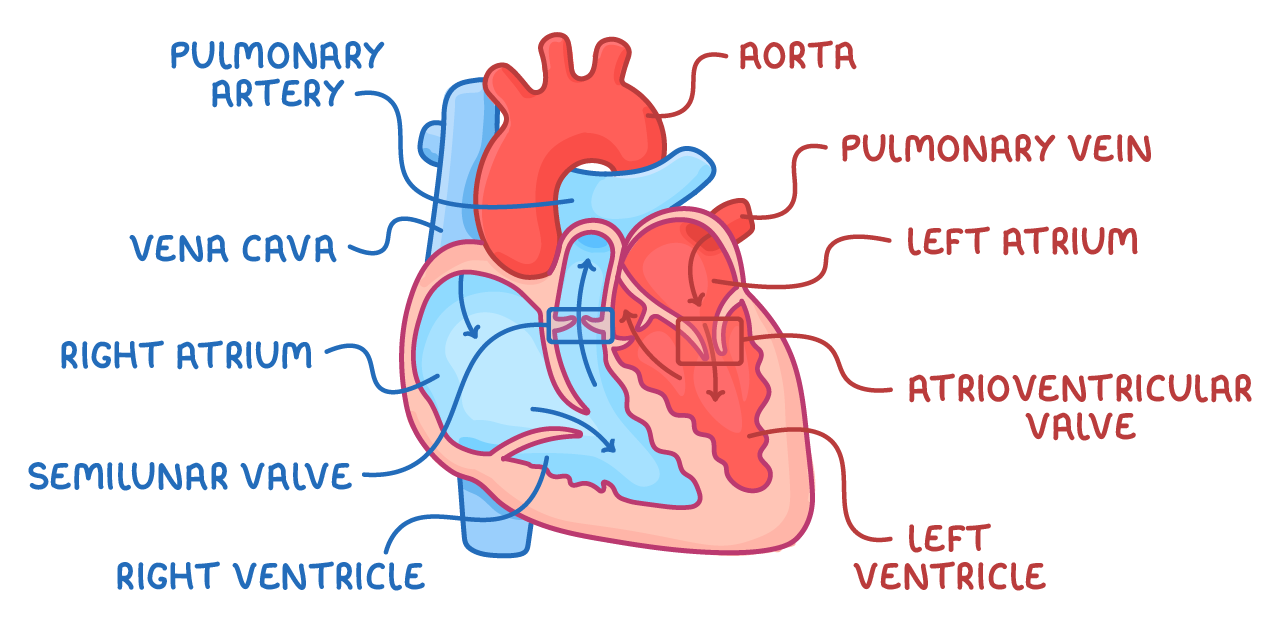
- It has four chambers: a left and a right atrium at the top, and a left and a right ventricle below.
- The walls are made of muscle, which contracts to force blood out.
- The left ventricle has a much thicker, more muscular wall than the right ventricle:
- It pumps blood all the way around the body at high pressure.
- The right ventricle only pumps blood the short distance to the lungs.
Valves prevent backflow
- Valves inside the heart make blood flow in one direction only by preventing backflow.
- Atrioventricular valves - Sit between the atria and the ventricles:
- Tricuspid valve on the right.
- Bicuspid valve on the left.
- Semilunar valves - Sit where blood leaves the ventricles into the arteries.
- When the ventricles contract, the atrioventricular valves close (so blood can't flow back into the atria) and the semilunar valves open (so blood can leave). This keeps blood moving forwards through the heart.
The pathway of blood through the heart
- The right atrium receives deoxygenated blood from the body through the vena cava; the left atrium receives oxygenated blood from the lungs through the pulmonary vein.
- The atria contract, pushing blood into the ventricles.
- The right ventricle pumps blood to the lungs through the pulmonary artery.
- The left ventricle pumps blood around the rest of the body through the aorta.
The heart muscle itself is supplied with oxygenated blood by the coronary arteries, which branch from the base of the aorta and spread over the heart.
Double circulation
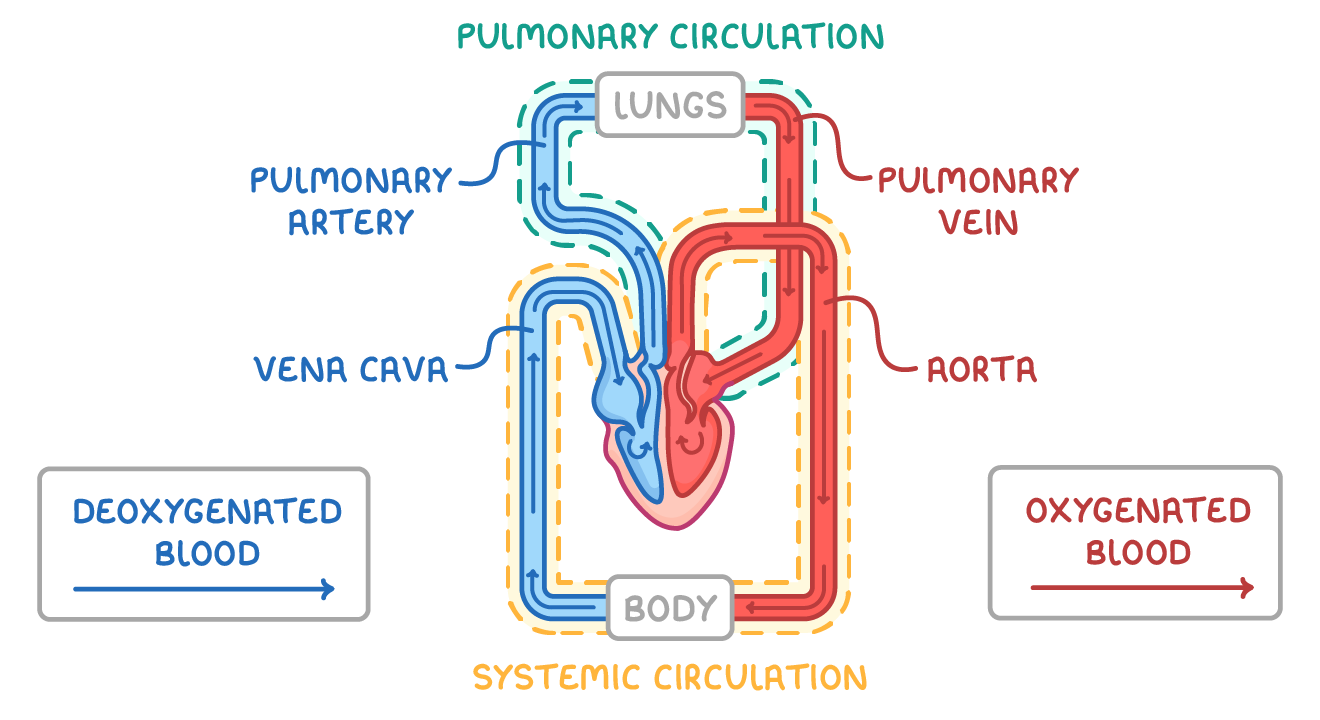
- Humans have a double circulatory system - two separate circuits joined together at the heart.
- The blood passes through the heart twice for each complete circuit of the body.
- The two circuits are:
- Pulmonary circuit (the pulmonary circulation) - Carries blood to the lungs
- Systemic circuit (the systemic circulation) - Carries blood to the rest of the body
How the two circuits work
- The right side of the heart pumps deoxygenated blood to the lungs.
- In the lungs the blood takes in oxygen, becomes oxygenated, and returns to the heart.
- The left side of the heart pumps this oxygenated blood out to all the other organs of the body.
- There the blood gives up its oxygen to the body cells, becomes deoxygenated, and returns to the heart - ready to be pumped to the lungs again.
Why the blood returns to the heart between circuits
- It can be given a fresh push at high pressure for the journey around the body.
- This means blood can be pumped to the tissues quickly and deliver plenty of oxygen.
How activity changes the heart rate
- When the body becomes more active, the heart rate goes up.
- During exercise the muscles respire faster to release more energy, so they need more oxygen delivered and more carbon dioxide taken away.
- To do this the blood must flow faster, which means the heart must beat faster.
How exercise raises the heart rate
- The rise in carbon dioxide in the blood during exercise is detected by receptors in the aorta and in the carotid artery (an artery in the neck).
- These receptors send signals to the brain.
- The brain sends signals to the heart that make it contract more often and more strongly.
How adrenaline raises the heart rate
- When the body is frightened or under threat, the adrenal glands release the hormone adrenaline into the blood.
- It binds to receptors in the heart and makes the cardiac muscle contract more frequently and more forcefully.
- The heart rate rises and more blood is pumped, which increases the oxygen supply to the tissues and prepares the body for action.
Monitoring the heart with pulse rate
- The activity of the heart can be monitored by measuring the pulse rate.
- Each time the ventricles contract, a surge of blood passes through the arteries. This surge can be felt as a pulse - for example at the wrist or the neck.
- Counting the number of pulses in one minute gives the heart rate.
- Taking the pulse before and after exercise shows how strongly activity raises it.