10.10 - Gas Exchange in Plants
The experiment
Aim
To use hydrogencarbonate indicator to find out whether a plant is taking in or giving out carbon dioxide overall, in bright light, in the dark, and behind a screen.
Background
- Hydrogencarbonate indicator changes colour with the amount of carbon dioxide dissolved in it. It's orange-red at the normal level of carbon dioxide in the air, yellow when there's more, and purple when there's less.
- A plant respires all the time, which gives out carbon dioxide. When there's light it also photosynthesises, which takes carbon dioxide in.
- The balance left once both processes have happened is the net gas exchange, the amount of carbon dioxide taken in or given out in total.
- You can't see respiration or photosynthesis happening, but you can see whether the carbon dioxide around a plant has gone up or down.
- So in this practical you seal a plant in tubes of indicator in different light, and read the colour to see which process was faster.
Variables
- Independent variable - The light each tube gets (bright light, darkness, or dim light behind a screen).
- Dependent variable - The colour of the indicator.
- Control variables - The volume of indicator, the amount of plant material, the temperature, and the time the tubes are left.
Method
- Fill the tubes - Put the same volume of hydrogencarbonate indicator into several test tubes, and note its starting orange-red colour.
- Add the plant - Put the same amount of pondweed, or the same number of leaf discs, into each tube and seal it with a bung. Set up one more tube with no plant as a control.
- Set the light - Put one tube in bright light, wrap one in aluminium foil for darkness, and cover one with gauze or muslin for dim light.
- Leave the tubes - Leave them all in the same place for the same time, an hour or more.
- Compare the colours - Compare the indicator in each tube with the control. Purple shows the carbon dioxide level fell, yellow shows it rose, and orange-red shows no net change.
Safety
- Eye protection - The indicator is low hazard, but wear eye protection and rinse off any splashes.
- Wash your hands - After handling the pondweed or leaf discs, because pond water can carry microorganisms.
- Push bungs in gently - So a glass tube doesn't break in your hand.
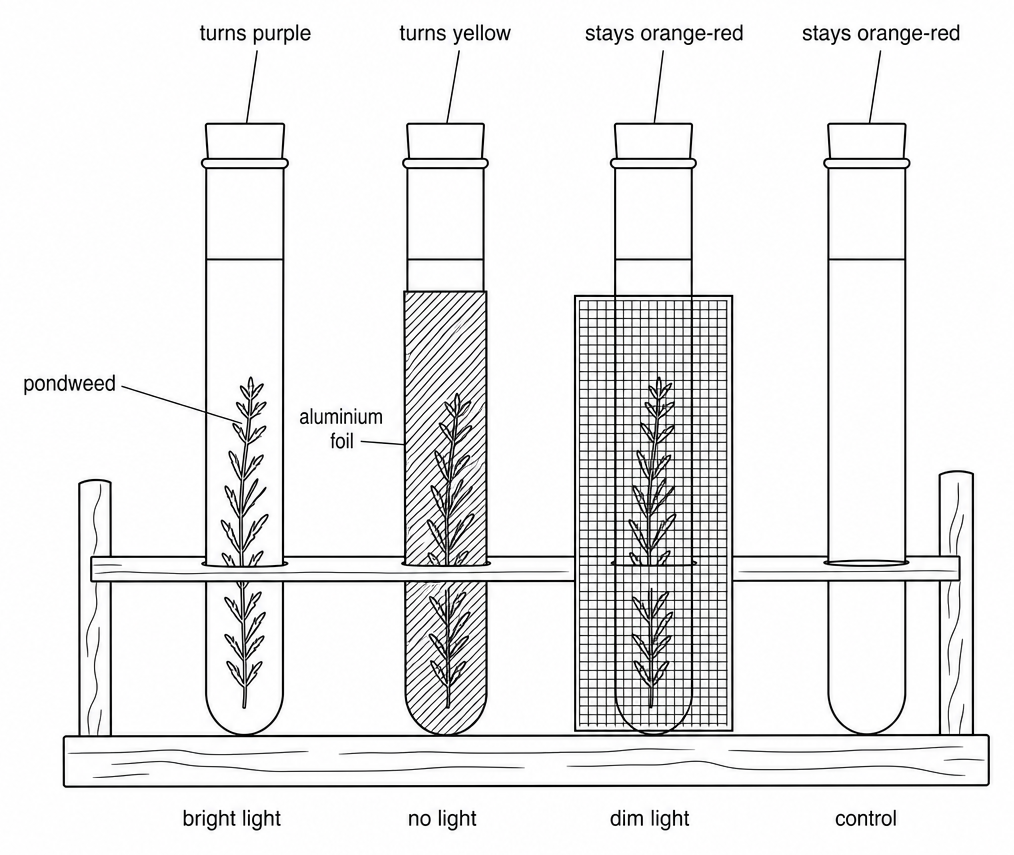
The fourth tube has no plant, so any colour change must come from the pondweed.
Common exam questions
Question 1
Why does the indicator turn purple in bright light?
Photosynthesis is faster than respiration, so the plant takes in more carbon dioxide than it gives out. The carbon dioxide level falls.
Question 2
Why does the indicator turn yellow in the dark?
With no light the plant can't photosynthesise and only respires. It gives out carbon dioxide, so the level rises.
Question 3
The tube behind the screen didn't change colour. Explain why.
At that dim light level photosynthesis and respiration happen at the same rate. The carbon dioxide taken in equals the carbon dioxide given out, so there's no net change.
Question 4
Why is a tube with no plant set up?
As a control, to show that any colour change is caused by the plant and not by something else, such as the light or the temperature.
Question 5
Why are all the tubes kept at the same temperature?
Temperature changes the rates of respiration and photosynthesis too. Keeping it the same means the light is the only difference between the tubes.