3.1 - Photosynthesis
The photosynthesis reaction
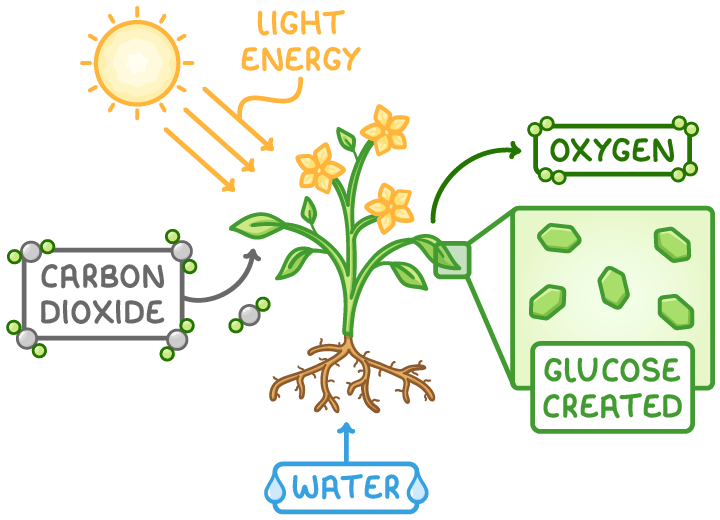
- Photosynthesis is the process by which green plants make their own food.
- Carbon dioxide and water are converted into glucose (also called sugar), and oxygen is produced as well.
- The reaction needs energy, which comes from light, so photosynthesis is an endothermic reaction - energy is transferred from the environment into the plant during the reaction.
Where photosynthesis happens
- The reaction takes place inside chloroplasts - small structures found in the cells of leaves and other green parts of a plant.
- Chloroplasts contain a green pigment called chlorophyll, which absorbs light and transfers its energy into the chemical energy stored in the glucose that is made.
The equations for photosynthesis
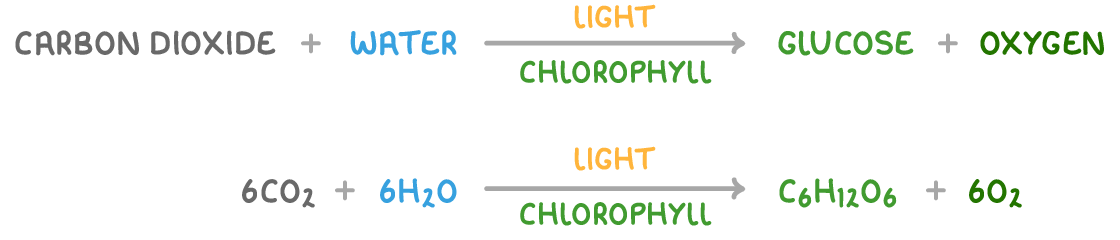
The word equation and the balanced chemical equation are shown above.
- The balanced equation shows that six molecules of carbon dioxide react with six molecules of water to make one molecule of glucose and six molecules of oxygen.
- The equation is balanced - there are the same numbers of carbon, hydrogen, and oxygen atoms on each side. The atoms are rearranged into new substances, but none are created or destroyed.
- In both equations, light supplies the energy and is written above the arrow, with chlorophyll written below it.
Uses of the glucose made in photosynthesis
- Some is used straight away in respiration, which releases the energy the plant needs for its life processes and lets it convert the rest of the glucose into other useful substances.
- The remaining glucose is built up into a range of materials.
What the glucose is converted into
- Cellulose - The tough material that makes up plant cell walls.
- Amino acids and proteins - Glucose is combined with nitrate ions taken up from the soil to make amino acids, which are then joined together into proteins.
- Lipids (fats and oils) - Stored, especially in seeds.
- Starch - An insoluble carbohydrate stored in the roots, stems, and leaves as an energy store for when photosynthesis is not happening, such as in winter.
- Starch is better than glucose for storage because it is insoluble, so it does not dissolve and draw water into the cells by osmosis.
- Sucrose - The soluble sugar in which carbohydrate is transported around the plant in the phloem.
Net gas exchange in plants
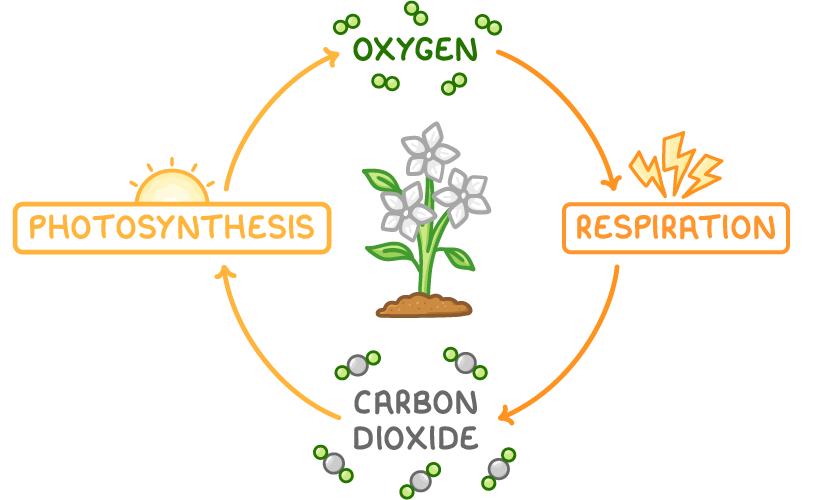
- Plants carry out two opposite gas-exchanging processes:
- Photosynthesis - Takes in carbon dioxide, gives out oxygen
- Respiration - Takes in oxygen, gives out carbon dioxide
- Both gases move in and out of the leaf through small pores called stomata.
- The carbon dioxide and oxygen that leave are waste products of these processes.
Net exchange depends on light
- Net gas exchange is the overall direction of gas movement once both processes are taken into account.
- Photosynthesis happens only when there's enough light, but respiration goes on all the time, day and night.
| Conditions | Which processes | Net gas exchange |
|---|---|---|
| Bright light | Photosynthesis faster than respiration | Takes in carbon dioxide, releases oxygen |
| Night / dim light | Respiration only at night; in dim light, photosynthesis slower than respiration | Takes in oxygen, releases carbon dioxide |
In bright light the plant makes more oxygen than it uses, and uses more carbon dioxide than it makes.
The compensation point
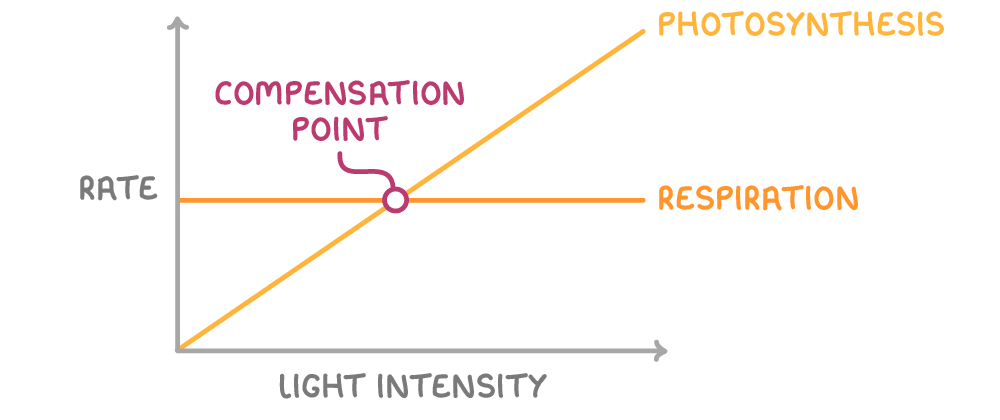
- At one particular light intensity, photosynthesis and respiration proceed at exactly the same rate.
- The carbon dioxide used in photosynthesis then equals the carbon dioxide released in respiration, so there is no net exchange of either gas.
- This light intensity is called the compensation point.
Changes in carbon dioxide can be tracked with hydrogencarbonate indicator:
- High carbon dioxide - Turns yellow
- Normal atmospheric levels - Stays red or orange
- Low carbon dioxide - Turns purple
TermDefinition
PhotosynthesisThe process in which green plants and algae use light energy to make glucose from carbon dioxide and water.
ChloroplastA sub-cellular structure in plant and algal cells where photosynthesis takes place.
ChlorophyllThe green pigment in chloroplasts that absorbs light energy for photosynthesis.
StomataTiny pores, mostly in the lower surface of a leaf, that let carbon dioxide and oxygen diffuse in and out and let water vapour escape.
Compensation pointThe light intensity at which a plant's photosynthesis and respiration happen at exactly the same rate.