9.9 - Cloning Animals
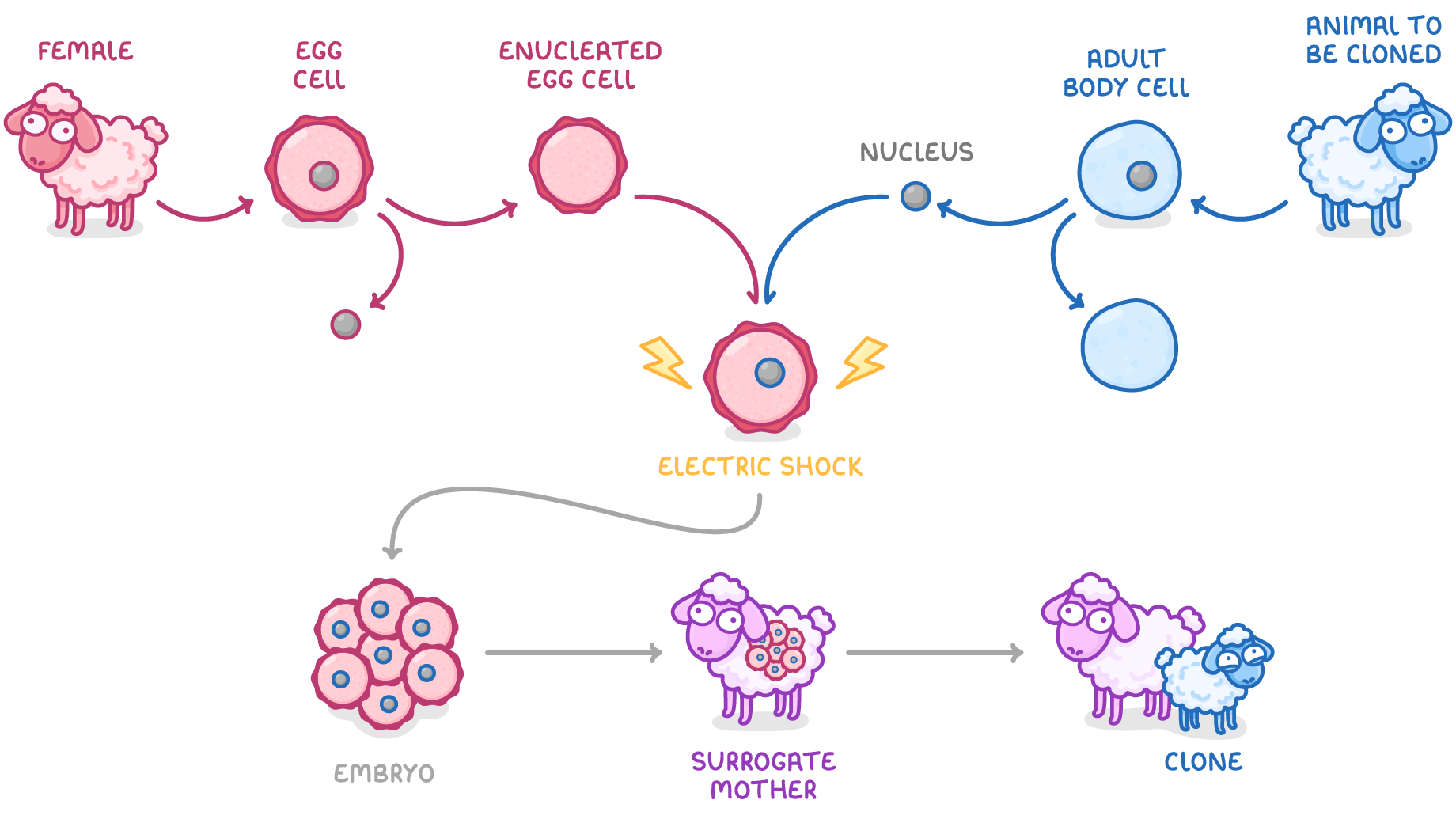
Adult cell cloning by nuclear transfer
- Adult cell cloning (also called nuclear transfer) makes a clone of an existing adult animal.
- The first mammal cloned this way was Dolly the sheep, in 1996. Other mammals have since been cloned by the same method.
The steps of nuclear transfer
- Take an unfertilised egg cell and remove its nucleus, leaving an egg with no nucleus (an enucleated egg).
- Take the nucleus from an adult body cell of the animal to be cloned - e.g. a skin cell or an udder cell.
- Insert this body-cell nucleus into the empty egg cell. The nucleus is diploid (it has two sets of chromosomes, one from each parent), so the egg now contains all the adult's genetic information.
- Give the egg cell a small electric shock, which stimulates it to start dividing by mitosis, just as a normal fertilised egg would.
- Once it has divided into a ball of cells (an embryo), implant it into the uterus of an adult female (a surrogate mother).
- The embryo develops until it is ready to be born.
The result
- The animal that is born is genetically identical to the adult that supplied the body-cell nucleus, because it has the same genetic information.
- It is a clone of that animal.
Cloned transgenic animals
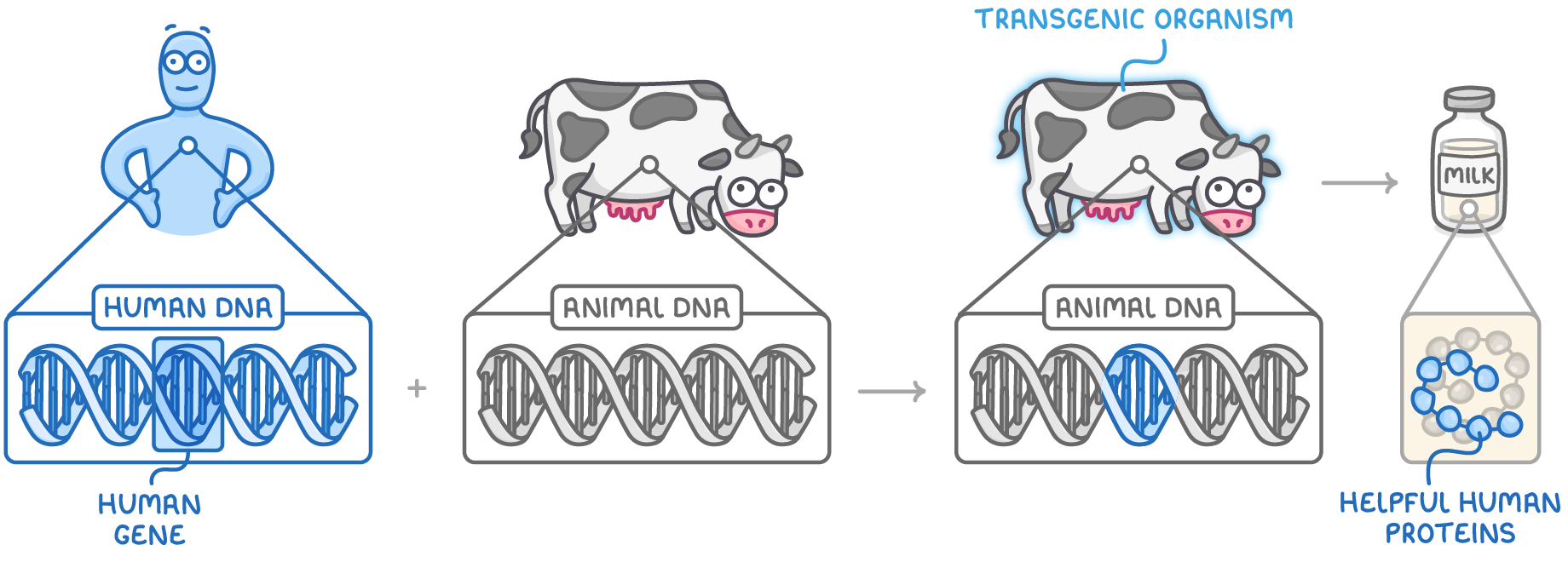
- A transgenic animal is one that has had a gene from a different species transferred into its cells, so it makes a protein it wouldn't normally produce.
- Cows and sheep already make protein in their milk, so transferring human genes into their cells can engineer them to produce useful human proteins in that milk.
Examples of useful proteins
- Transgenic cows and sheep - Make human antibodies used to treat illnesses such as arthritis, some types of cancer, and multiple sclerosis.
- Transgenic chickens - Engineered to produce human proteins in their egg white.
Why transgenic animals are cloned
- Once a transgenic animal with a useful gene has been produced, it can be cloned, for example by nuclear transfer.
- Cloning makes genetically identical copies, so the useful inserted gene is reliably passed on to every clone.
- This is an advantage over ordinary breeding, where the useful characteristic is not always passed to the offspring.
TermDefinition
Adult cell cloningA method of cloning an existing adult animal by inserting a nucleus from one of its body cells into an empty egg cell.
Enucleated eggAn egg cell that has had its nucleus removed.
Transgenic organismAn organism that contains genes transferred from a different species.