9.6 - Fish Farming
Why fish are farmed
- So many fish are taken from the wild that, without care, wild populations could be driven down to very low numbers.
- Fish farming is one response: fish are reared for food in enclosures or tanks rather than caught at sea.
- A fish farm is run in a deliberately controlled way, aiming to produce as many fish as possible, because fish are a valuable source of protein in the human diet.
Controlling growth and survival
- Keeping the fish enclosed lets the farmer control the things that affect how well the fish grow and survive - impossible with wild fish:
- The food they get
- The predators and diseases they are exposed to
- The quality of the water around them
- Selective breeding is also used - breeding from fish with useful characteristics, such as fast growth and less aggressive behaviour, so successive generations are better suited to farming.
Keeping farmed fish healthy
- Crowding many fish together in cages lets disease and parasites spread easily, so farmed fish are more prone to infection than wild fish living at low density.
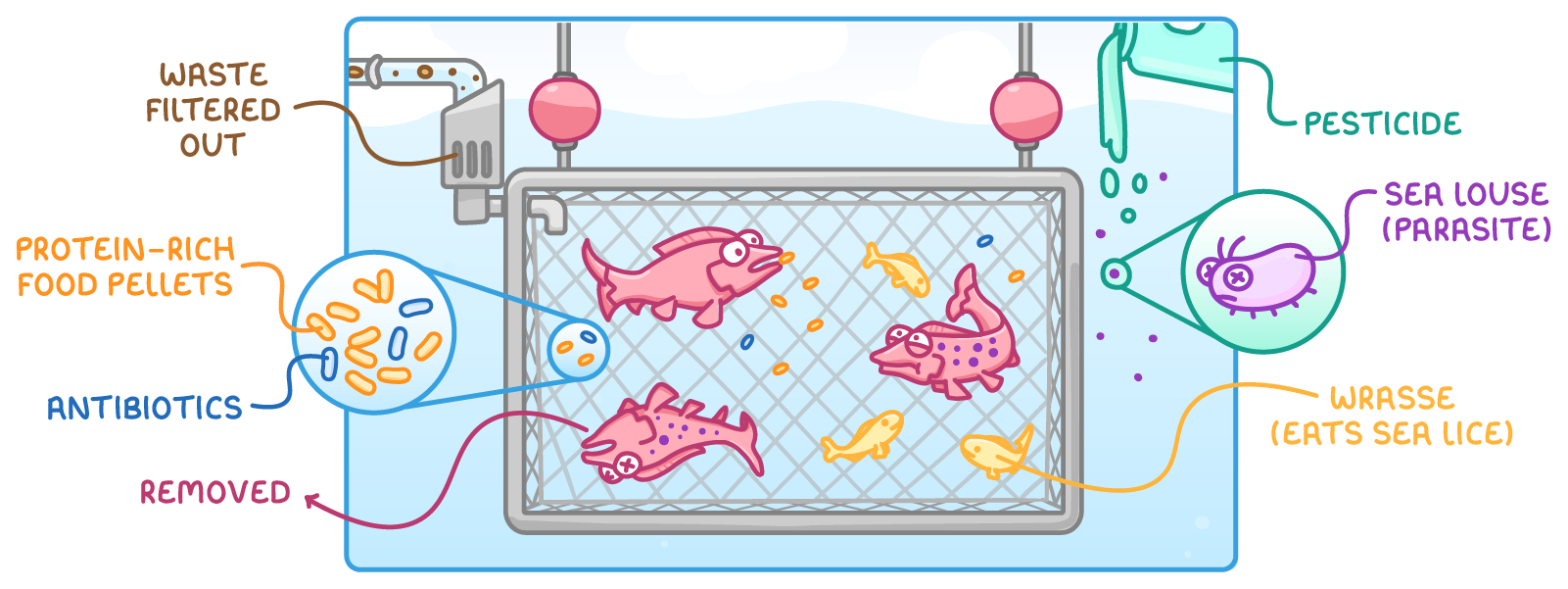
- A common parasite of caged fish is the sea louse, which attaches to the fish and damages it.
Controlling disease and parasites
- Adding pesticides to the water to kill parasites
- Treating the fish with antibiotics or vaccinating them
- Removing any dead or diseased fish
- Keeping the stocking density low so infection spreads less easily
Pesticides have a drawback - the chemicals can pollute the surrounding sea. An alternative is biological control: a small fish called a wrasse is kept with the salmon and eats the sea lice off their bodies, controlling the parasite without the pollution a chemical pesticide would cause.
Feeding and clean water
- The fish are given a controlled diet of protein-rich food pellets, supplied in the right amount and at the right frequency.
- Better-quality food gives more energy, so the fish grow quicker and bigger and the farm's yield rises.
- Feeding the right amount stops leftover food fouling the water.
- Uneaten food and fish faeces would otherwise build up, making the water dirty and using up its oxygen.
- The waste is filtered out of the water and the water is kept oxygenated.
- Keeping the water clean and well-oxygenated keeps the fish healthy and prevents pollution of the surrounding environment.
TermDefinition
Biological controlUsing a living organism, such as a predator or parasite, to reduce the numbers of a pest or pathogen.
Key points to remember
How were these notes?