4.2 - Darwin & Wallace
Darwin and Wallace
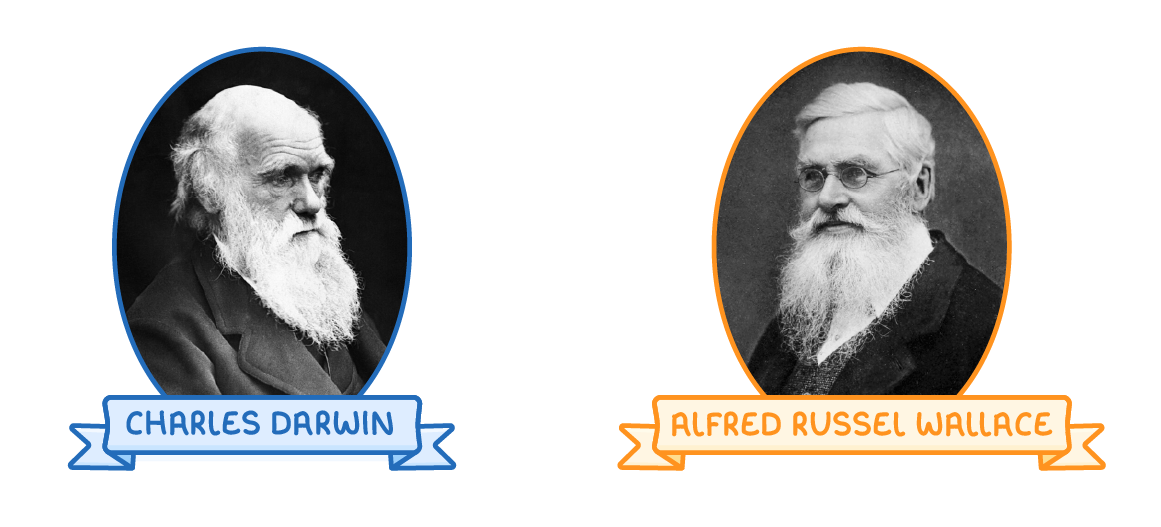
- Charles Darwin proposed the theory of evolution by natural selection in the nineteenth century.
- He developed it after around five years on a round-the-world expedition on HMS Beagle, studying plants, animals, and fossils in many different places.
- The idea was supported by years of further experiment and discussion, and by the developing science of geology and fossils.
Darwin's key observations
- Members of a species show a wide range of variation.
- Organisms must compete for limited resources.
- The individuals with characteristics best suited to their environment are the ones more likely to survive, breed, and pass those characteristics on to their offspring.
He reasoned that, over many generations, the helpful characteristics become more common and the species gradually changes - it evolves. He set this out in On the Origin of Species (1859), bringing together a large body of evidence.
Why Darwin's theory was incomplete
- The relevant science did not yet exist, so Darwin could not explain why new characteristics appeared, nor exactly how an organism passed beneficial characteristics on to its offspring.
- Genes and mutations weren't discovered until about fifty years after the theory was published.
- The inheritance mechanism we now know underpins natural selection was therefore a gap in Darwin's account.
Why the theory was only gradually accepted
- It was controversial - it challenged the widely held religious belief that God had made all the animals and plants on Earth, offering instead the first convincing explanation of how life could develop without a creator.
- There wasn't yet enough evidence to convince many scientists, as little other research had been done into how organisms change over time.
- The unknown mechanism of inheritance left an obvious hole in the argument.
Acceptance came later, once genetics showed how characteristics are passed on. The theory is now widely accepted and underpins much of modern biology, including the idea that all living things share common ancestors and the way organisms are classified by how closely related they are.
Alfred Russel Wallace
- Alfred Russel Wallace was a scientist working at the same time as Darwin who independently arrived at the same idea of natural selection.
- He travelled the world making observations that provided evidence for the theory.
- He is especially known for his work on warning colouration - the bright colours some species, such as certain butterflies, use to deter predators, itself a characteristic that evolved by natural selection.
- He also did early work on speciation - the way new species form.
- Wallace and Darwin published their work on evolution jointly in 1858, acknowledging each other's contributions. This prompted Darwin to bring out On the Origin of Species the next year.
- Because that book set out the case so fully, Darwin is usually the better remembered of the two.
TermDefinition
EvolutionThe change in the inherited characteristics of a population over time, brought about by natural selection.
Natural selectionThe process in which individuals with characteristics best suited to their environment are more likely to survive, breed, and pass on their genes.
Warning colourationThe bright colours some species use to deter predators.
SpeciationThe formation of a new species when two populations can no longer interbreed to produce fertile offspring.
Key points to remember
How were these notes?