9.5 - Biomass Transfer & Pyramids
Biomass and energy transfer
- Biomass is the mass of living material in an organism. At each level of a food chain it carries the energy originally captured from sunlight.
- Producers (plants and algae) sit at the base of every chain - they capture light energy and store it as biomass through photosynthesis.
- Only about 1% of the light reaching producers is transferred into new biomass this way.
- Biomass, and the energy it holds, then passes up the chain as one organism eats another.
The transfer is very inefficient
- Only about 10% of the biomass at any trophic level is passed on to the level above.
- The other 90% is lost on the way.
Three reasons so much is lost at each step
- Not all of the food is eaten - Bones, teeth, claws, roots, and tough plant fibres are usually left uneaten, so their biomass never enters the next level.
- Not all that is eaten is absorbed - Indigestible parts pass straight through the gut and are egested as faeces.
- Most absorbed material is used in respiration - This releases energy for movement, warmth, and other life processes rather than being built into new body tissue.
- Respiration returns this material to the surroundings as waste products such as carbon dioxide and water.
- The breakdown of proteins adds urea, lost in urine.
Consequences for the food chain
- Because so much is used up keeping each organism alive rather than stored, each trophic level holds less biomass and less energy than the one below it.
- There are usually fewer organisms higher up the chain.
- This is why food chains rarely have more than four or five trophic levels - after a few steps there is too little biomass and energy left to support another level.
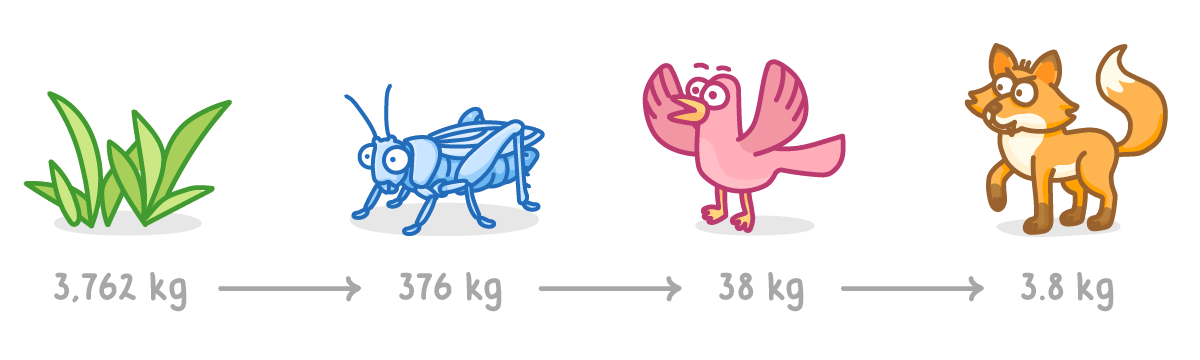
Efficiency of biomass transfer between trophic levels
- The efficiency of transfer is the percentage of the biomass (or the energy it holds) at one trophic level that is passed on to the next, rather than lost.
- It's worked out by dividing the amount transferred to the next level by the amount available at the level below, then multiplying by 100 to turn the fraction into a percentage.
Formula for efficiency of transfer
The typical efficiency is about 10% - this is the value usually used when no measured masses are given.
Why food chains are short
- Because only about a tenth of the biomass passes on at every step, the amount of biomass and energy available shrinks rapidly up the chain.
- This limits both the number of organisms a food chain can support and how long the chain can be:
- The number of organisms tends to fall at each higher level.
- After about four or five levels there's too little biomass left to support any more, so the chain runs out.
- Shorter food chains lose less overall, so more of the original energy reaches the top.
Worked example - Efficiency from rabbits to snakes
A population of rabbits holds 144 kg of biomass. The snakes that feed on them gain 15 kg. Calculate the efficiency of transfer from rabbits to snakes.
Step 1 - Identify the values
- Biomass transferred to the next level (snakes) = 15 kg
- Biomass available at the previous level (rabbits) = 144 kg
Step 2 - Apply the formula
Step 3 - Calculate
Efficiency = 10.4%
So just over a tenth of the rabbits' biomass became snake biomass - close to the typical figure of about 10%.
The next step up works out much the same way: if the snakes (15 kg) pass on 1.6 kg to the hawks above them, the efficiency of that transfer is .
Pyramid of biomass
- A pyramid of biomass represents a food chain as a stack of horizontal bars, one for each trophic level.
- The length of each bar shows the total biomass at that level - the combined mass of all the organisms there if you weighed them together.
- So the producer bar represents the total mass of all producers, the next bar the total mass of all primary consumers, and so on.
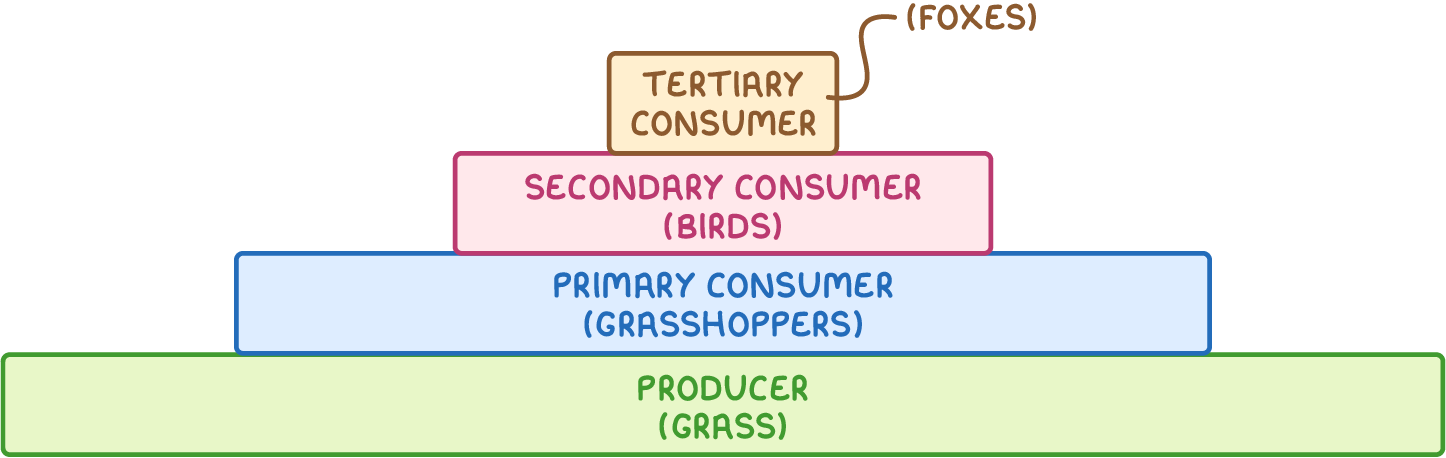
Drawing the pyramid
- The producer always forms the large bar along the bottom as trophic level 1.
- Bars are drawn in food-chain order, each one labelled with its trophic level, such as producer or primary consumer.
- Bars are scaled to the actual biomass values so the pyramid is accurate.
Why the bars get shorter going up
- Each higher trophic level holds less biomass than the one below it.
- This is because biomass is lost at every transfer up the chain, so only a small fraction of the biomass at one level ends up as biomass at the next.
- As a result, a pyramid of biomass is almost always a true pyramid shape - a wide base narrowing to the top - even in food chains where the numbers of organisms don't get smaller up the chain.
TermDefinition
BiomassThe material that living organisms are made of, or the mass of this material in an organism or at a trophic level (a feeding level in a food chain).
ProducerAn organism, usually a green plant or alga, that makes its own food by photosynthesis and begins a food chain.
Pyramid of biomassA diagram where the length of each horizontal bar represents the total mass of organisms at a trophic level.
Key points to remember
How were these notes?