4.7 - Cloning Plants
Tissue culture (micropropagation)
- Tissue culture (also called micropropagation) produces large numbers of genetically identical plants (clones) from a single parent plant.
- Every plantlet develops from the parent's own cells, so all the new plants are genetically identical to the parent and to each other, sharing the same beneficial features.
The stages of tissue culture
- Choose a parent plant with desirable characteristics - e.g. a good fruit crop, attractive flowers, or a useful trait such as pest resistance.
- Remove explants - Small pieces of tissue - from the parent. The best results come from fast-growing tissue at the tips of the roots and shoots.
- Sterilise the explants to kill any microorganisms.
- Grow them on a growth medium containing the nutrients the cells need plus plant growth hormones. This is done under aseptic (sterile) conditions so microbes cannot grow and harm the developing plants.
- The cells in each explant divide and grow into a small plant, or plantlet.
- Move the plantlets into compost or soil to carry on growing.
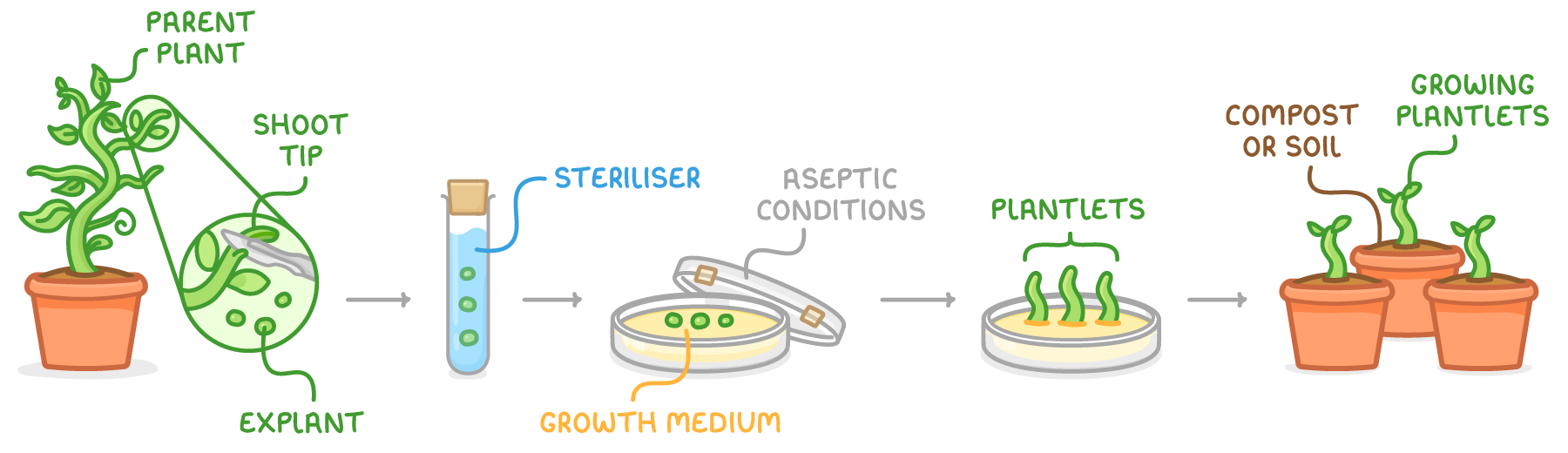
Why the method is useful
- Fast - Plants can be produced quickly.
- Needs very little space and can be carried out all year round.
- Preserves rare plants that are difficult to reproduce naturally.
- Commercial production - Nurseries can produce plants for sale.
- Scalable - When large quantities are needed, further explants can be taken from the new plantlets and grown on, producing thousands of identical plants.
Animal tissue culture for medical research
- Animal tissue culture is a technique for growing animal cells in the laboratory so that a single type of tissue can be studied on its own.
- It's used in medical research because experiments can be done on an isolated tissue, without the complications of other processes going on in a whole living animal.
- Example: the effect of glucose on the cells of the pancreas can be investigated by growing pancreatic cells in culture and looking only at how those cells respond.
- It's a way of producing cells to experiment on, not a way of producing whole new organisms.
Setting up a tissue culture
- A sample of the tissue to be studied is extracted from the animal.
- The cells in the sample are separated from one another using enzymes.
- The separated cells are placed in a culture vessel and bathed in a growth medium that supplies all the nutrients they need, allowing them to grow and multiply.
- After several rounds of cell division, the cells can be split up again and moved into separate vessels to encourage further growth.
- Once grown, the culture can be stored for future use.

TermDefinition
Tissue cultureA laboratory technique for growing plant or animal cells.
MicropropagationA laboratory technique that produces large numbers of genetically identical plants from a single parent plant.
CloneAn organism that is genetically identical to another organism, such as its parent.
ExplantA small piece of tissue taken from a parent plant to be grown in tissue culture.
Culture mediumA liquid or gel containing the nutrients that microorganisms or cells need to grow.
Key points to remember
How were these notes?