7.7 - Thermoregulation
Detecting a change in body temperature
- The body keeps its core temperature - the temperature deep inside, around the internal organs - at about 37 °C.
- This is the optimum temperature for the enzymes that run the body's reactions:
- Below it, the enzymes work too slowly.
- Much above it, they begin to denature and stop working.
- So the core temperature has to be held steady whatever the surroundings are doing.
The thermoregulatory centre
- The thermoregulatory centre is a region of the brain, found in the hypothalamus, that controls body temperature.
- It monitors temperature in two ways:
- It contains receptors sensitive to the temperature of the blood flowing through the brain, so it monitors core temperature directly.
- It receives nervous impulses from temperature receptors in the skin, which report the temperature at the body's surface.
- The skin receptors are nerve endings in the outer layer of the skin (the epidermis) and the deeper layer beneath it (the dermis).
- Taking the blood-temperature and skin-temperature information together, the thermoregulatory centre acts as a coordination centre: when it detects the core temperature has moved too high or too low, it automatically triggers the effectors in the skin that bring the temperature back to normal.
The structures that carry out the response are effectors in the skin
- Sweat glands
- Hair erector muscles - The small muscles attached to the hairs
- Blood vessels - Those running close to the surface
The body's response to being too hot or too cold
- The thermoregulatory centre detects when core temperature moves away from normal, then triggers effectors in the skin to bring the temperature back.
- The responses to being too hot and too cold are opposites of each other.
- It's the change in diameter of the blood vessels supplying the skin - not the blood being shut off entirely - that raises or lowers the rate of heat loss.
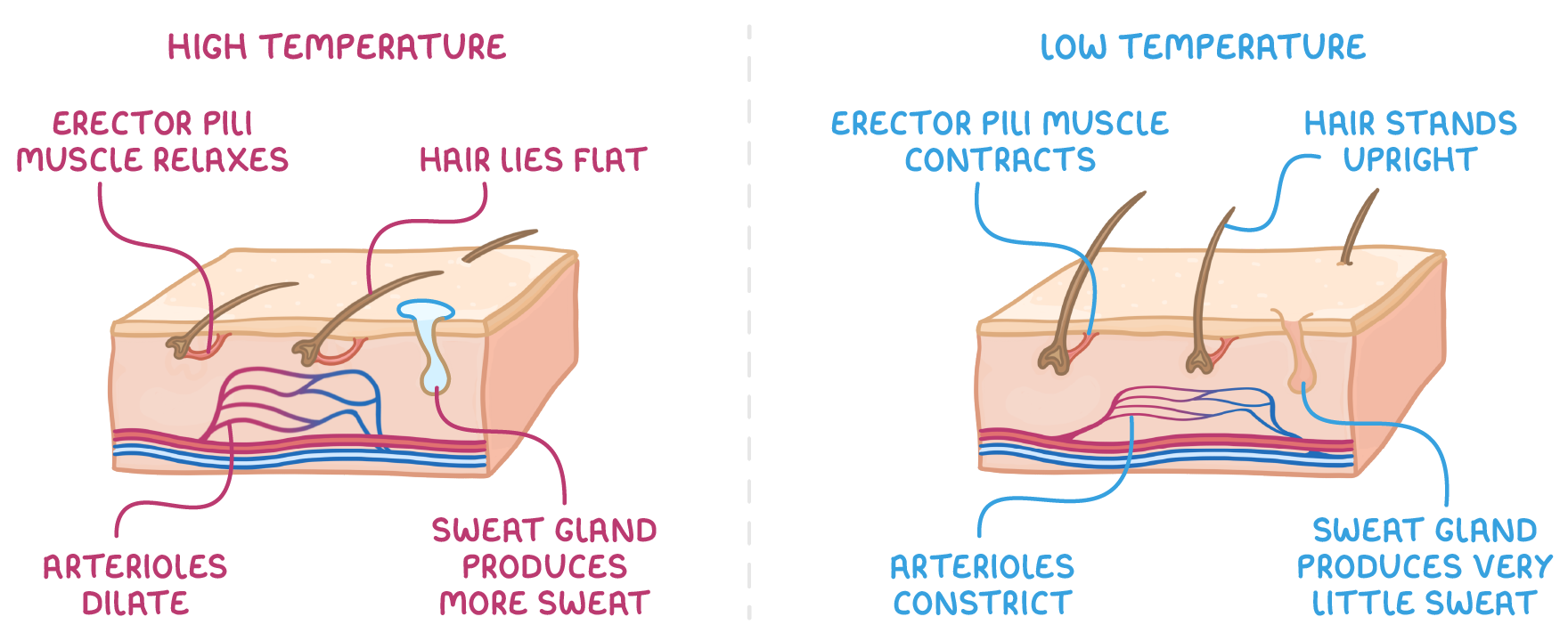
When the body is too hot - Losing heat
- Sweating - Sweat glands produce sweat onto the skin surface. As the water evaporates, it takes energy from the skin and transfers it to the environment, cooling the body.
- Hairs lie flat - The hair erector muscles (erector pili muscles) relax, so hairs lie flat and trap little air, leaving the skin poorly insulated so heat is lost more easily.
- Vasodilation - The small blood vessels (arterioles) supplying the skin dilate (widen), so more blood flows through the capillaries near the surface and more energy is transferred from the blood to the surroundings.
When the body is too cold - Conserving and generating heat
- Very little sweat - Little sweat is produced, so little energy is lost by evaporation.
- Hairs stand up - The hair erector muscles contract, pulling the hairs upright so they stand on end and trap a layer of air next to the skin; this trapped air insulates the surface and reduces heat loss.
- Vasoconstriction - The blood vessels supplying the skin constrict (narrow), so less blood flows near the surface and less energy is lost to the surroundings.
- Shivering - The skeletal muscles contract automatically in small, rapid movements. Because muscle contraction needs respiration, the extra respiration releases energy that warms the body.
TermDefinition
Core temperatureThe temperature deep inside the body, around the internal organs.
Thermoregulatory centreThe region of the brain that monitors and controls body temperature.
VasodilationThe widening of the small blood vessels supplying the skin, increasing blood flow near the surface to lose heat.
VasoconstrictionThe narrowing of the small blood vessels supplying the skin, reducing blood flow near the surface to conserve heat.
Key points to remember
How were these notes?