3.14 - Inheritance of Blood Groups
Multiple alleles and the ABO blood groups
- Most genes have just two alleles (two versions) - one dominant and one recessive.
- A gene with more than two possible alleles is said to have multiple alleles.
- Any one individual still carries only two alleles (one on each chromosome of the pair), but across a population there can be three or more different alleles to choose from.
The three alleles of the blood-group gene
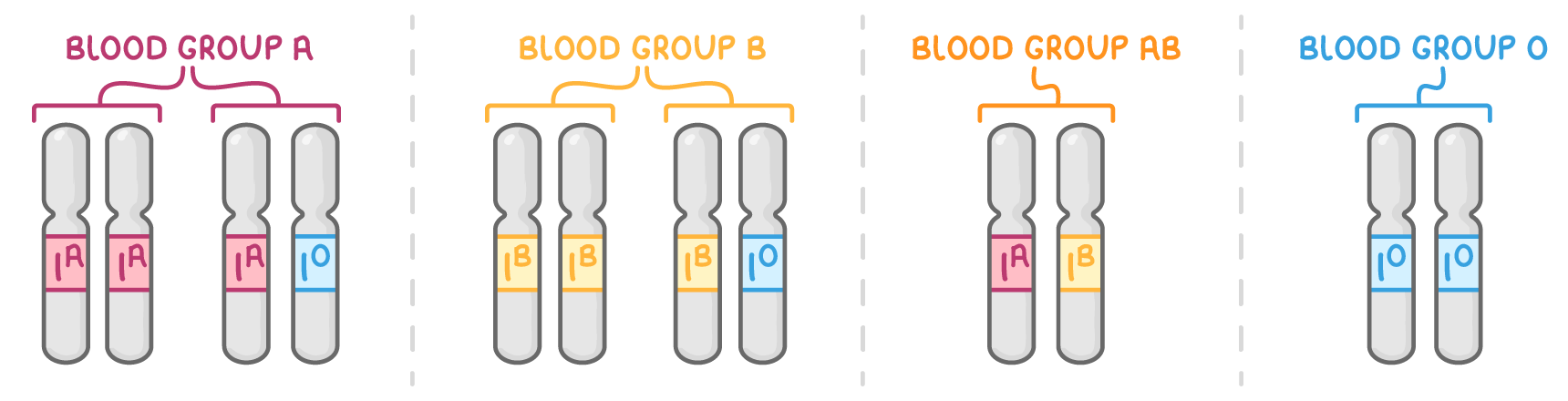
- The gene controlling human ABO blood group is the standard example - it has three alleles: IA, IB, and Io (also written IO).
- The combination of the two alleles a person inherits decides their blood group: A, B, AB, or O.
- These four blood groups are the phenotypes; the pairs of alleles behind them are the genotypes.
How the alleles interact
- IA and IB are codominant - if a person inherits one of each, neither overrules the other and both are expressed, so both contribute to the phenotype.
- This is what codominance means: in a heterozygous individual both alleles are expressed and together determine the phenotype, rather than one dominant allele masking a recessive one.
- Io is recessive - it is masked whenever it is paired with IA or IB, so its effect only shows when there is no codominant allele present.
Genotypes and their phenotypes
- IA IA or IA Io - Blood group A
- IB IB or IB Io - Blood group B
- IA IB - Blood group AB (both alleles expressed - codominance)
- Io Io - Blood group O (the only group needing two recessive alleles)
Predicting blood groups with a genetic cross
A blood-group cross is set out as an ordinary genetic diagram (a Punnett square). Work through it in four steps:
- Write each parent's two alleles.
- Work out the alleles their gametes can carry.
- Put one parent's gametes along the top, the other's down the side.
- Combine them in the cells to give the offspring genotypes.
The one extra step compared with a simple dominant-recessive cross is reading each offspring genotype back to a blood group, using the rule that IA and IB are codominant and Io is recessive.
Example - Group A × group B
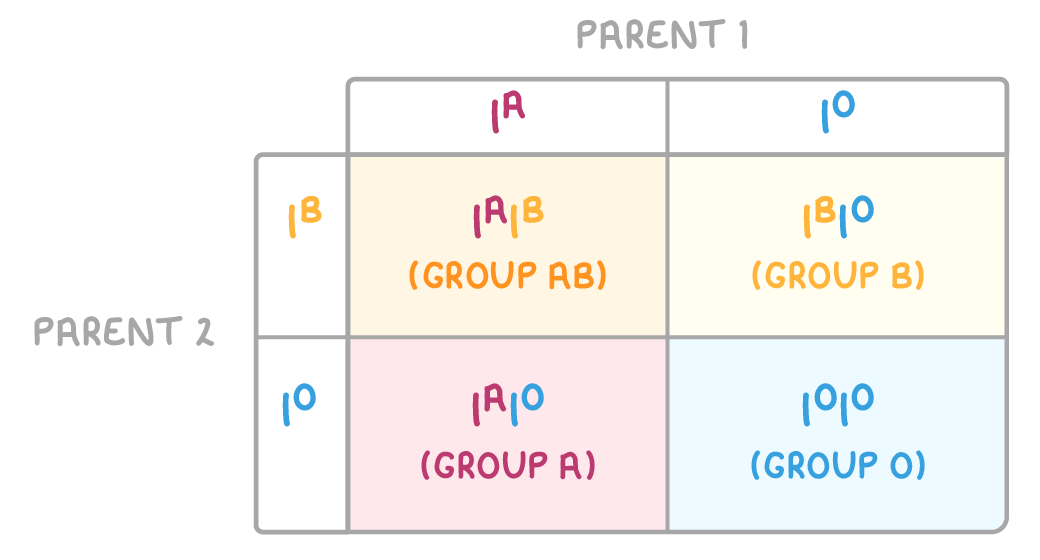
Parent 1 is group A (IA Io); parent 2 is group B (IB Io).
- IA IB - Group AB (both alleles expressed)
- IA Io - Group A (the recessive Io is masked)
- IB Io - Group B (the recessive Io is masked)
- Io Io - Group O (two recessive alleles)
So the child could be any of the four groups - AB, A, B or O - each a 1 in 4 (25%) chance, a 1:1:1:1 ratio. This surprises people, because neither parent is group AB or group O.
The ratio depends on the parents' genotypes
- A cross between two parents who are both group AB (each IA IB) gives a different pattern.
- Each parent's gametes carry either IA or IB, so the offspring genotypes are:
- IA IA - Group A
- IA IB - Group AB
- IA IB - Group AB
- IB IB - Group B
- That's a 1:2:1 ratio of group A to group AB to group B, with no group O possible - neither parent carries an Io allele to pass on.
As with every genetic diagram, the square gives only the probability of each outcome, not a certainty of what any individual child will be.
TermDefinition
Multiple allelesThree or more different alleles of the same gene that exist in a population.
CodominanceA situation in which both alleles in a heterozygous organism contribute to the phenotype.
Key points to remember
How were these notes?