10.5 - Energy Content of Food (Calorimetry)
The experiment
Aim
To compare how much energy different foods store, by burning a food sample and using the heat it gives off to warm a known amount of water.
Background
- Food stores chemical energy. When food burns, that energy is released as heat.
- Fatty foods store a lot of energy per gram. A peanut burns for a long time and warms the water sharply, but a piece of pasta warms it far less.
- You can't measure the energy stored in a food directly, but you can use the heat from the burning food to warm a measured amount of water, and measure the temperature rise.
- So in this practical you burn each food under a tube of water, and use the temperature rise and the mass of the food to work out the energy released per gram.
Variables
- Independent variable - The type of food, for example a crisp, a peanut, or pasta.
- Dependent variable - The energy released per gram of food, in joules per gram (J/g).
- Control variables - The volume of water, its starting temperature, the distance from the flame to the tube, and the way the food is held and lit.
Method
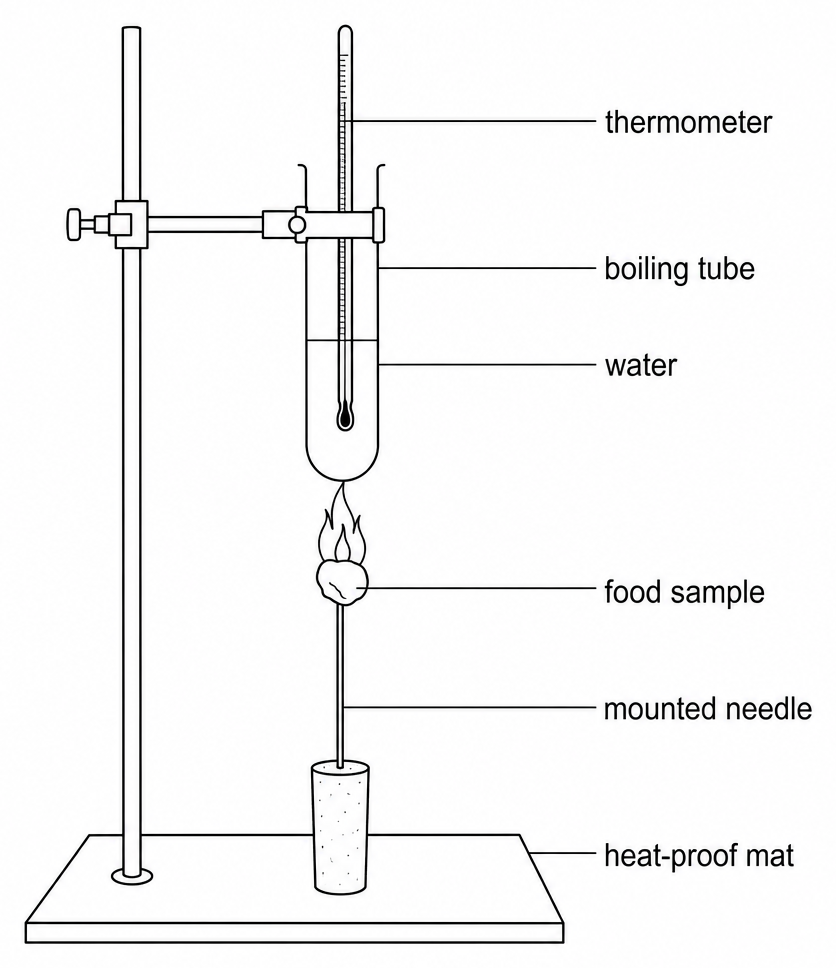
- Measure the water - Put 25 cm3 of water into a boiling tube and record its starting temperature.
- Weigh the food - Find the mass of the food sample on a balance.
- Light the food - Hold it on a mounted needle, set it alight, and hold it under the boiling tube straight away.
- Keep it under the tube - Until it stops burning, relighting it if it goes out before then.
- Record the highest temperature - Note the highest temperature the water reaches, and work out the temperature rise.
- Repeat for each food - Use the same volume of fresh water each time.
Safety
- Naked flame - Wear eye protection, tie back long hair, and burn the food over a heatproof mat with nothing flammable nearby.
- Hot boiling tube - It can scald, so hold it in a clamp rather than your hand, and let it cool before you move it.
- Mounted needle - Keep it pointed away from you.
- Allergies - Don't use nuts if anyone in the room has a nut allergy.
Worked example - Energy content of food
A 0.5 g peanut is burned under a boiling tube holding 25 cm3 of water. The water's temperature rises from 18 °C to 38 °C. Find the energy released per gram of peanut. (25 cm3 of water has a mass of 25 g.)
Step 1 - Find the temperature rise
38 - 18 = 20 °C
Step 2 - Find the energy given to the water
Use energy = mass of water × 4.2 × temperature rise. The 4.2 is the energy in joules needed to warm 1 g of water by 1 °C.
Energy = 25 × 4.2 × 20 = 2,100 J
Step 3 - Find the energy per gram of food
Divide the energy by the mass of food burned.
Step 4 - Compare the result with the true energy content
This peanut released about 4,200 J for every gram. The true figure is higher, because not all the heat from the burning peanut reached the water.
Common exam questions
Question 1
Suggest two ways to make the result more accurate.
Any two of these.
- Shield the tube from draughts, or insulate it.
- Hold the burning food closer to the tube.
- Use a proper calorimeter instead of a boiling tube.
Question 2
Why is the same volume of water used for each food?
A different amount of water would warm by a different amount for the same energy, so the temperature rises couldn't be compared.
Question 3
Why is the energy given per gram rather than per sample?
So foods can be compared fairly, even when the samples burned have different masses.