7.12 - Kidney Failure
Dialysis
- When the kidneys fail they can no longer filter the blood properly:
- Waste substances such as urea build up in the blood.
- The body loses its ability to control the levels of ions and water.
- Left untreated, this eventually causes death.
- Dialysis keeps a patient alive by using a machine to do the job the kidneys would normally do.
How the dialysis machine works
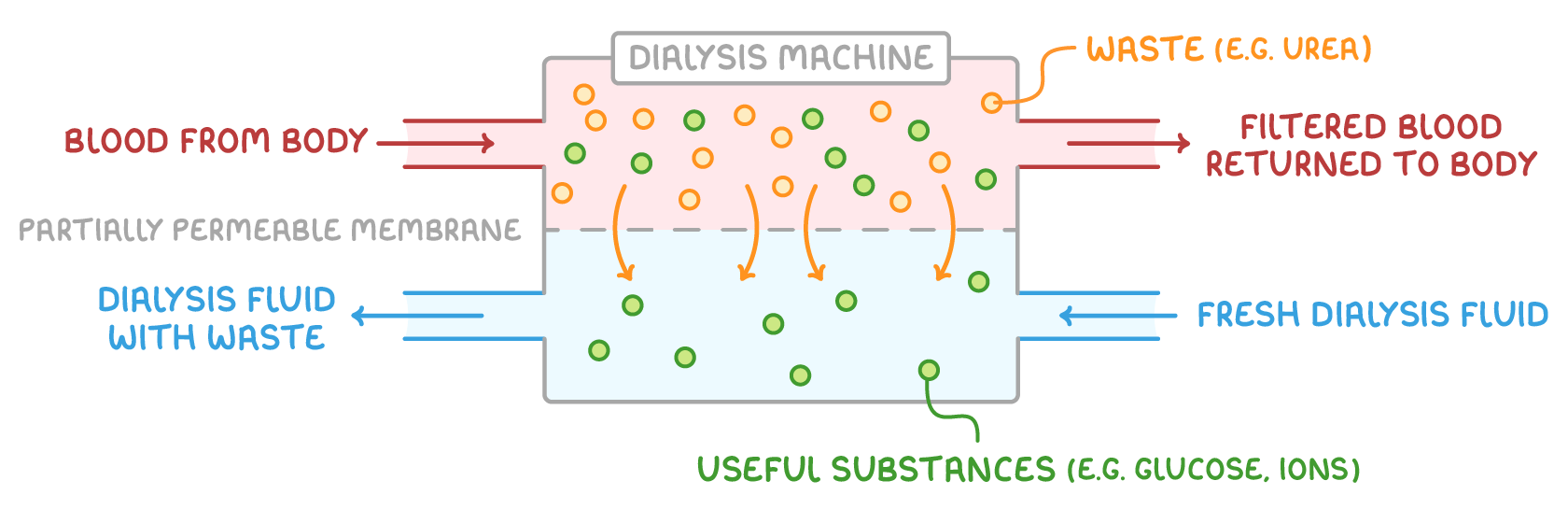
- Blood from the patient is led between partially permeable membranes (also called selectively permeable membranes), with dialysis fluid flowing on the other side.
- The membrane works like the filtering membranes in the kidney - permeable to small particles (ions and waste substances) but not to large molecules such as proteins.
- Urea, along with excess water and ions, diffuses out of the blood across the membrane into the dialysis fluid.
- Blood cells and proteins are too big to cross, so they stay in the blood.
Keeping useful substances in the blood
- The dialysis fluid is made up to have the same concentration of useful dissolved substances - ions and glucose - as healthy blood.
- With no concentration difference across the membrane, these substances do not diffuse out, so the patient keeps the glucose and ions the body needs while still losing urea and the excess water and ions.
- The cleaned blood is then returned to the patient.
Dialysis does not cure kidney failure, so it must be carried out regularly to:
- Keep the concentrations of dissolved substances in the blood at normal levels.
- Keep removing the waste urea before it builds up again.
Kidney transplants and dialysis vs transplant
- Kidney failure can be treated with dialysis or cured with a kidney transplant.
- A transplant is currently the only cure - a healthy kidney from a donor replaces the failed kidneys.
Where donor kidneys come from
- From people who have died suddenly and were on the organ donor register or carried a donor card - provided their relatives agree.
- From a living donor, because a person has two kidneys and can survive with one. Donating carries a small risk to the donor.
The problem of rejection
- The main problem with a transplant is rejection: the patient's immune system can treat the donor kidney as a foreign body and attack it with antibodies, just as it would a pathogen.
- Two precautions reduce this risk:
- A donor whose tissue type closely matches the patient's is chosen.
- The patient is given drugs that suppress the immune system so it doesn't attack the transplant.
- Even with these precautions, rejection can still happen.
Dialysis vs transplant
Dialysis keeps a patient alive and buys valuable time until a donor kidney is found, but it does not cure the condition. A transplant is a cure, but a well-matched kidney must be found first.
The two treatments have different advantages and disadvantages.
| Dialysis | Transplant | |
|---|---|---|
| Advantages | Keeps the patient alive and buys valuable time until a donor kidney is found | It is a cure; it frees the patient from those hours on the machine; and in the long run it is cheaper than continuing dialysis |
| Disadvantages | Does not cure the condition; many patients need sessions about three times a week, each lasting three to four hours; it can cause blood clots or infections; it is unpleasant to be attached to the machine; and it is expensive to run | Risk of rejection; long waiting lists for a suitable, closely matched donor kidney |
- A well-matched kidney is less likely to be rejected, so donors are matched by blood type and tissue type.
- This improves the outcome but lengthens the wait for a suitable kidney.
TermDefinition
DialysisA medical treatment that uses a machine to filter the blood and do the job of the kidneys when they fail.
RejectionThe attack by a patient's immune system on a transplanted organ, tissue or cells, which it recognises as foreign.
Key points to remember
How were these notes?