3.6 - Protein Synthesis
The genetic code
- A gene is a section of DNA. The order of the bases along the gene is a code for building a protein.
- A protein is a chain of small molecules called amino acids. What makes one protein different from another is the number of amino acids and the order they're joined in.
- The order of the bases in the gene sets the order of the amino acids, so the base sequence decides which protein is made.
Reading the code in threes
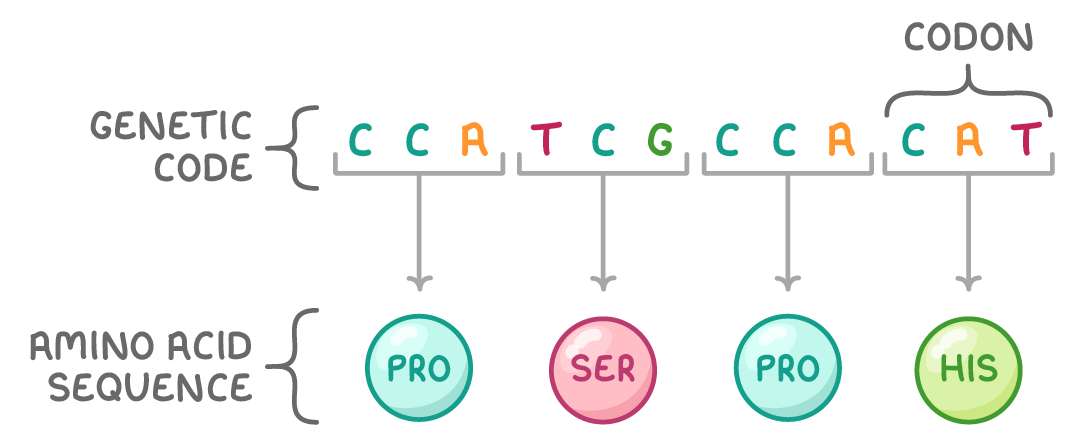
- The bases are read in groups of three. Each set of three bases is called a base triplet (also called a codon).
- Each triplet codes for one amino acid. The triplets are read one after another, with no overlapping - the first triplet fixes the first amino acid, the next triplet the next, and so on along the whole gene.
- Only about 20 different amino acids are used, but they can be arranged into the many thousands of proteins a body needs - like a small alphabet spelling a huge number of words.
- Four bases read three at a time give 4 × 4 × 4 = 64 possible triplets. That's more triplets than amino acids, so some amino acids are coded for by more than one triplet.
From chain to protein
- Once the amino acids are joined in the order the gene sets, the chain folds into a particular 3D shape.
- It's this shape that lets the finished protein do its specific job.
- A different base sequence gives a different amino-acid sequence, which folds into a differently shaped protein - so each gene makes its own specific protein.
Jobs that proteins do
- Structural proteins - Such as collagen, they give tissues their shape and strength
- Enzymes - Speed up chemical reactions
- Hormones - Such as insulin, they carry signals around the body
- Antibodies - Help defend against pathogens
- Receptors - Sit on the cell surface and let the cell detect chemical signals
Transcription and translation
- Making a protein from a gene happens in two stages: transcription and translation.
- Proteins are assembled on ribosomes in the cytoplasm.
- DNA is too big to leave the nucleus, so the gene's code is first copied onto a messenger molecule that can - messenger RNA (mRNA).
Transcription - Copying the gene into mRNA
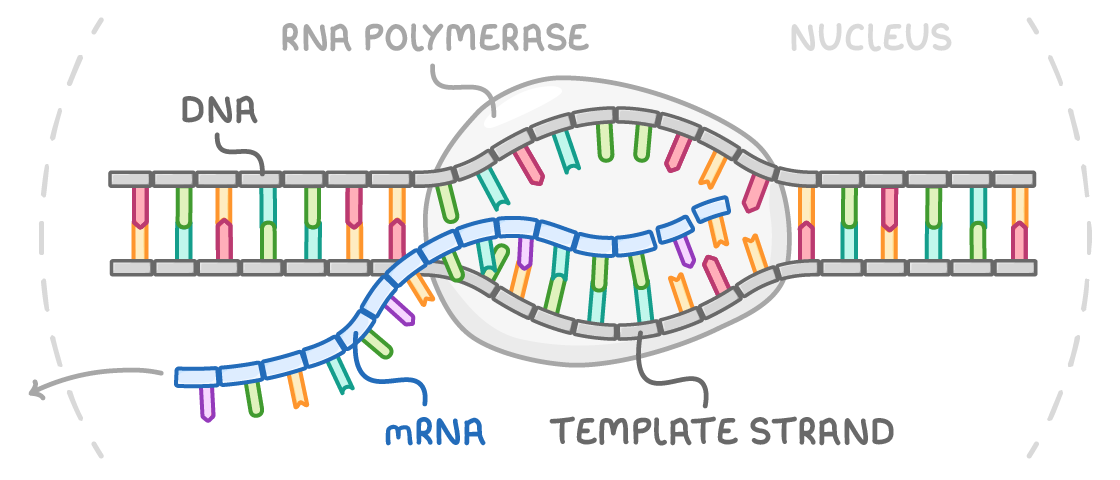
- RNA polymerase (an enzyme) binds to a region of non-coding DNA just in front of the gene.
- The two DNA strands unzip.
- RNA polymerase moves along one strand of the gene, the template strand, using it as a template to build a complementary mRNA strand - each base added to the mRNA pairs with the matching base on the DNA.
- Once complete, the mRNA leaves the nucleus and attaches to a ribosome.
Like DNA, mRNA is made of bases, but it is:
- A single, shorter strand.
- Made with the base uracil (U) in place of thymine (T).
Translation - Building the protein at the ribosome
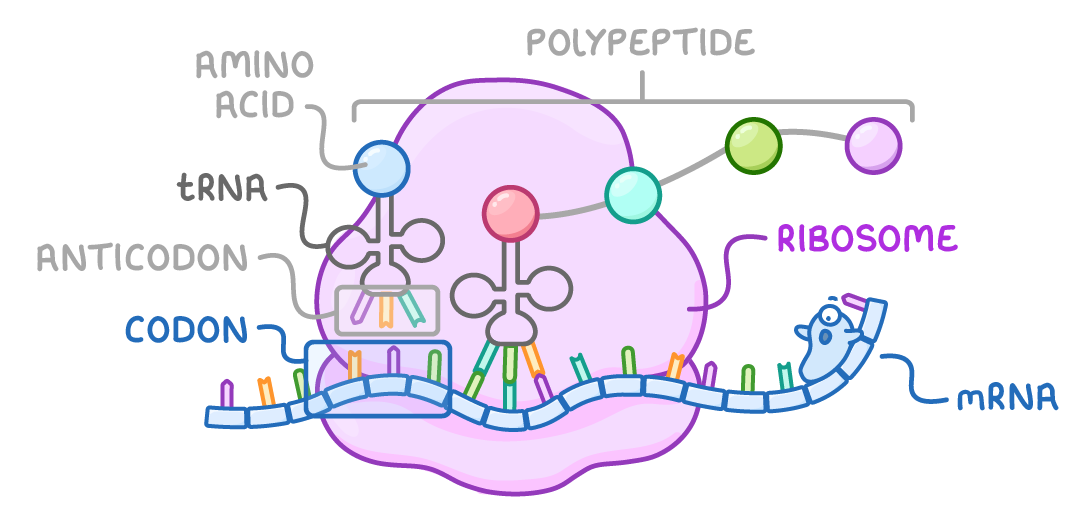
- The mRNA's bases are read in triplets called codons. Each codon codes for one amino acid.
- Amino acids are brought to the ribosome by transfer RNA (tRNA).
- Each tRNA molecule carries a particular amino acid and has a set of three bases called an anticodon, which is complementary to a codon on the mRNA.
- As the ribosome moves along the mRNA, each codon pairs with the matching tRNA anticodon, so each amino acid is delivered to the right place in the sequence.
- The ribosome links the amino acids together in the order the codons set, building a chain called a polypeptide, which then folds into the finished protein.
TermDefinition
GeneA section of DNA on a chromosome that codes for a particular sequence of amino acids, to make a specific protein.
CodonA sequence of three bases that codes for one amino acid.
Messenger RNA (mRNA)A short, single-stranded molecule that carries a copy of a gene's code from the nucleus to a ribosome.
TranscriptionThe first stage of protein synthesis where a gene is copied into a complementary strand of messenger RNA.
TranslationThe second stage of protein synthesis where a ribosome builds a protein by reading the messenger RNA codons.
Transfer RNA (tRNA)A carrier molecule that brings a specific amino acid to the ribosome and pairs with an mRNA codon.
Key points to remember
How were these notes?