7.11 - Kidneys - The Nephron
Gross structure of the kidney and the nephron
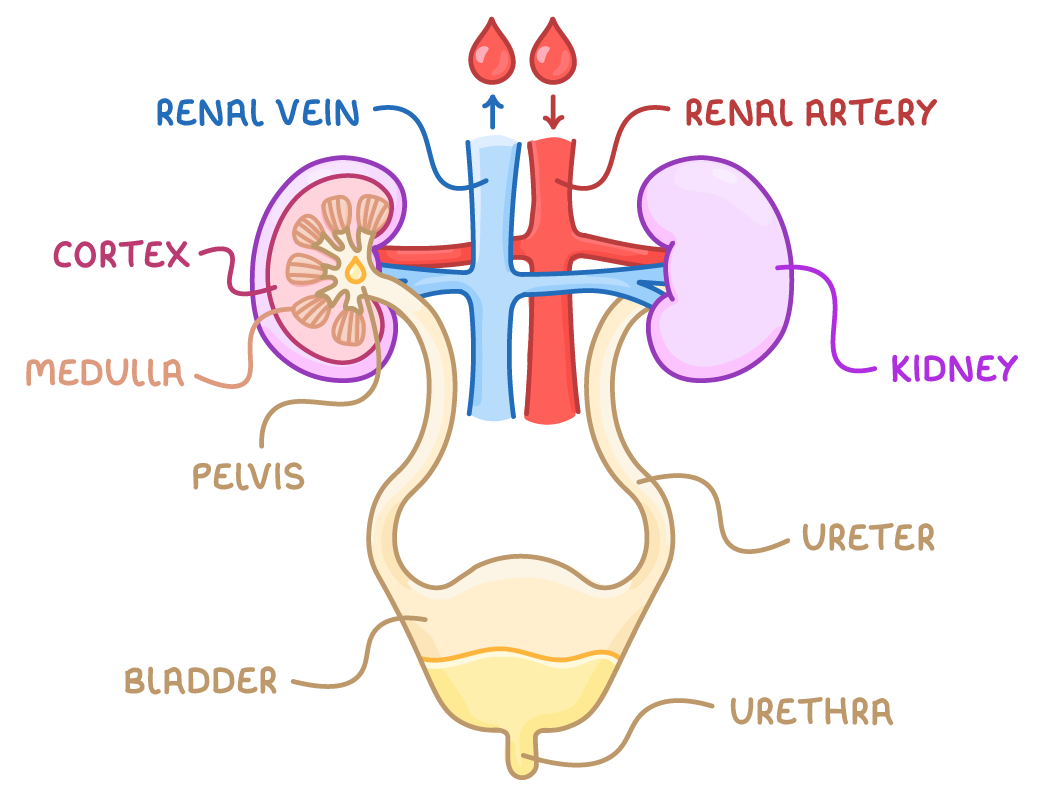
- Each kidney is part of the urinary system.
- Renal artery - Brings blood to the kidney.
- Renal vein - Carries filtered blood away from the kidney.
- Ureter - Carries the urine produced to the bladder.
- Bladder - Stores urine before it is released through the urethra.
Regions of the kidney
- Cortex - The outer part.
- Medulla - The inner part.
- Pelvis - A wide, funnel-shaped region where the ureter meets the kidney; it collects the urine the kidney has made and channels it into the ureter.
Nephrons do the filtering
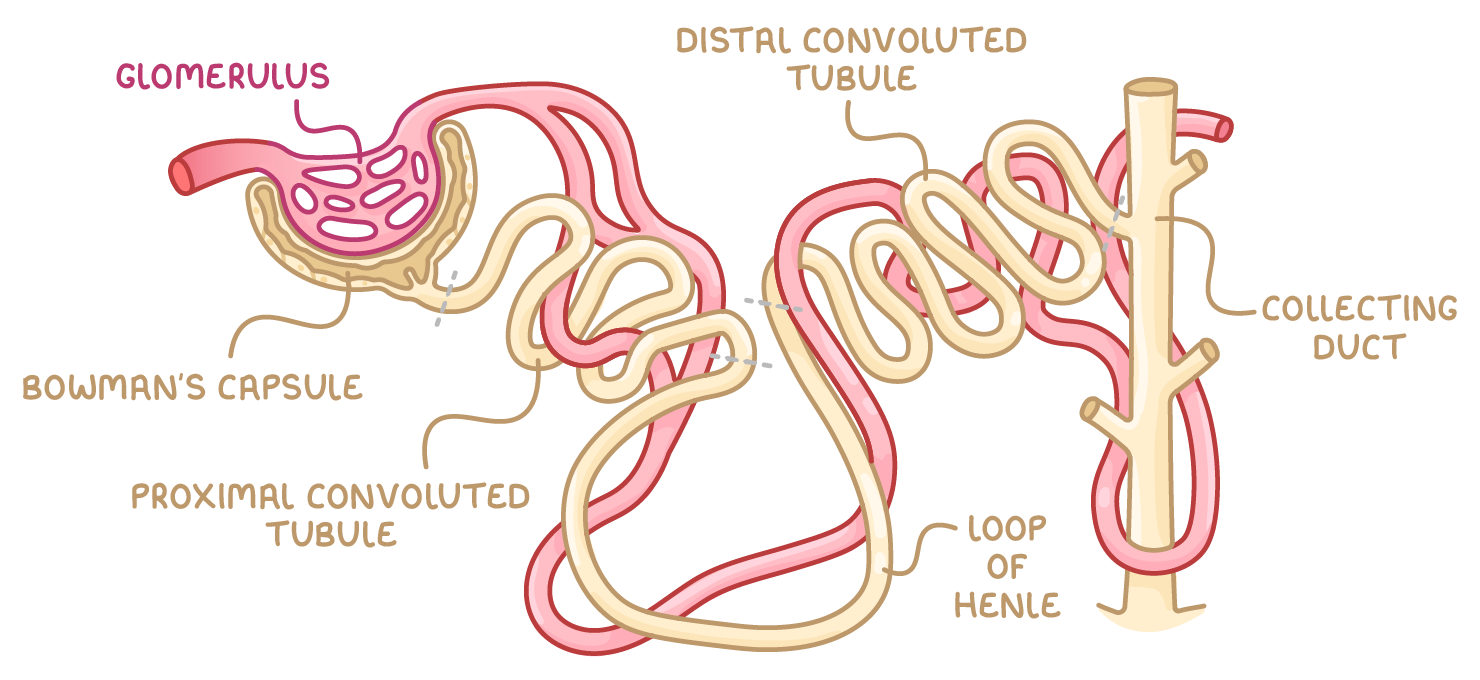
- Filtering happens in tiny tube-like structures called nephrons (also called kidney tubules).
- A single kidney contains around a million nephrons.
- The nephrons run across both the cortex and the medulla.
Structure of a single nephron
Each nephron begins at a ball of capillaries and leads into a long, looping tubule that empties into a collecting duct:
- Glomerulus (sometimes called the capillary knot) - A ball of capillaries that sits inside the Bowman's capsule.
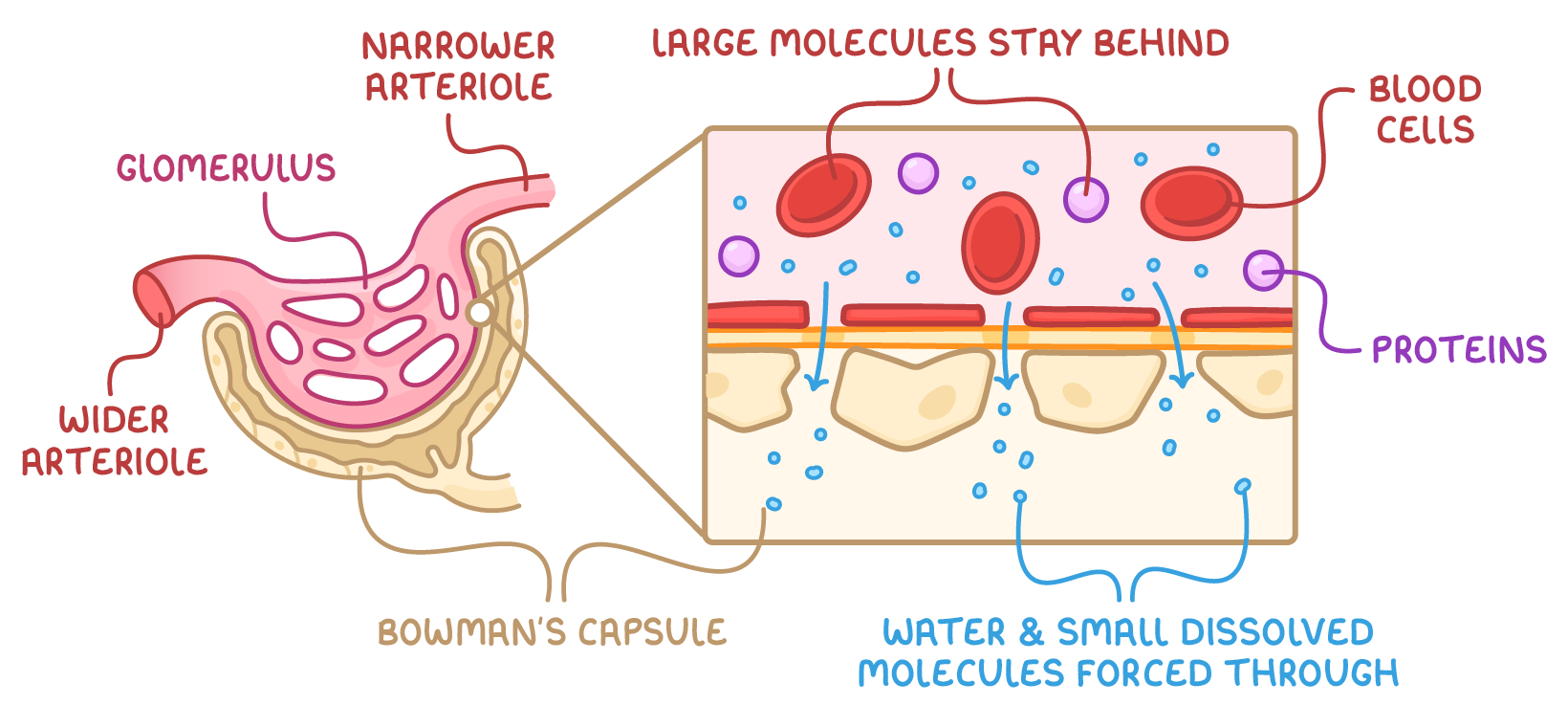
- The arteriole carrying blood into the glomerulus is wider than the one carrying blood away from it, which builds up a high pressure inside the glomerulus.
- Bowman's capsule - A cup-shaped structure surrounding the glomerulus.
- Proximal convoluted tubule - The first part of the looping tubule leading away from the Bowman's capsule.
- Loop of Henle - The middle, looping section of the tubule.
- Distal convoluted tubule - The final part of the tubule.
- Collecting duct - Carries the finished urine away towards the ureter.
A network of capillaries wraps around the tubule alongside the nephron.
Ultrafiltration and selective reabsorption
Inside each nephron, urine is made in two stages: ultrafiltration, then selective reabsorption.
Stage 1 - Ultrafiltration
- Blood arriving at the glomerulus is under high pressure, because the arteriole leaving the glomerulus is narrower than the one entering it.
- This high pressure squeezes the liquid part of the blood - water, plus the small dissolved molecules glucose, urea, and ions - out of the glomerulus and into the Bowman's capsule.
- The membranes between the glomerulus and the capsule act like filters with very small holes:
- Larger molecules such as proteins, and the blood cells, are too big to be squeezed out and stay behind in the blood.
- The high-pressure filtration is called ultrafiltration, and the filtered liquid now in the Bowman's capsule is the glomerular filtrate.
Stage 2 - Selective reabsorption
- As the filtrate flows along the tubule, substances the body needs are taken back into the blood, while waste is left behind.
- It's called selective reabsorption because only some substances are reabsorbed:
| Substance | What happens | How |
|---|---|---|
| Glucose | All reabsorbed at the proximal convoluted tubule, so none is lost and it can be used in respiration | Active transport, against the concentration gradient |
| Ions | Sufficient reabsorbed; excess ions left in the filtrate | - |
| Water | Most reabsorbed, much of it from the collecting duct | Osmosis |
From filtrate to urine
- The substances not reabsorbed - urea, excess water, and excess ions - stay in the tubule and form urine.
- Urine passes through the collecting duct, into the ureter, and down to the bladder, where it's stored before being released through the urethra.
TermDefinition
NephronA tiny tube in the kidney that filters the blood, reabsorbs useful substances, and produces urine.
GlomerulusA ball of capillaries at the start of the nephron where high pressure forces small molecules out of the blood.
Bowman's capsuleA cup-shaped structure surrounding the glomerulus that collects the liquid filtered from the blood.
UltrafiltrationThe high-pressure filtration of water and small dissolved molecules out of the blood and into the Bowman's capsule.
Selective reabsorptionThe process of taking useful substances back into the blood as the filtrate flows along the nephron tubule.
Key points to remember
How were these notes?