3.7 - Mutations
What a mutation is and how it changes the protein
- A mutation is a random change to the sequence of bases in DNA.
- Mutations happen continuously and arise spontaneously - for example when DNA isn't copied perfectly as a cell prepares to divide.
- A mutation produces a genetic variant - a different form of the gene, also called a new allele - and can sometimes be passed from parent to offspring.
How a mutation changes the protein
- The order of bases in a gene sets the order of amino acids in the protein it codes for, read three bases at a time - each triplet codes for one amino acid.
- A mutation that changes the base sequence can change which amino acids are joined, and so change the protein that's built.
- A protein folds into a particular shape that depends on its amino-acid sequence, and that shape lets it do its job.
- So changing the amino acids can change the shape, and so change how well the protein works - its activity might increase, decrease, or stop altogether.
Effect on the phenotype ranges from none to large
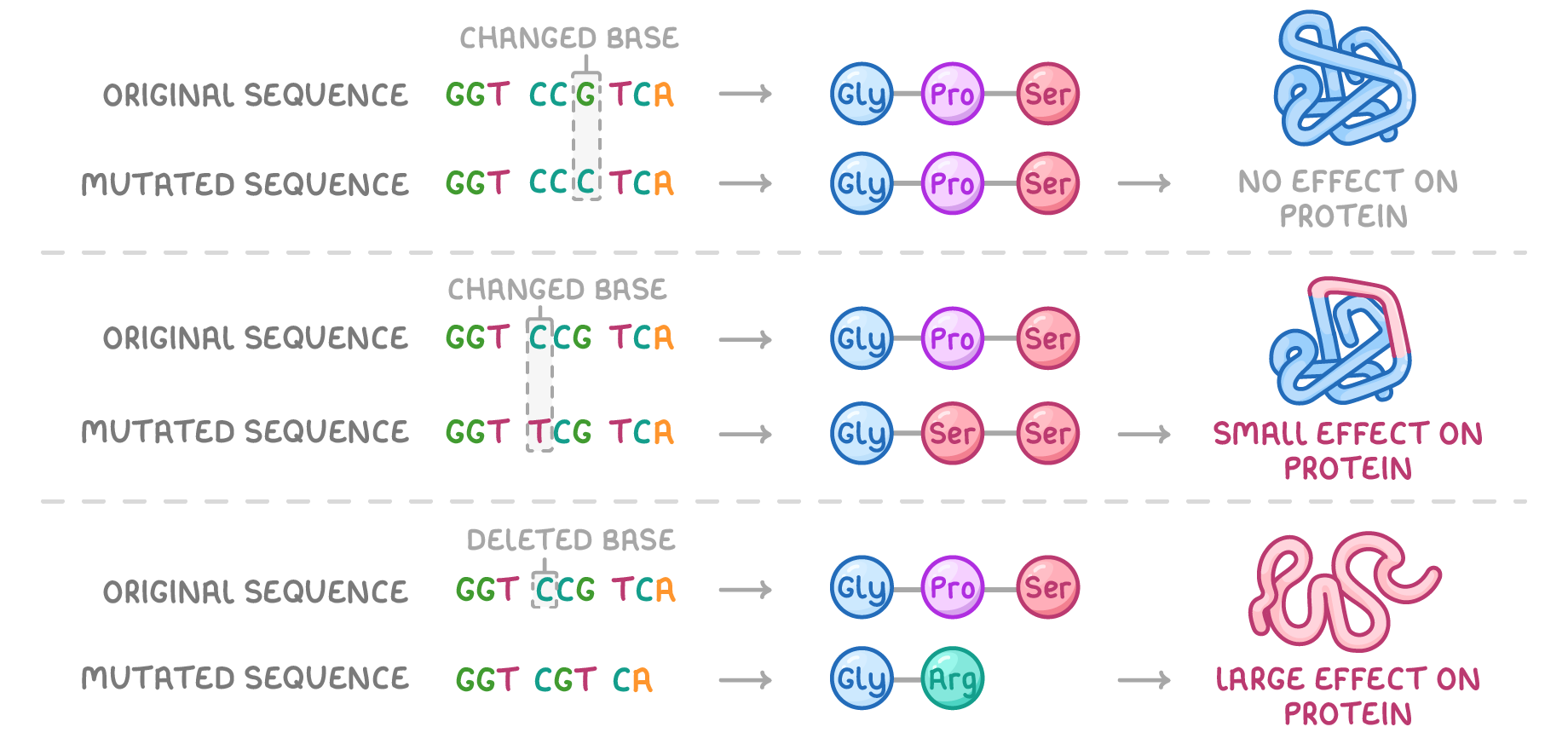
A mutation often changes nothing, because:
- The changed triplet may still code for the same amino acid.
- The change to the protein may be too small to alter its shape and function.
- The mutation may fall in a part of the DNA that does not do an important job, or sit in a recessive allele masked by a dominant one.
Other outcomes:
- Small effect - Alters a characteristic only slightly.
- Large effect - Occurs when a key protein is badly disrupted or not made at all.
The two kinds of protein where this matters most
- Enzymes - Have an active site with a very specific shape that the substrate fits into. If a mutation changes the active site's shape, the substrate may no longer bind, so the enzyme can't speed up its reaction. A mutation can even stop the enzyme being produced at all.
- Structural proteins (e.g. collagen) - Depend on their shape to give strength and support. If a mutation changes that shape, the protein can lose its strength and become much less useful for holding tissues together.
Mutations in coding and non-coding DNA
- DNA contains genes - sequences of bases that code for proteins.
- A large amount of DNA does not code for any protein - this is non-coding DNA.
- Mutations aren't confined to genes: they can happen in either coding or non-coding DNA.
How the two types of mutation differ
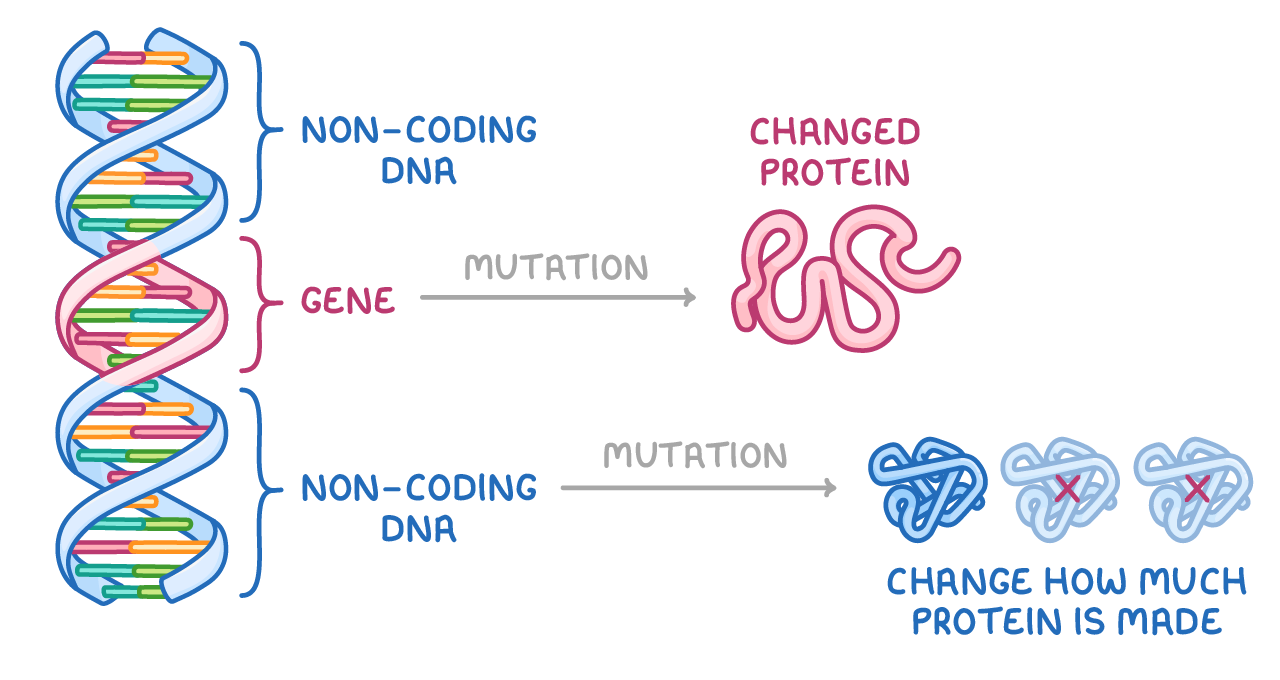
- Coding DNA mutation - Changes the protein that gene makes, so it can change how the protein works.
- Non-coding DNA mutation - Doesn't change a protein directly. Instead it can change whether a gene is switched on or off, and how strongly it's expressed.
- Some non-coding DNA controls the expression of nearby genes, so a mutation there can change how much of a protein is made, or stop it being made at all.
- A non-coding mutation can therefore still affect the phenotype, even though it doesn't lie within a gene.
The role of RNA polymerase binding
- Before a gene can be transcribed, the enzyme RNA polymerase has to bind to a region of non-coding DNA just in front of the gene.
- A mutation in that region changes the binding site, so RNA polymerase may bind more easily or less easily than before:
- Binds more easily → more mRNA transcribed → more protein made.
- Binds less easily → less protein made.
- Can't bind at all → none of the protein is made.
- So a variant in the non-coding DNA in front of a gene alters the quantity of protein produced, and it's that change in quantity that changes the phenotype.
TermDefinition
MutationA random change in an organism's genetic material (DNA).
Genetic variantA different form of a gene, produced by a mutation.
Non-coding DNAA section of DNA that does not code for a protein.
Key points to remember
How were these notes?