2.7 - The Eye - Vision Defects
Short-sightedness and long-sightedness
- Some people can't focus light correctly onto the retina, giving a blurred image.
- There are two common defects - one affects near vision, the other affects distant vision.
- Each is corrected by placing a lens of the right shape in front of the eye.
Long-sightedness (hyperopia)
- The person can't focus clearly on near objects.
- Caused by either:
- The lens being the wrong shape and not refracting the light enough, or
- The eyeball being too short.
- Light from a near object is focused behind the retina, so the image is blurred.
- Corrected with a convex lens - curves outwards, fattest in the middle.
- It starts to refract the light so it's already converging before entering the eye, bringing the image forward onto the retina.
Short-sightedness (myopia)
- The person can't focus clearly on distant objects.
- Caused by either:
- The lens being the wrong shape and refracting the light too much, or
- The eyeball being too long.
- Light from a distant object is focused in front of the retina, so the image is blurred.
- Corrected with a concave lens - curves inwards, thinner in the middle than at the edges.
- It refracts the light so the rays diverge (spread apart) a little before entering the eye, reducing the convergence and letting the image fall back onto the retina.
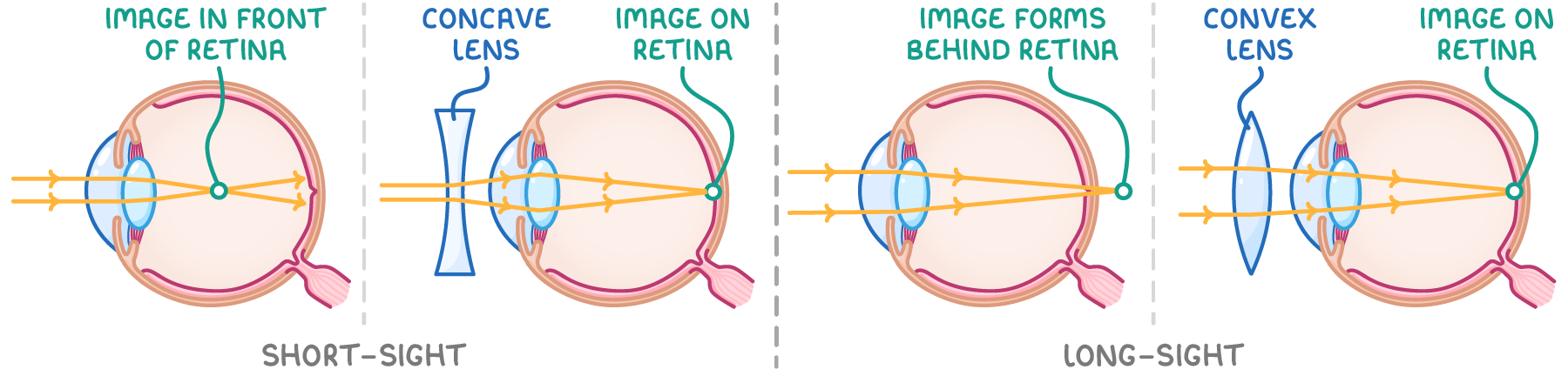
Other ways to correct vision defects
- Contact lenses - Sit on the surface of the eye, shaped the same way to compensate for the fault.
- Laser eye surgery - A laser reshapes the cornea so it refracts light by the right amount.
- Replacement-lens surgery - The natural lens is replaced with an artificial one. You are expected to be able to read, explain, and complete ray diagrams showing where the image forms and how a lens corrects it.
Cataracts and colour blindness
As well as focusing defects, the lens and the light receptors can develop other faults that affect vision.
Cataracts
- A cataract is a cloudy patch that forms on the lens of the eye.
- The cloudiness blocks some of the light passing through the lens, so less light reaches the retina and a person with a cataract has:
- Blurred vision
- Colours that look less vivid
- Difficulty seeing in dim light, and dazzle from bright lights
- Cataracts often develop in older people, because the tissues of the eye degrade over time.
Treatment:
- An operation removes the faulty lens and replaces it with an artificial lens made of clear plastic.
- Like any surgery, this carries a small risk of complications, such as damage to the retina.
Colour blindness
- Colour blindness is a difficulty in telling certain colours apart.
- The most common form is red-green colour blindness, where a person cannot easily distinguish reds from greens.
- It happens when the red cones or green cones in the retina do not work properly, so the eye cannot compare the signals from the different cone types in the normal way.
- There is no cure, because the faulty cone cells cannot be replaced or repaired.
- Tinted lenses can sometimes help a colour-blind person tell some colours apart more easily.
TermDefinition
Long-sightednessA vision defect where a person cannot focus clearly on near objects because light is focused behind the retina.
Short-sightednessA vision defect where a person cannot focus clearly on distant objects because light is focused in front of the retina.
CataractA cloudy patch on the lens of the eye that stops light passing through normally.
Colour blindnessA difficulty in telling certain colours apart caused by faulty cone cells in the retina.
Key points to remember
How were these notes?