5.3 - Viral Diseases
HIV and AIDS
- HIV (human immunodeficiency virus) attacks the immune cells - a type of white blood cell.
- There is no cure, but the infection can be controlled with antiretroviral (antiviral) drugs, which stop the virus replicating inside the body.
How HIV is spread
- Through sexual contact.
- Through the exchange of body fluids such as blood - for example when drug users share needles.
Its spread can be reduced by using a condom during sex, and by people who inject drugs not sharing needles.
The stages of infection
- At first HIV causes a flu-like illness for a few weeks.
- The person then often feels well for several years while the virus attacks the immune cells.
- If the immune system becomes so badly damaged that the body can no longer fight off other infections or cancers, the person has late-stage HIV infection, or AIDS (acquired immune deficiency syndrome).
- With a weakened immune system, a person with AIDS becomes vulnerable to other infections such as tuberculosis and pneumonia.
Ebola
- Ebola is a virus that causes haemorrhagic fever - a fever accompanied by bleeding.
- It is spread through body fluids.
Controlling outbreaks
- Isolating infected people
- Sterilising any area where the virus may be present
Virus replication - The lytic and lysogenic cycles
- A virus is not a cell - it's usually no more than a protein coat surrounding a strand of genetic material.
- A virus can only reproduce inside a living host cell, and a particular virus will only infect particular types of cell.
- The life cycle begins when a virus infects a new host cell. Many viruses then reproduce straight away by the lytic pathway, while some first enter the lysogenic pathway before becoming active.
The lytic pathway
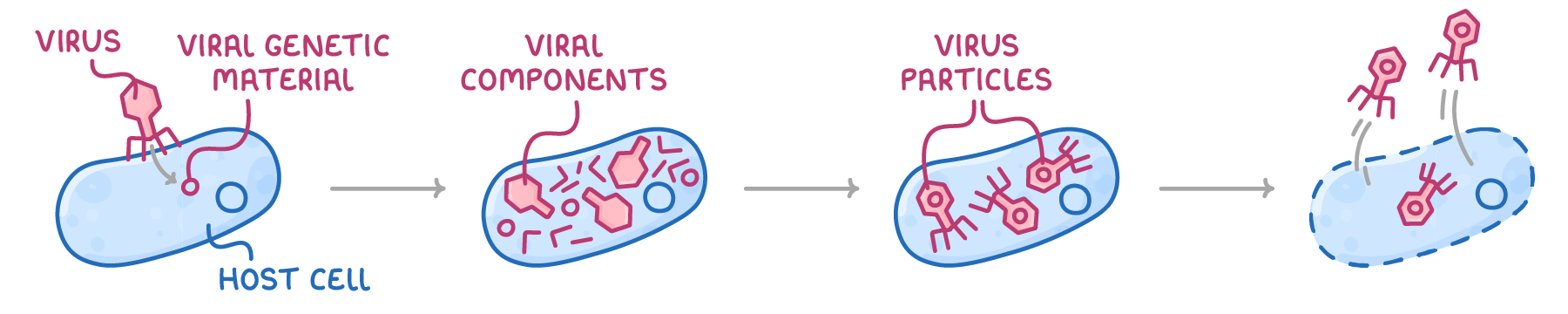
- The virus attaches to a specific host cell and injects its genetic material into the cell.
- The virus uses the host cell's proteins and enzymes to copy its genetic material and make the components of new viruses.
- These components assemble into new virus particles.
- The host cell splits open, releasing the new viruses, which go on to infect more cells.
The lysogenic pathway
- The injected genetic material is incorporated into the host cell's own genome (its DNA) instead of being copied straight away.
- Each time the host cell divides, the viral genetic material is copied along with the host DNA, but the virus stays dormant (inactive) and no new viruses are made.
- Eventually a trigger - for example the presence of a particular chemical - causes the viral genetic material to leave the host genome and enter the lytic pathway, at which point new viruses are made and the cell bursts.

TermDefinition
HIVA virus that attacks the body's immune cells and can eventually lead to AIDS if it is not treated.
AIDSThe late stage of HIV infection, when the immune system is so badly damaged that the body can no longer fight off other infections.
Antiretroviral drugsMedicines that control an HIV infection by stopping the virus from replicating.
Host cellA cell that a virus gets inside and uses to make copies of itself. In genetic engineering, it is the cell a new gene is put into.
Lytic pathwayA viral replication cycle where the virus copies itself and causes the host cell to burst open.
Lysogenic pathwayA viral replication cycle where the viral genetic material inserts into the host DNA and remains dormant.
Key points to remember
How were these notes?