5.5 - Plant Diseases
Plant diseases and their signs
- Plants can be infected by the same types of pathogen as animals: viruses, bacteria, and fungi.
- They can also be infested and damaged by larger organisms, such as insects.
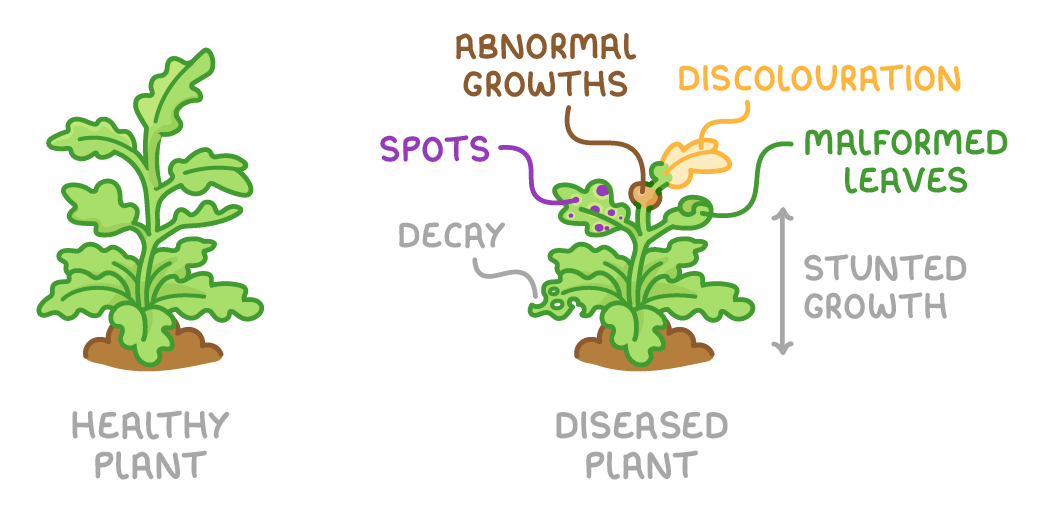
- It's usually fairly clear when a plant has a disease, because diseased plants show characteristic signs.
- Different diseases produce different combinations of these signs - that's what makes it possible to tell one disease from another.
Ash dieback - A fungal disease
- Ash dieback is a disease of ash trees caused by a fungus.
- It's carried from tree to tree through the air by the wind.
- It produces leaf loss and lesions on the bark, and eventually kills the tree.
Common signs of plant disease
- Stunted growth
- Spots on the leaves
- Patches of decay or rot
- Abnormal growths, such as lumps
- Malformed stems or leaves
- Discolouration
Detecting and identifying plant disease
- A plant pathologist is an expert in plant disease.
- Detection usually starts with observation in the field, and moves to the laboratory when field observation isn't enough.
Detecting disease in the field
- The pathologist recognises the signs and matches them to a disease - for example by looking them up in a gardening manual or website:
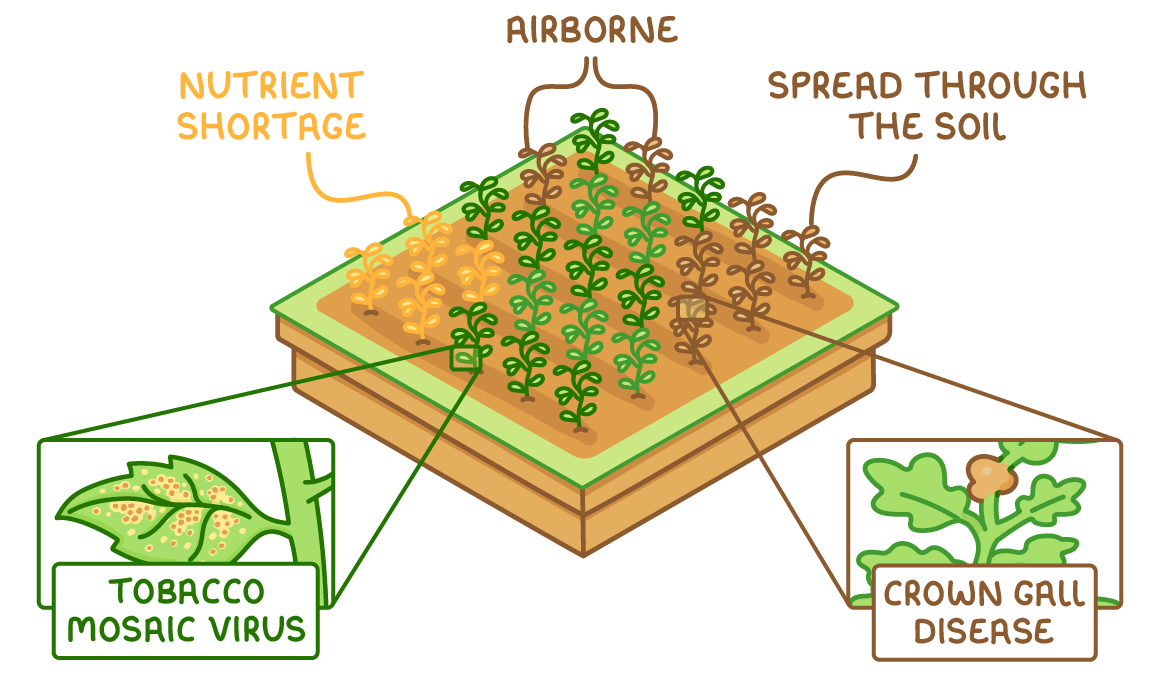
- Growths on the stems might point to crown gall disease.
- Mottled leaves might point to tobacco mosaic virus.
- The distribution of diseased plants is a clue to the pathogen, because different pathogens spread in different ways:
- Patches of diseased plants suggest a pathogen spread through the soil.
- Plants diseased at random suggest an airborne pathogen.
- A sign such as yellow leaves may not be caused by a pathogen at all, but by an environmental problem such as a nutrient shortage. This can be ruled out by changing the conditions - e.g. adding nutrients to the soil - and seeing whether the symptoms improve.
Identifying the pathogen in the laboratory
- When field observation isn't enough, an infected sample is taken to a laboratory to identify the pathogen accurately.
- A microscope can be used to look at the sample in more detail, and to tell apart pathogens that look alike (such as similar-looking fungi) and can't be distinguished by eye.
Two laboratory methods identify a pathogen from molecules unique to it:
- Detecting the pathogen's antigens - Antigens are the unique molecules on a pathogen's surface. Antibodies that bind to a particular pathogen's antigen show it's present. The ELISA test uses such antibodies linked to an enzyme that gives a colour change when the antigen is found.
- Detecting the pathogen's DNA - A technique such as the polymerase chain reaction (PCR) copies pathogen DNA from the sample many times over, until even a small amount can be detected - identifying exactly which pathogen is present.
Physical plant defences
- Plants don't have an immune system of specialised cells and antibodies like animals do.
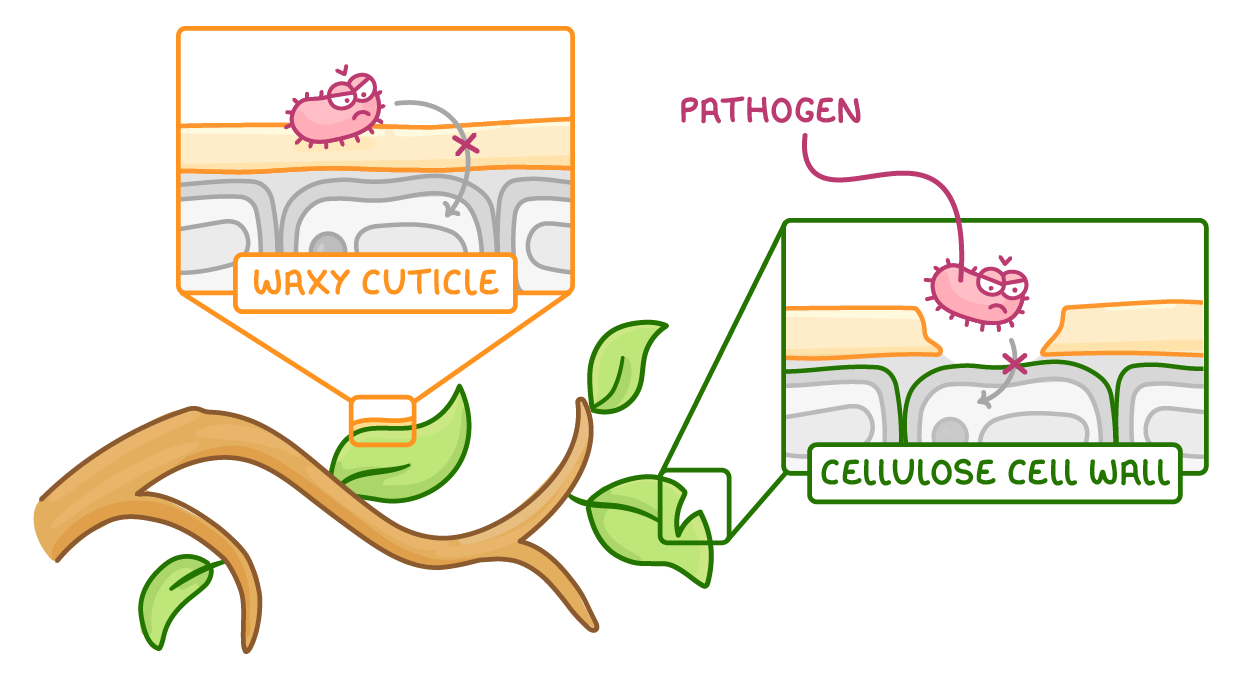
- Instead, they use physical defences - barriers that stop pathogens getting into the plant in the first place.
The two physical barriers
- Waxy cuticle - A tough layer covering most leaves and stems. It blocks pathogens from entering, and stops water collecting on the leaf - which lowers the risk of infection by pathogens carried in water.
- Cellulose cell wall - Every plant cell is surrounded by a cell wall made of cellulose, sitting beneath the cuticle. It forms a further barrier against any pathogen that gets past the cuticle.
Chemical plant defences
As well as physical barriers, many plants make chemical defences - substances that kill pathogens or deter the animals that would eat the plant.
Antimicrobial chemicals
- Some plants produce antimicrobial chemicals (also called antibacterials or antiseptics), which kill or stop the growth of bacteria and fungi.
- Examples: mint and witch hazel.
Poisons to deter herbivores
- Other plants produce poisons that deter herbivores.
- Tobacco plants, foxgloves, and deadly nightshade all make poisonous chemicals.
- The poison digitalis comes from the foxglove.
Plant chemicals as human medicines
- Quinine - Comes from cinchona bark and has long been used to treat malaria.
- Aspirin - Comes from willow.
TermDefinition
Plant pathologistAn expert in plant disease.
Antimicrobial chemicalA substance produced by a plant that kills or stops the growth of bacteria and fungi.
HerbivoreAn animal that eats plants.
Key points to remember
How were these notes?