6.5 - Transpiration
Transpiration and the transpiration stream
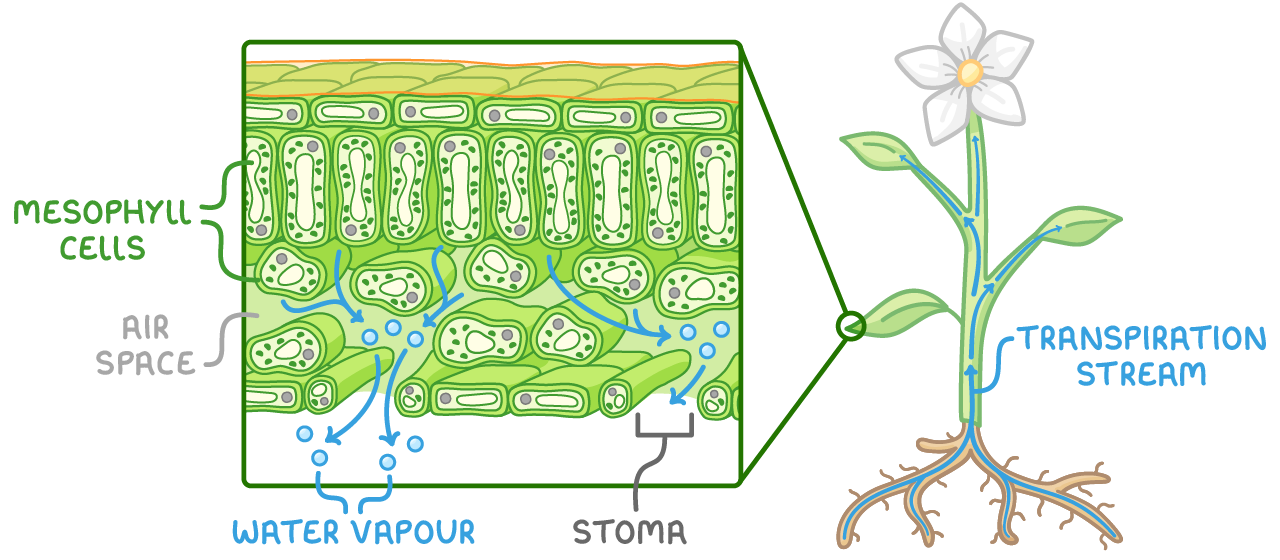
- Transpiration is the loss of water vapour from a plant, and it happens mostly at the leaves.
- It follows this sequence inside the leaf:
- Water evaporates from the surface of the mesophyll cells inside the leaf, turning into water vapour.
- The water vapour collects in the air spaces between those cells.
- It diffuses out of the leaf through the stomata (tiny pores in the leaf surface).
- This diffusion happens because there is much more water inside the leaf than in the drier air outside.
Why transpiration happens
- Transpiration is really a side-effect of the way a leaf is built for photosynthesis.
- The leaf must have stomata so carbon dioxide and oxygen can be exchanged with the air.
- Having those pores open also lets water vapour escape - so while the stomata are open for gas exchange, the plant unavoidably loses water by transpiration.
The transpiration stream
- As water is lost by transpiration, it leaves a slight shortage of water in the leaf.
- More water is drawn up to replace it, moving up through the xylem vessels from the rest of the plant.
- This in turn draws more water up from the roots, giving a continuous flow of water from the roots, up through the xylem, and out of the leaves.
- This steady upward flow is called the transpiration stream.
- The transpiration stream also carries dissolved mineral ions up from the roots along with the water, distributing them to the stems and leaves where they're needed.
Factors that affect the rate of transpiration
- The rate of transpiration is how quickly a plant loses water.
- Transpiration happens by water vapour diffusing out of the leaf through the stomata.
- Anything that steepens the difference in water concentration between the inside of the leaf and the air outside, or that opens the stomata wider, speeds it up.
The four environmental factors
- Light intensity - The brighter the light, the faster transpiration. In bright light the stomata open to let carbon dioxide in for photosynthesis, which also lets more water vapour out. As it gets darker the stomata begin to close (photosynthesis can't happen in the dark), and when closed very little water escapes.
- Temperature - The warmer it is, the faster transpiration. When warm, water molecules have more energy, so they evaporate and diffuse out of the stomata more quickly.
- Humidity - The drier the air, the faster transpiration. Humid air already holds a lot of water, so there's only a small concentration difference between the inside and outside of the leaf, and diffusion out is slow. Dry air gives a large difference, so water diffuses out quickly.
- Air movement (wind speed) - The better the air movement, the faster transpiration. In still air the water vapour sits around the leaf, keeping the outside concentration high and diffusion slow. Moving air sweeps the water vapour away, keeping the outside concentration low, so water continues to diffuse out quickly.
Surface area
- The greater the surface area of the leaves, the faster transpiration.
- A larger surface carries more stomata for water vapour to escape from.
Rate of transpiration from a potometer
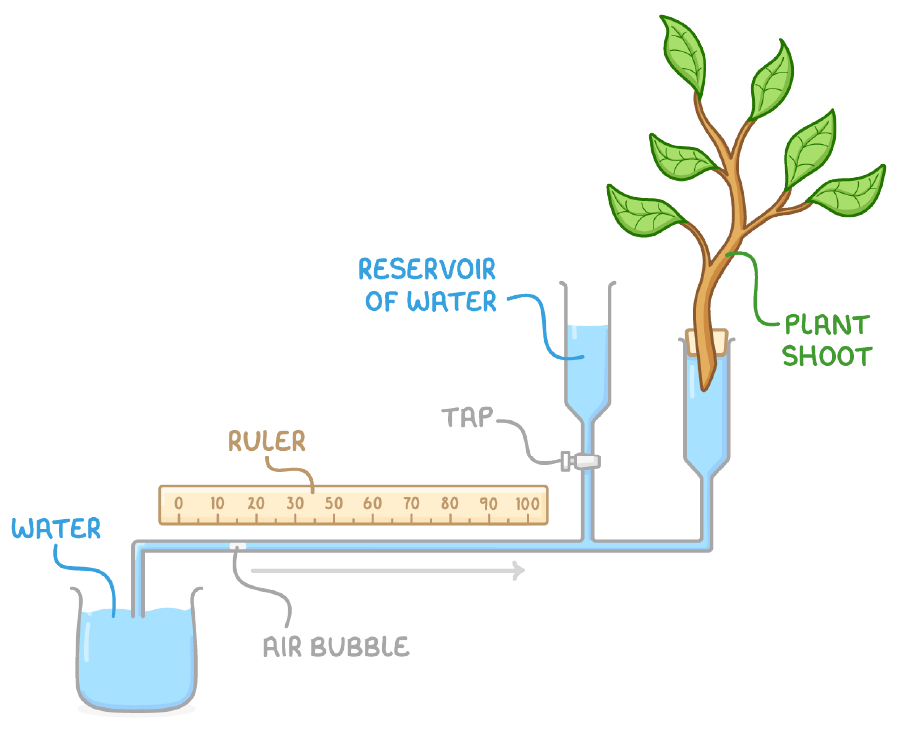
- A potometer measures how much water a cut shoot takes up. Almost all of that water is lost by transpiration, so the water uptake is taken as a measure of the transpiration rate.
- As the shoot takes up water, an air bubble moves along a scale. The distance the bubble moves in a given time gives the rate.
- The rate is the distance moved ÷ time taken.
- The rate can also be found from the mass a plant loses over time, since transpiration makes the plant lighter - dividing the change in mass by the time gives the rate of water loss.
Worked example - Rate of transpiration from a potometer
An air bubble in a potometer moves 36 mm in 8 minutes. Calculate the rate of transpiration.
Step 1 - Formula
Step 2 - Substitution and calculation
Plant adaptations to extreme (dry) environments
- A xerophyte is a plant adapted to survive in very dry, extreme environments such as deserts, where there is little water and conditions can be hot and windy.
- Losing too much water would be fatal, so all of a xerophyte's adaptations work to reduce water lost by transpiration - the evaporation and diffusion of water vapour from the leaves.
Reduced leaf size and shape
- A smaller leaf has a smaller surface area, so there's less area from which water vapour can escape.
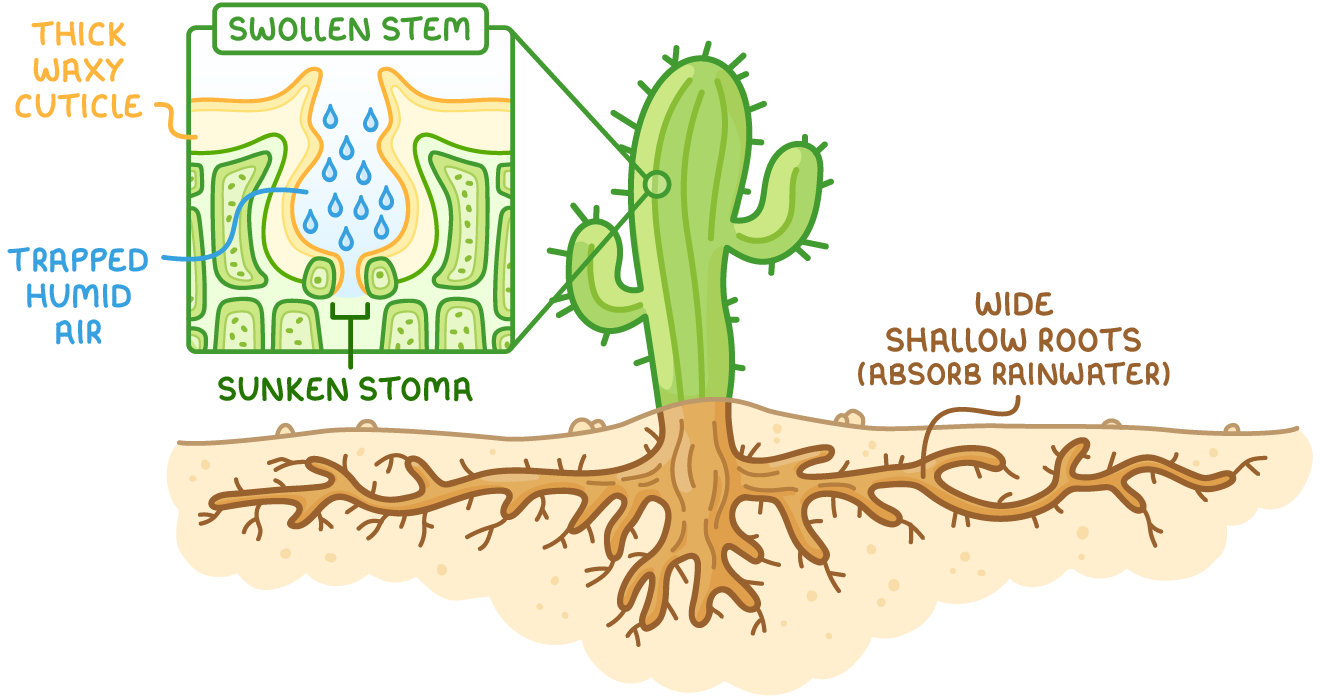
- In many xerophytes, such as cacti, the leaves are reduced all the way to thin spines, giving a very small surface area for water loss (and helping protect the plant from animals).
- Photosynthesis then happens mainly in the green stem instead.
Thick, waxy cuticle
- The cuticle is a waterproof layer on the outside of the leaf and stem.
- Making it thick greatly reduces how much water can evaporate directly from the plant's surface.
Stomata adapted to slow water loss
- Xerophytes tend to have fewer stomata than a typical plant.
- The stomata are often sunken into pits below the leaf surface and found mainly on the lower surface, away from direct sun and wind.
- In some xerophytes, such as cacti, the leaves carry no stomata at all - the stomata are sunken into pits on the stem instead.
- Sunken stomata trap a layer of still, humid air in the pits just outside the pore. This keeps the water concentration outside the stoma high, so the difference in water concentration between the inside and outside of the leaf is small - and water vapour diffuses out more slowly.
Storing and reaching water
- Plants such as cacti store water in fleshy, swollen stems or leaves, giving them a reserve to draw on during droughts.
- Their roots are often either:
- Very widespread and shallow, to absorb as much rain as possible over a large area before it evaporates, or
- Very deep, to reach water far underground.
TermDefinition
TranspirationThe loss of water vapour from a plant, mostly from the leaves through the stomata.
Transpiration streamThe continuous upward flow of water from the roots, through the xylem, and out of the leaves.
StomataTiny pores, mostly in the lower surface of a leaf, that let carbon dioxide and oxygen diffuse in and out and let water vapour escape.
PotometerA piece of equipment that measures how much water a cut shoot takes up.
XerophyteA plant adapted to survive in very dry conditions.
Key points to remember
How were these notes?