2.2 - Specialised Cells
Specialised cells and their functions
- Most cells are specialised: their structure is adapted to a particular function.
- The seven specialised cells below each pair a function with the structures that suit it.
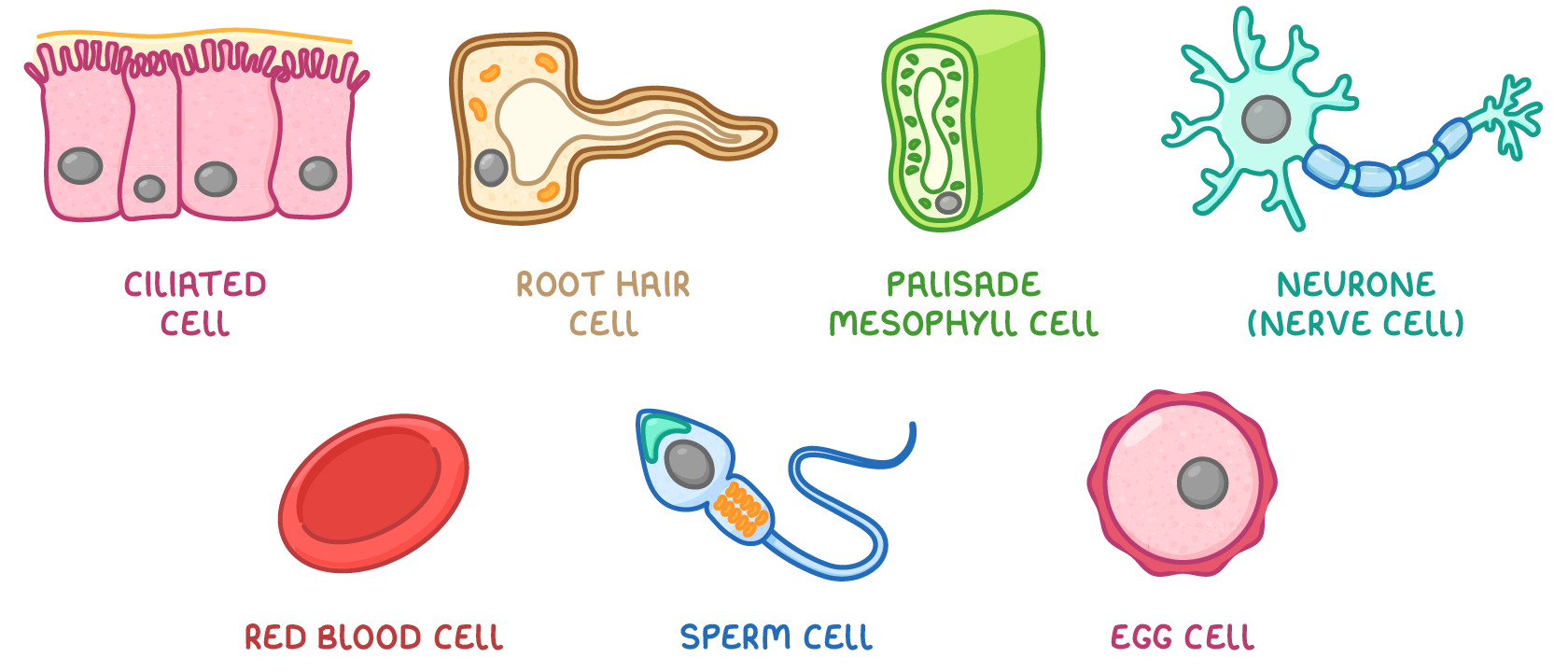
Ciliated cell
- Function - Moves substances along a surface.
- Has cilia - hair-like structures on its top surface that beat to move substances in one direction.
- Lines the trachea and bronchi, sweeping mucus and trapped particles up towards the throat so they don't reach the lungs.
- The mucus is made by goblet cells in the airway lining; it traps pathogens and particles, and the cilia sweep it to the throat to be swallowed - protecting the breathing system and keeping the lungs clear.
Root hair cell
- Function - Absorbs water and mineral ions.
- Sits on the surface of a plant root and grows out into a long hair sticking into the soil.
- This gives a large surface area for absorption.
Palisade mesophyll cell
- Function - Carries out most of a leaf's photosynthesis.
- Sits in a layer near the top of the leaf, where it receives the most light.
- Packed with chloroplasts - the structures in which photosynthesis takes place.
- Long and thin, so many can be packed into the same space.
Neurone (nerve cell)
- Function - Conducts electrical impulses from one part of the body to another.
- Long, so it can carry impulses over a large distance.
- Has branched connections at its ends to link with other neurones and form a network through the body.
Red blood cell
- Function - Transports oxygen from the lungs to the rest of the body.
- Biconcave disc shape (squashed in the centre) - gives a large surface area for absorbing oxygen.
- Filled with the red pigment haemoglobin, which carries the oxygen.
- Has no nucleus, leaving more room for oxygen.
Sperm and egg cells
Sperm and egg cells are the gametes - the sex cells of reproduction.
- Sperm cell:
- Long flagellum (tail) and a streamlined head to swim to the egg.
- Many mitochondria in its middle section for energy.
- Enzymes stored in the acrosome at its head to digest through the egg's membrane.
- Egg cell:
- Large, with nutrients in its cytoplasm to nourish the developing embryo.
TermDefinition
Specialised cellA cell whose structure is adapted to perform a particular function.
CiliaTiny hair-like structures on the surface of some cells that beat to move substances, such as mucus, in one direction.