3.2 - Surface Area to Volume Ratio
Surface area to volume ratio
- The surface area to volume ratio (written SA : V) compares the size of an object's outer surface with the amount of space inside it.
- A ratio shows how big one value is compared with another - so a ratio of 6 : 1 means there are six units of surface area for every one unit of volume.
- It can be written three ways: as a ratio (e.g. 6 : 1), as a fraction, or as a single number (surface area ÷ volume, e.g. 6).
Why bigger organisms have a smaller ratio
- As an object gets bigger, its surface area and its volume don't grow at the same rate:
- Surface area depends on the sides multiplied two at a time (length × width)
- Volume depends on all three dimensions multiplied together (length × width × height)
- Volume grows faster than surface area, so a large object has a smaller surface area compared with its volume than a small object does.
- In short: the bigger an organism is, the smaller its surface area to volume ratio.
Why the ratio matters in biology
- Substances enter and leave an organism across its surface, by diffusion, while the whole volume has to be supplied.
- The surface is where exchange happens; the volume is what needs supplying.
- As an organism gets bigger, the distance a substance must diffuse from the surface to reach the middle also grows.
- A large surface area compared with the volume, and a short diffusion distance, both make exchange easy.
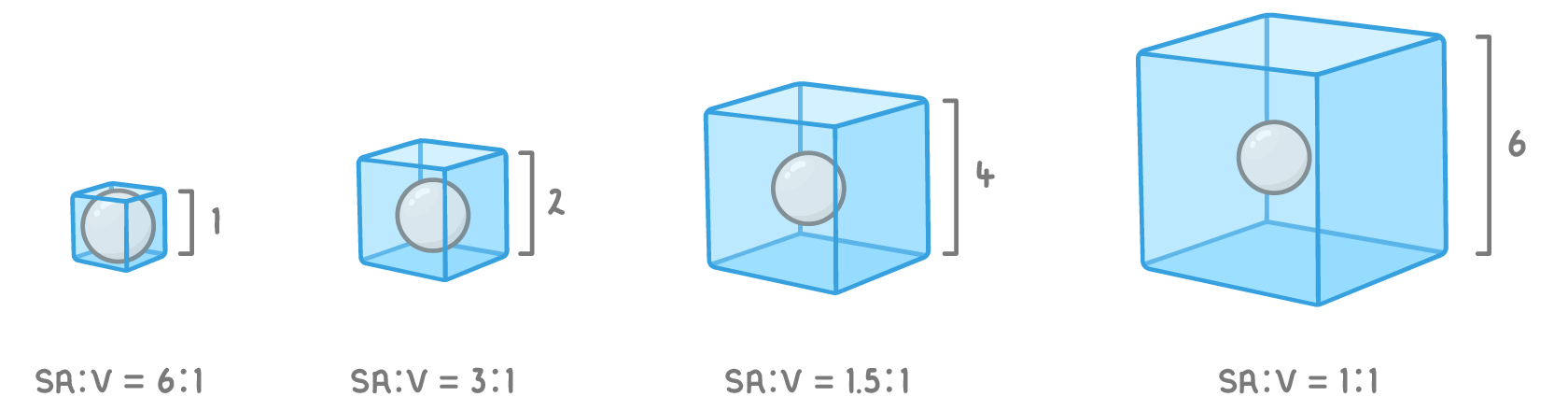
Worked example - Surface area to volume ratios
An elephant is modelled as a block 8 cm by 8 cm by 4 cm, and a shrew as a 2 cm cube. Work out the surface area to volume ratio of each, giving both in the form n : 1, and say which is larger.
Step 1 - Elephant surface area
Add the area of all six faces:
- Top and bottom: 8 × 8 = 64 cm2 each
- Four sides: 8 × 4 = 32 cm2 each
(64 × 2) + (32 × 4) = 256 cm2
Step 2 - Elephant volume
8 × 8 × 4 = 256 cm3
Step 3 - Elephant ratio
Surface area : volume = 256 : 256
Divide both sides by 256:
256 : 256 = 1 : 1
Step 4 - Shrew surface area
Add the area of its six faces:
(2 × 2) × 6 = 24 cm2
Step 5 - Shrew volume
2 × 2 × 2 = 8 cm3
Step 6 - Shrew ratio
Surface area : volume = 24 : 8
Divide both sides by 8:
24 : 8 = 3 : 1
Step 7 - Interpretation
The shrew's surface area is three times its volume, while the elephant's is only equal to its volume. The smaller animal has the larger surface area to volume ratio - much more surface, relative to its size, across which to exchange substances with its surroundings.
TermDefinition
Surface area to volume ratioThe size of an object's outer surface compared with the amount of space inside it.