8.2 - Transpiration
Transpiration and the transpiration stream
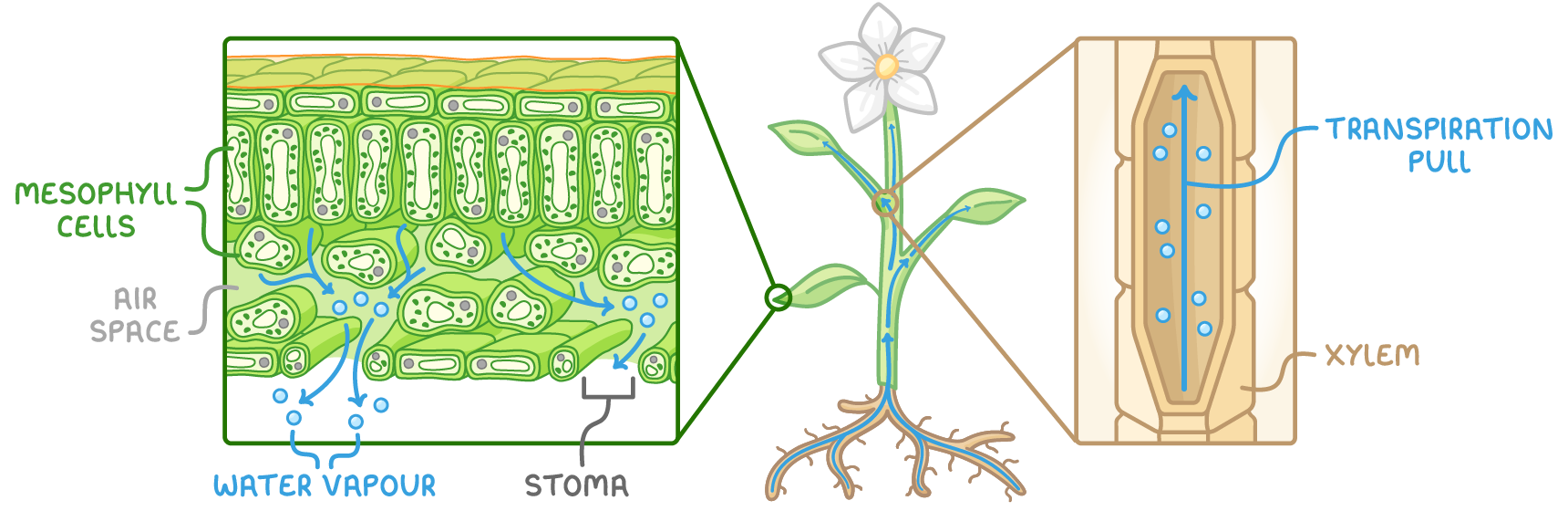
- Transpiration is the loss of water vapour from a plant. It happens mostly at the leaves.
- The process at the leaf:
- Water evaporates from the surface of the mesophyll cells inside the leaf, turning into water vapour.
- The water vapour collects in the air spaces between the cells.
- It then diffuses out through the stomata (tiny pores in the leaf surface), because there's much more water inside the leaf than in the drier air outside.
Transpiration is a side-effect of gas exchange
- A leaf must have stomata so that carbon dioxide and oxygen can be exchanged with the air for photosynthesis.
- Having those pores open also lets water vapour escape.
- So as long as the stomata are open for gas exchange, the plant unavoidably loses water by transpiration.
The transpiration stream
- Losing water from the leaf leaves a slight shortage of water at the top of the xylem in the leaf.
- More water is drawn up from the rest of the plant through the xylem vessels to replace it, and in turn more is drawn up from the roots.
- This gives a continuous flow of water from the roots, up through the xylem, and out of the leaves - called the transpiration stream.
- The stream also carries dissolved mineral ions up from the roots along with the water.
The transpiration pull
- The water column is held together by the attraction between the water molecules themselves.
- Water molecules are pulled towards one another, so when some are drawn into the leaf, others follow behind them.
- This means the whole column of water in the xylem - from the leaves down to the roots - is pulled upwards as one continuous thread.
- This pulling force is the transpiration pull, and it's what moves water up the plant against gravity.
Factors affecting the rate of transpiration
- The rate of transpiration is how quickly a plant loses water, and it changes with the conditions around the leaf.
- All three factors below work through the same idea: water vapour diffuses out of the leaf, so anything that steepens the difference in water concentration between the inside of the leaf and the air outside speeds transpiration up.
The three factors
- Temperature - The warmer it is, the faster transpiration. When it is warm the water molecules have more kinetic energy, so they evaporate and diffuse out of the stomata more quickly.
- Wind speed - The higher the wind speed, the faster transpiration. In still air the water vapour just surrounds the leaf, keeping the concentration outside high so diffusion out is slow. When it is windy, the vapour is swept away, keeping the concentration outside low so water keeps diffusing out quickly.
- Humidity - The more humid the air, the slower transpiration. Humid air already holds a lot of water, so there is only a small difference in water concentration between inside and outside, and diffusion out is slow. Dry air gives a large difference, so water diffuses out quickly.
Why the leaf loses so much water
- Inside the leaf, the mesophyll cells are surrounded by a network of interconnecting air spaces.
- These air spaces give the moist mesophyll cells a very large total surface area exposed to the air inside the leaf.
- So a lot of water can evaporate from them quickly, then diffuse through the leaf and out of the stomata.
The role of the stomata
- The guard cells can change the diameter of each stoma. Making the stomata smaller reduces the amount of water lost by diffusion.
- The number of stomata matters too: the more stomata a leaf has, the more water it can lose.
TermDefinition
TranspirationThe loss of water vapour from a plant, mostly from the leaves through the stomata.
Transpiration streamThe continuous upward flow of water from the roots, through the xylem, and out of the leaves.
Transpiration pullThe pulling force that moves water up the plant against gravity as a continuous thread.
StomataTiny pores, mostly in the lower surface of a leaf, that let carbon dioxide and oxygen diffuse in and out and let water vapour escape.