7.3 - Teeth
The types of teeth and their functions
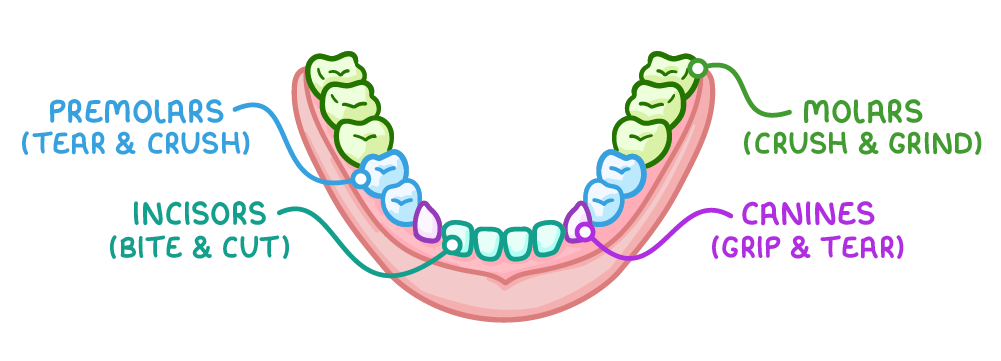
- There are four types of teeth in the human mouth, and each is shaped for a particular job in breaking food into smaller pieces.
- Chewing food is the first stage of physical digestion - the food is cut, torn, and ground into smaller pieces without its molecules being chemically changed.
The four types and their jobs
Incisors and canines sit at the front and have sharp biting surfaces; premolars and molars sit further back and have broad, flat biting surfaces.
- Incisors - The teeth at the front of the mouth, used for biting and cutting into food
- Canines - Next to the incisors, with a sharp point, used for gripping and tearing food
- Premolars - Sit further back, used for crushing and grinding food
- Molars - At the very back, used for crushing and grinding food into a paste that can be swallowed
The structure of a tooth
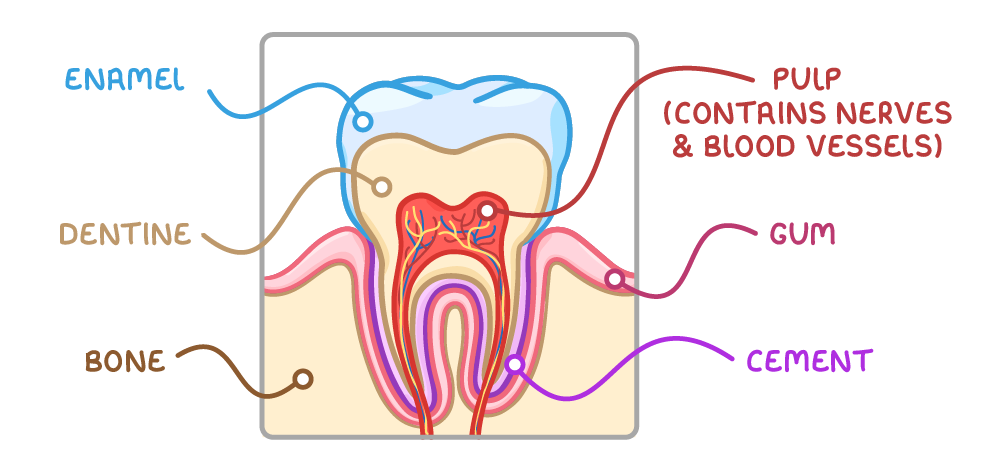
A typical tooth is made of several layers, from a hard outer coating down to a soft living centre, and is held firmly in the jaw.
Layers of the tooth
- Enamel - A very hard outer layer that covers the visible part of the tooth and protects it
- Dentine - A softer material beneath the enamel that forms the bulk of the tooth
- Pulp - The soft tissue at the centre of the tooth, containing the nerves and blood vessels
- The nerves let the tooth sense things such as temperature and pain
- The blood vessels supply the living part of the tooth
Holding the tooth in the jaw
- The tooth is embedded in the bone of the jaw.
- Cement - A bone-like tissue that surrounds the tooth and helps hold it in place
- Gum - The soft tissue that surrounds and protects the tooth and the bone around it
TermDefinition
Physical digestionThe breakdown of food into smaller pieces without chemical change to the food molecules.
IncisorA tooth at the front of the mouth used for biting and cutting into food.
CanineA pointed tooth next to the incisors used for gripping and tearing food.
PremolarA tooth between the canines and the molars, used for crushing and grinding food.
MolarA tooth at the back of the mouth used for crushing and grinding food.
EnamelThe very hard outer layer that covers and protects the visible part of a tooth.
DentineA softer material beneath the enamel that forms the bulk of a tooth.
PulpThe soft tissue at the centre of a tooth containing nerves and blood vessels.
CementA bone-like tissue that surrounds a tooth and helps hold it in the jaw.