21.3 - Uses of Enzymes
Industrial uses of enzymes
- Enzymes can be put to work outside living things to do useful jobs in industry and the home.
- Each enzyme breaks down one particular substance, and works quickly without needing high temperatures.
- This lets enzymes do jobs that would otherwise be slow, costly, or need harsh conditions.
Pectinase in fruit juice production
- Pectin is a carbohydrate found in the cell walls of plant cells, where it helps hold the cells together.
- Pectinase is an enzyme that breaks pectin down. It's produced naturally by some bacteria and fungi.
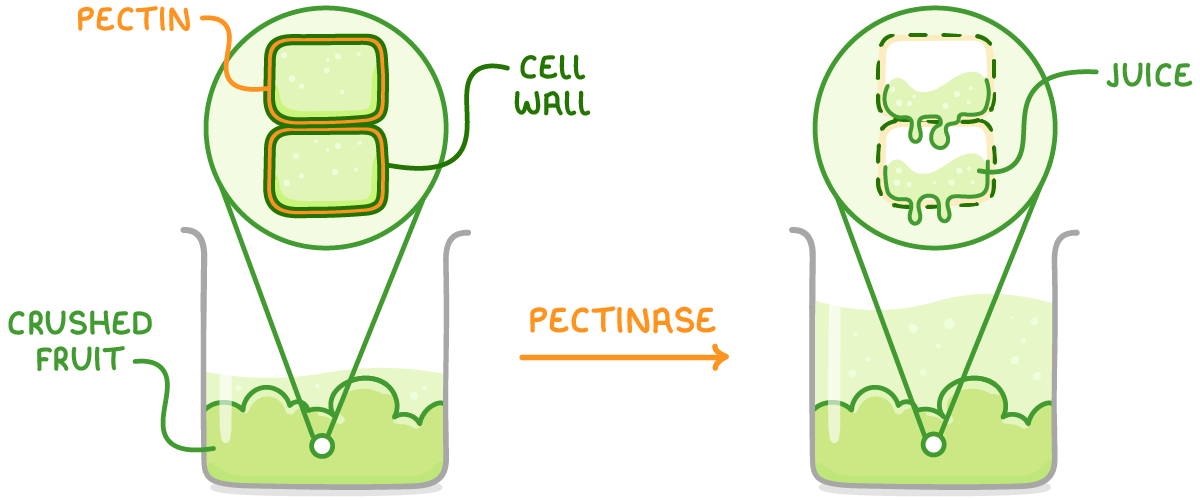
- Crushed fruit on its own gives up only some of its juice, because much of the liquid is held inside the cells by their walls.
- Adding pectinase breaks down the pectin in those cell walls, so the walls fall apart and the trapped juice is released.
This means:
- More juice can be extracted from the same amount of fruit.
- The juice flows out more easily.
- The juice is usually clearer as well.
Biological washing powders
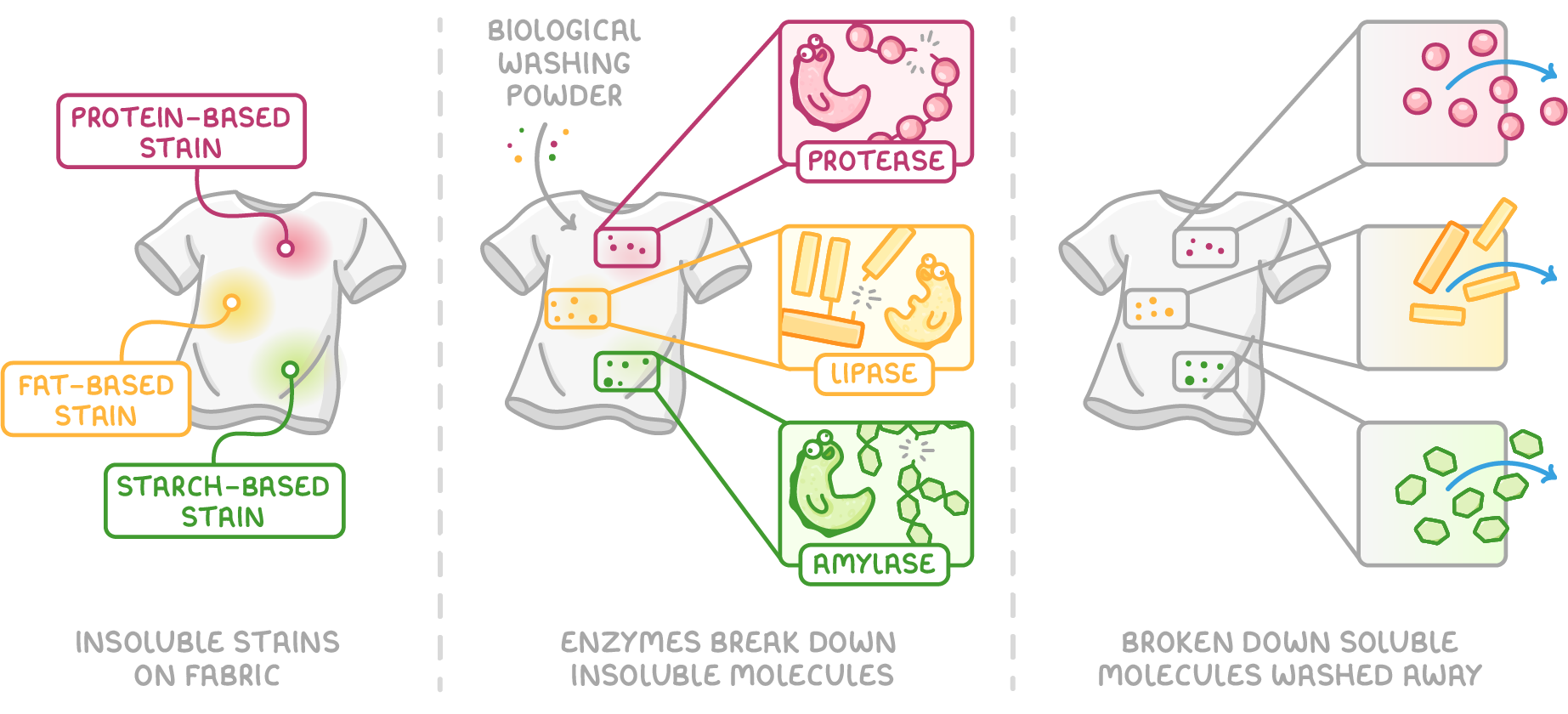
- Biological washing powders contain enzymes that break down the substances making up stains.
- They turn large, insoluble stain molecules into small, soluble ones that can be rinsed away.
- Different enzymes deal with different kinds of stain:
- Proteases - Break down protein-based stains such as blood, sweat, and food.
- Lipases - Break down fat-based and grease stains.
- Amylases - Break down carbohydrate- and starch-based stains.
- Because the cleaning is done by enzymes, they work effectively at low temperatures, around 30°C, rather than needing a hot wash.
- Washing at a lower temperature uses less energy, so it's cheaper and gentler on fabrics, while the enzymes still digest the stains.
Lactase and lactose-free milk
- Lactose is a sugar found in milk.
- Some people are lactose intolerant - they can't digest lactose because their bodies don't produce enough of the enzyme lactase.
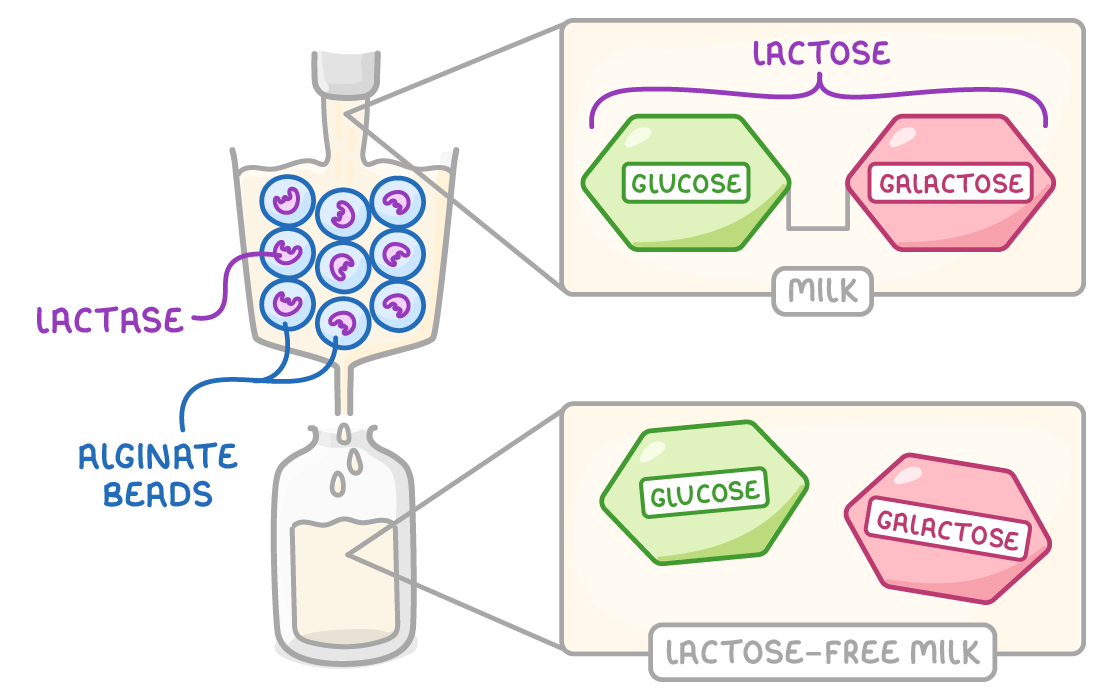
- Lactase breaks lactose down into two simpler sugars, glucose and galactose, which can be absorbed without trouble.
Making lactose-free milk:
- Rather than mixing the enzyme straight into the milk, the lactase is first immobilised - trapped in place - usually by encasing it in small jelly-like alginate beads.
- Milk is passed over or through the beads, and as it flows past, the lactose is broken down into glucose and galactose.
- Because the enzyme stays held in the beads, it doesn't end up in the final milk and can be used again for more milk.
TermDefinition
PectinA carbohydrate found in the cell walls of plant cells that helps hold the cells together.
PectinaseAn enzyme that breaks down pectin.
LactoseA sugar found in milk.
LactaseAn enzyme that breaks down lactose into the simpler sugars glucose and galactose.
ImmobilisedDescribes an enzyme that is trapped in place (for example inside jelly-like beads), so it can be reused and does not end up in the final product.