Variation & Evolution - exam practice
Variation & Evolution
Question 1 of 9
Herdwick sheep are hardy hill-sheep that live in the Lake District, where they graze the Cumbrian fells.
They can live at heights of more than 900 metres and withstand extremely cold temperatures and relentless rain.
Herdwick sheep are able to survive extremely harsh winters because they have a very thick coat that does not part when the wind blows and sheds water quickly.
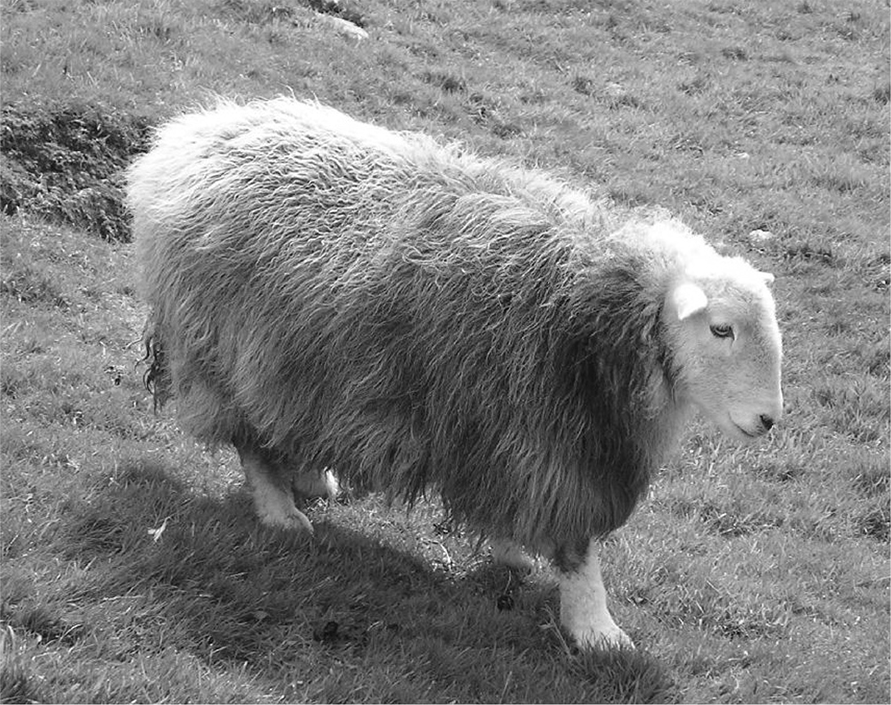
Use Charles Darwin’s theory of natural selection to explain why the Cumbrian Herdwick sheep have especially thick coats compared to the sheep in the south of England.
What do you predict will happen to the coats of Herdwick sheep over many generations if the winter temperatures start increasing?
Explain your answer.
The theory of natural selection was proposed by Charles Darwin in 1859.
His theory was not widely accepted until much later.
Give two reasons why Darwin’s theory was only very slowly accepted.
What is meant by natural selection?
Moles dig tunnels in search for food.
Moles have:
- extremely large, clawed front paws
- a wrist bone that has evolved into an additional thumb that increases surface area for digging
Use Darwin’s theory of natural selection to explain how the mole's front paws evolved.
Organisms can be classified by the five kingdom or three domain system.
What is the name of the domain that animals belong to?
Give one reason why the three domain classification system was proposed.
Why are the cells from animals described as eukaryotic?
Dogs belong to the Kingdom Animalia.
Identify the genus of the domestic dog, Canis familiaris.
Antibiotic-resistant bacteria can cause infection outbreaks in hospitals.
In the UK, the number of deaths from infections picked up in hospital is estimated to be around 20,000 every year.
Half of those 20,000 deaths are thought to be from methicillin resistant Staphylococcus aureus bacteria (MRSA).
Explain how antibiotic resistant bacteria develop, and why they are such a problem in hospitals.
Describe some steps that can be taken to prevent the development of antibiotic resistant strains.
The diagram shows a family tree in which some individuals have an inherited disorder called polydactyly.
Polydactyly is a condition in which someone is born with extra fingers or toes.
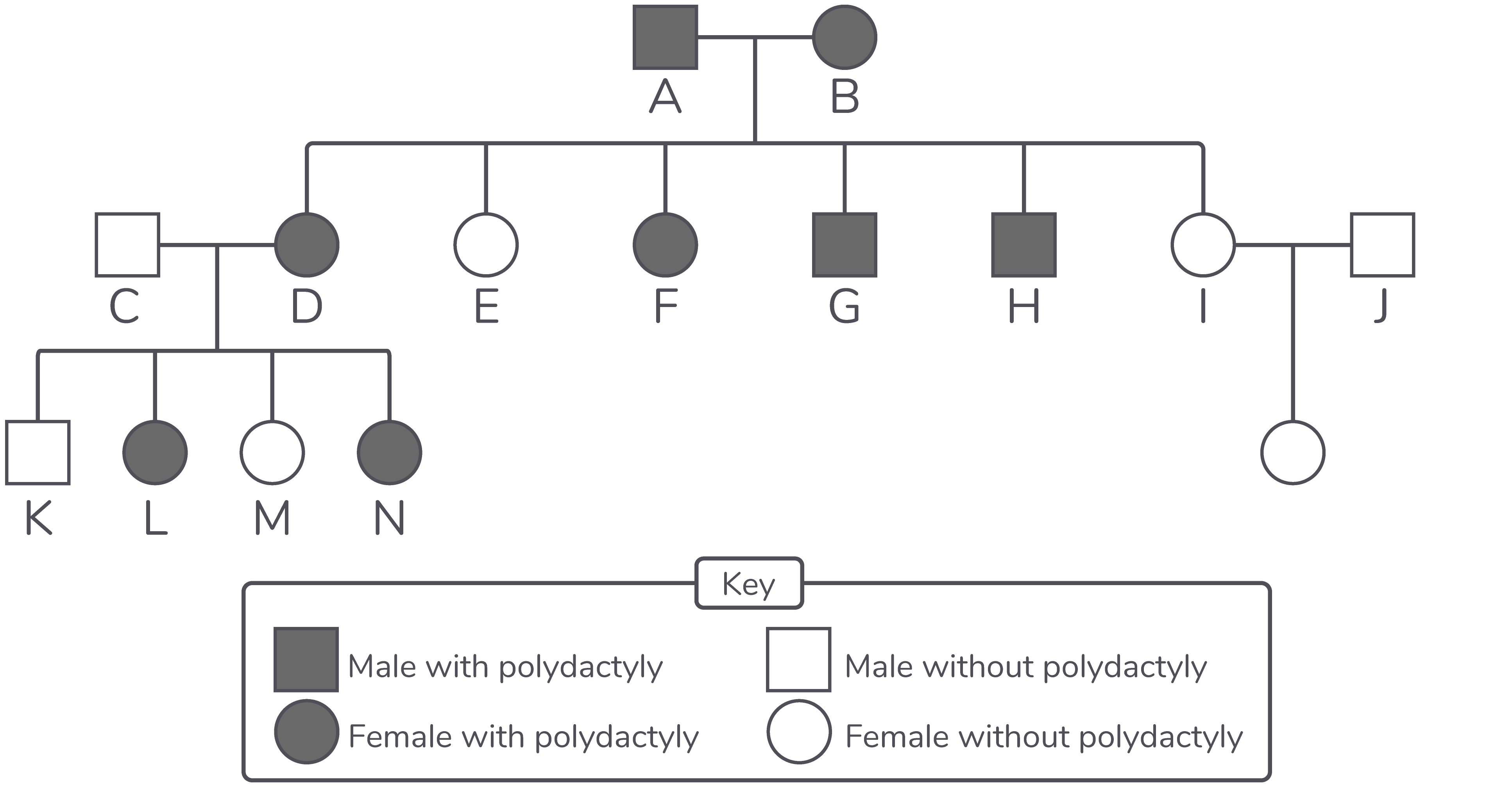
What proportion of the children of A and B have polydactyly?
Using parents A and B, and their offspring, explain the evidence which shows that the allele for the disorder is dominant.
Use the appropriate letters to identify individuals in your answer.
Cystic fibrosis is a condition that causes sticky mucus to build up in the lungs and digestive system.
It is caused by a recessive allele.
What is an allele?
What is meant by recessive?
Explain how someone can be a carrier of cystic fibrosis.
Draw a Punnet Square between a mother and father who are both carriers.
Use it to calculate the probability of having a child with cystic fibrosis.
Use the following symbols in your explanation:
c = cystic fibrosis allele
C = normal allele
Human sex chromosomes are represented by the letters X and Y.
Doctors take a blood sample from a pregnant woman and extract the baby's DNA from the mother's blood.
The baby's DNA is tested to see which chromosomes are present.
Which conclusion is correct?
The Punnett square below shows the inheritance of sex in humans.
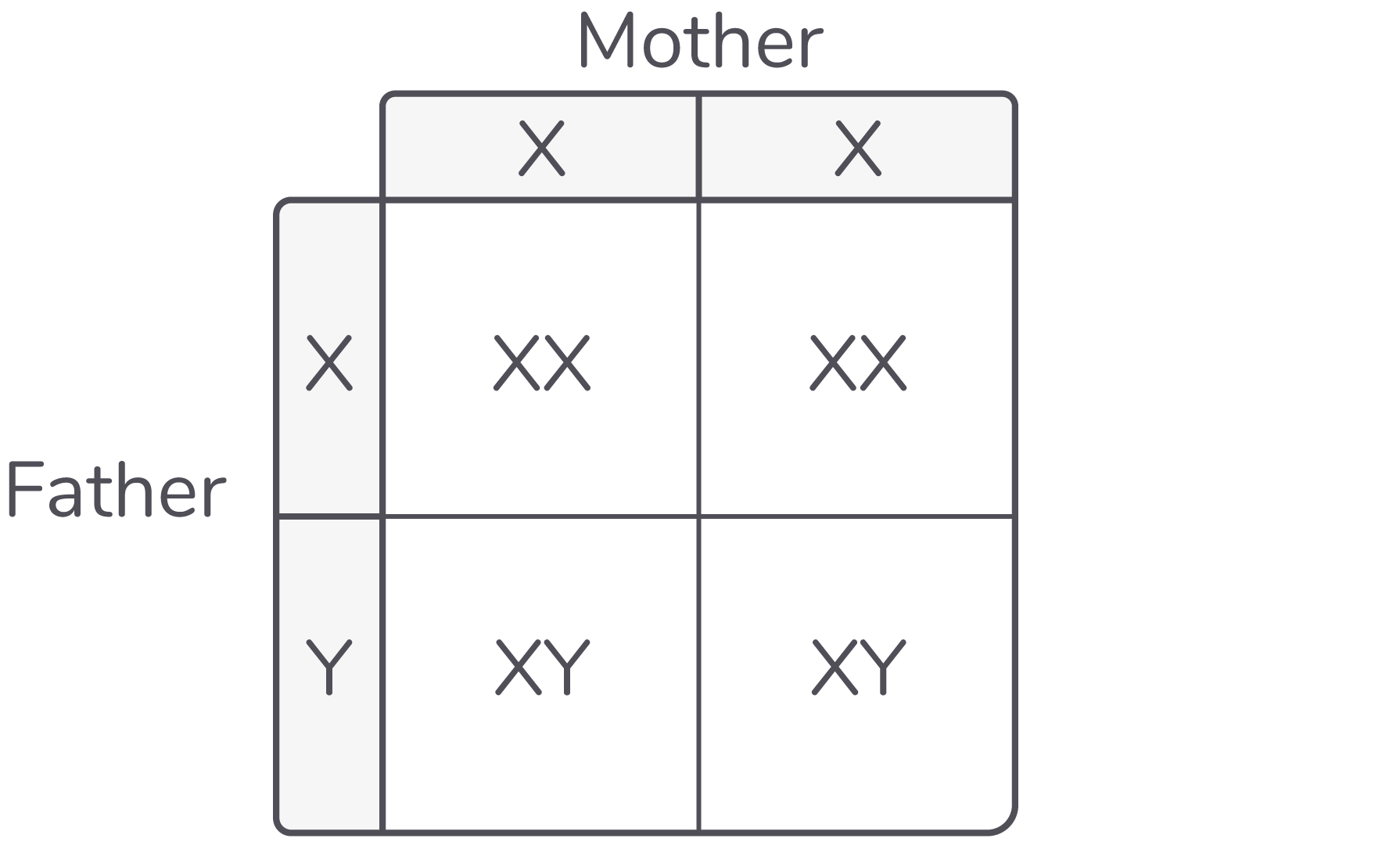
Give the genotype of:
- male offspring
- female offspring
A man and a woman have three daughters.
The woman is pregnant with a fourth child.
What is the chance that this child will also be a girl?
Explain how sperm determine the sex of offspring at fertilisation.
The allele for blood group A (IA) and the allele for blood group B (IB) are codominant.
The allele for blood group O (i) is recessive.
Define the word codominance.
Give the possible genotypes for someone with blood group A.
A woman with blood group O had a baby with a man with blood group AB.
Complete a Punnett square representing this cross.
Determine, using the Punnett square, the percentage probability that the child may have each of the four ABO blood types.