6.1 - Homeostasis
What homeostasis is, and the control-system model
- Homeostasis is the maintenance of a constant internal environment - regulating conditions inside the body and its cells to keep them steady in response to internal and external changes.
- It's important because cells only work properly within a narrow range of conditions.
- In particular, the enzymes that drive the body's reactions need the right temperature and pH - if conditions drift too far from normal it can be dangerous to health.
- Keeping conditions steady means responding to internal and external change while balancing what enters the body against what leaves it.
Conditions that must be kept steady
- Body temperature
- The concentration of glucose in the blood
- The body's water content
Each is kept near its normal level by an automatic control system, using both nervous and hormonal communication.
The three components of a control system
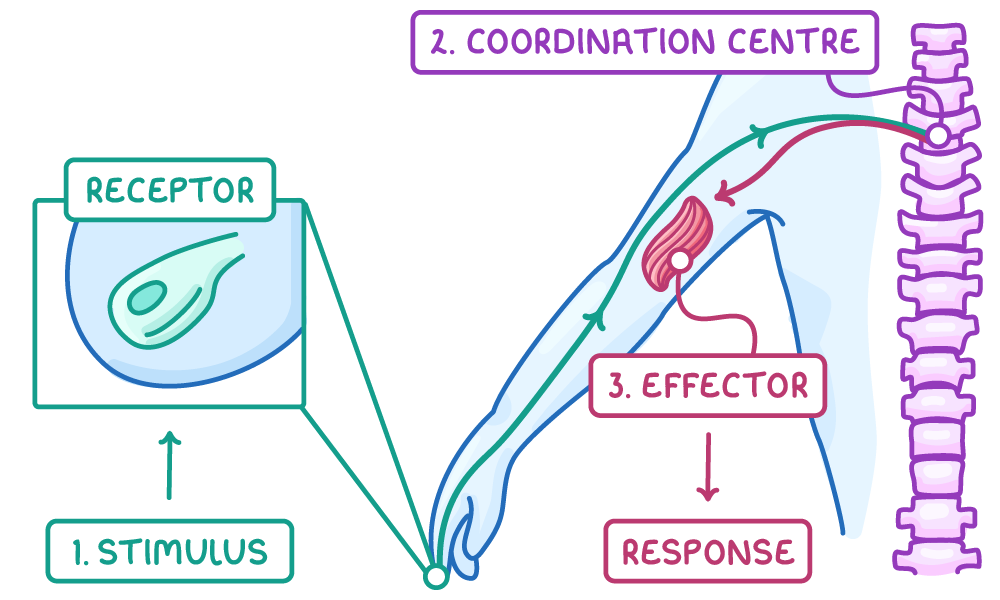
- Receptors - Cells that detect a change (a stimulus), e.g. a change in temperature or blood glucose. They can be on their own or grouped inside a larger sense organ.
- Coordination centre - Receives the information from the receptors, processes it, and decides on the response. Examples: the brain, the spinal cord, and the pancreas.
- Effectors - Carry out the response that counteracts the change. Effectors are muscles (which respond by contracting) or glands (which respond by secreting a substance such as a hormone).
Every coordinated response needs all three
- A stimulus is detected by a receptor.
- The coordination centre processes the information.
- The effector acts to counteract the change.
This same three-box pattern - receptor → coordination centre → effector - is shown below, and it lies behind every example of homeostasis, whatever condition is being controlled.
TermDefinition
Homeostasis
Stimulus
Receptor
Coordination centre
Effector