10.3 - Human Reproduction & Pregnancy
The male reproductive system
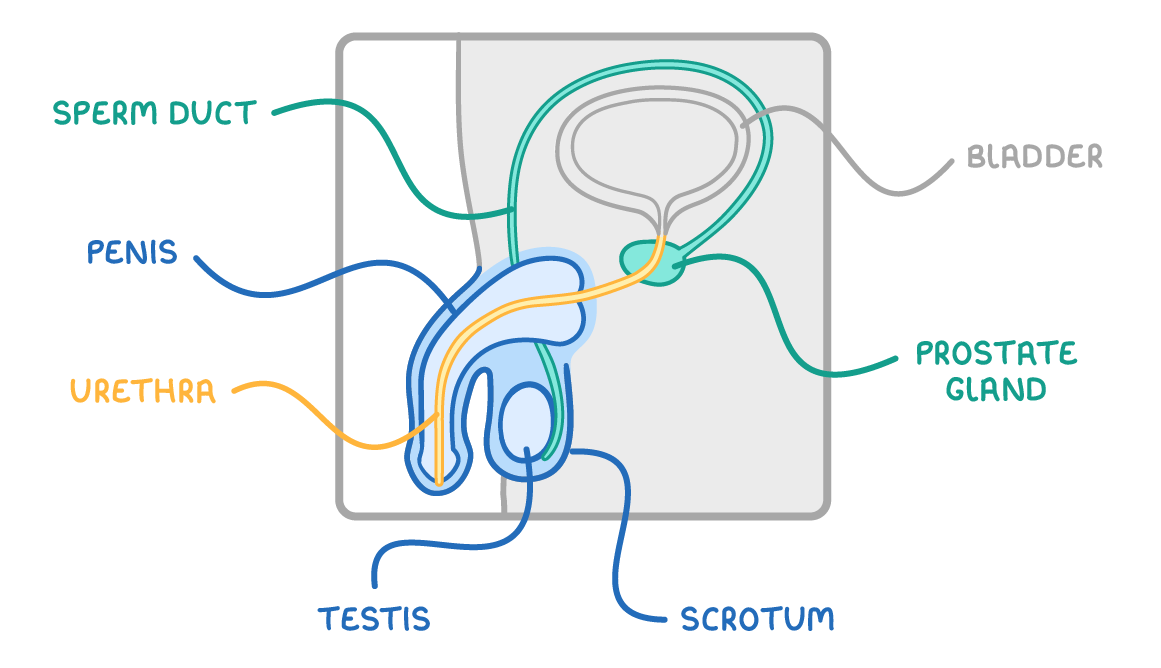
- The male reproductive system makes sperm (the male gametes) and delivers them into the female.
- It is made up of several parts, each with its own job.
Making and storing sperm
- Sperm are made in the testes.
- The two testes are held in the scrotum - a sac of skin that hangs behind the penis.
- Keeping the testes outside the main body keeps them slightly cooler than body temperature, which is the condition sperm need to be made.
Delivering the sperm
- Sperm ducts (sperm tubes) - Muscular tubes that carry sperm from the testes towards the urethra.
- Prostate gland - Adds a fluid that nourishes the sperm. The mixture of sperm and this fluid is called semen.
- Urethra - The tube running through the penis. It carries semen out of the body during ejaculation, and also carries urine out from the bladder at other times.
- Penis - Stiffens when it fills with blood, which lets it place sperm inside the female.
Female reproductive system, fertilisation, implantation
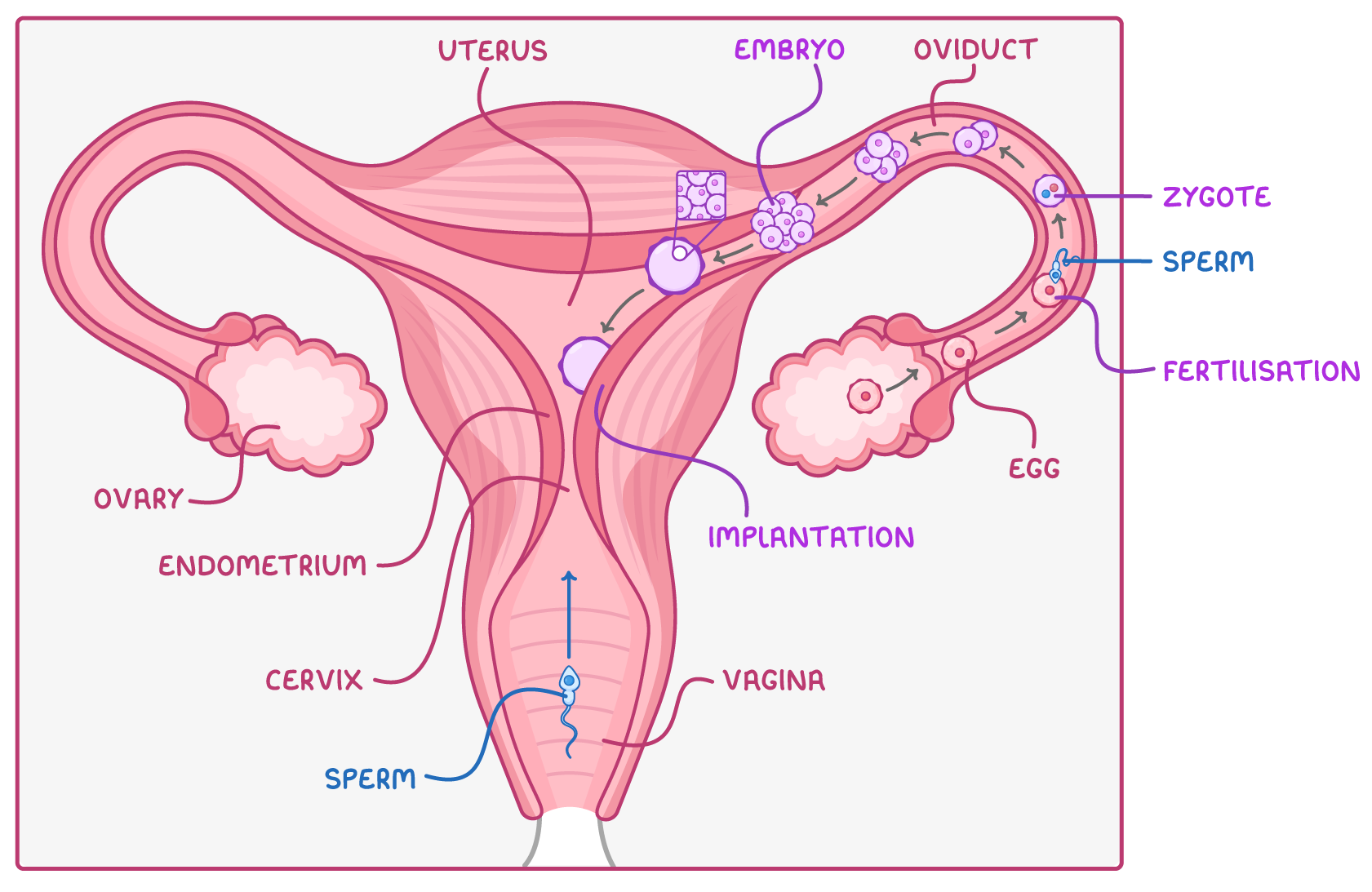
- The female reproductive system produces egg cells, holds and nourishes a developing baby, and is where fertilisation takes place.
- It is made up of several parts, each with its own job.
Parts of the female reproductive system
- Ovaries - Two organs that make the egg cells (ova) and also produce the sex hormones. Each month an egg is released from an ovary.
- Oviduct - A muscular tube that carries the released egg towards the uterus.
- Uterus - The organ in which an embryo can grow and develop.
- Cervix - The neck of the uterus, at its lower narrowed end; it opens into the vagina and widens during birth to let the baby pass through.
- Vagina - Where sperm are deposited; they then swim up through the cervix and uterus into the oviducts.
Fertilisation and implantation
Fertilisation happens in the oviduct.
- A sperm reaches an egg there, and the nucleus of the sperm fuses with the nucleus of the egg cell to form a single new cell called a zygote.
- Within about four days the zygote divides several times to form an embryo - a small ball of cells.
- This ball of cells travels down the oviduct to the uterus and implants into the soft, thick lining of the uterus (the endometrium), which has a good blood supply to support the implanted embryo.
This implantation marks the start of a pregnancy.
Pregnancy - The placenta and exchange across it
- After the embryo implants in the lining of the uterus, structures develop to nourish and protect it as it grows.
- At about nine weeks after fertilisation, once it starts to look human, the developing baby is called a foetus.
Structures that support the foetus
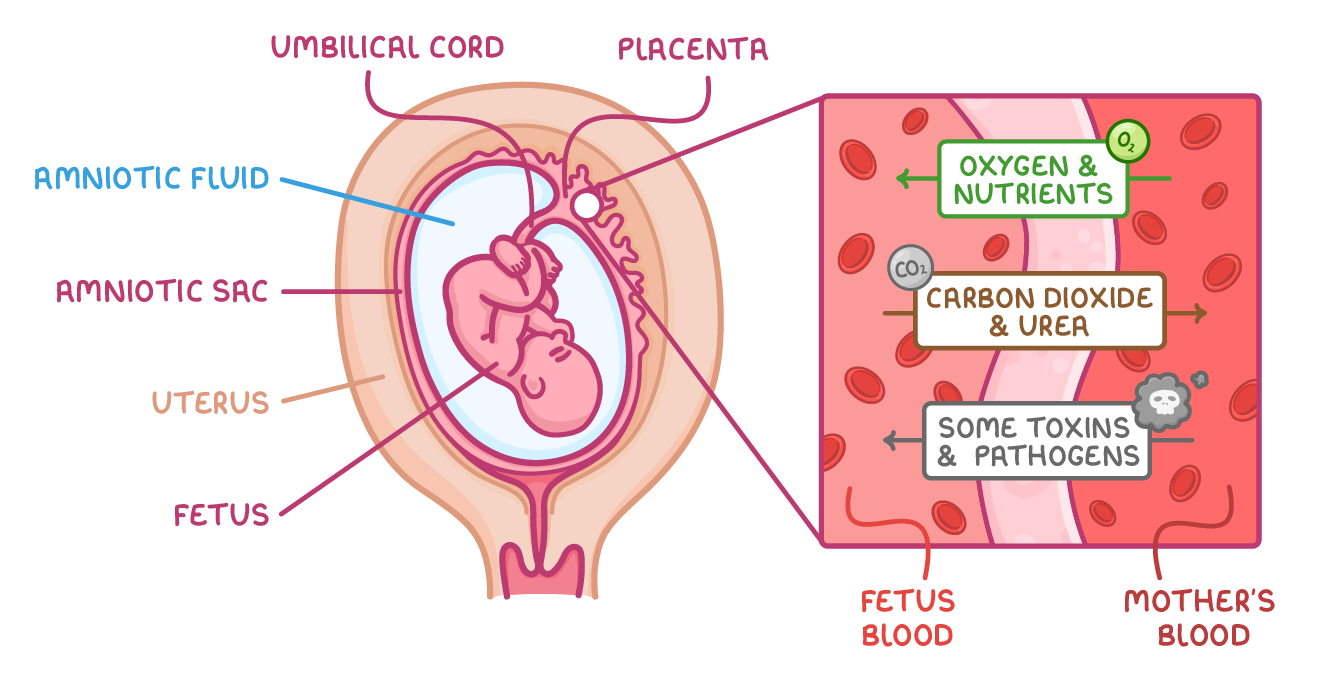
- Placenta - An organ that grows in the wall of the uterus. It is the organ of exchange between the mother's blood and the foetus's blood, with a large surface area so substances pass across quickly by diffusion.
- Umbilical cord - Joins the placenta to the foetus. Substances are carried to and from the foetus in its blood vessels.
- Amniotic sac - A membrane surrounding the foetus, filled with a watery liquid called amniotic fluid.
- Amniotic fluid - Protects the foetus from knocks and bumps, supports its weight as it grows, and lets it move around.
Exchange across the placenta
- The placenta's surface is folded into many finger-like projections called villi, which push into the wall of the uterus and give it a very large surface area.
- The villi bring the foetus's blood and the mother's blood very close together, but the two blood supplies do not mix.
- With only a thin barrier between them, substances pass quickly from one blood supply to the other by diffusion:
- To the foetus - Oxygen and dissolved nutrients (glucose and amino acids) supply food and the oxygen it needs.
- From the foetus - Waste substances, carbon dioxide and urea, pass back to the mother.
The placenta as a barrier
- The placenta keeps most harmful substances out, but it does not stop everything.
- Some harmful substances - such as alcohol, nicotine, and certain drugs - and some pathogens can cross from the mother to the foetus, where they can harm the developing baby.
TermDefinition
Semen
Zygote
Embryo
Foetus
Placenta
Amniotic fluid