6.6 - Regulating Blood Glucose
Why blood glucose is controlled
Body cells need the amount of glucose (a sugar) in the blood kept steady - too much or too little stops cells working properly and can be dangerous to health.
How glucose enters and leaves the blood
- Glucose in - Enters the blood from the gut whenever carbohydrate-containing food is digested and absorbed in the small intestine.
- Glucose out - Removed by the normal metabolism of cells, which use glucose in respiration; much more is removed during vigorous exercise.
Storing excess glucose
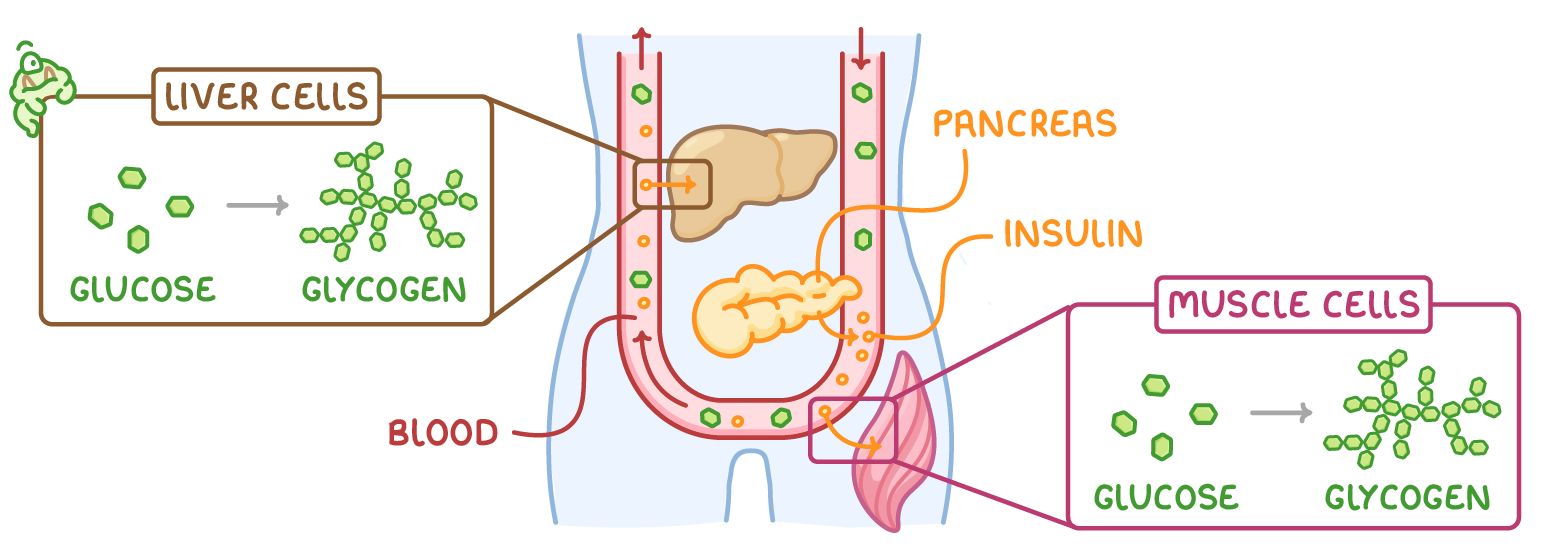
- Excess glucose is converted to glycogen (a storage carbohydrate) and kept in the liver and the muscles.
- Once those stores are full, the rest is stored as lipid (fat) in the tissues.
The pancreas monitors blood glucose
- Because glucose is constantly going into and out of the blood, its concentration would swing up and down without a control system.
- The pancreas does the controlling: it constantly monitors the concentration of glucose in the blood and responds to keep it within a narrow, healthy range.
Insulin lowers blood glucose
- When blood glucose concentration rises too high - for example after a meal containing carbohydrate - the pancreas detects the change.
- The pancreas responds by secreting the hormone insulin (a protein) into the blood.
- Insulin travels in the blood to its target organs: the liver and the muscles.
How insulin lowers blood glucose
- Insulin makes glucose move out of the blood and into the liver and muscle cells.
- In these cells, the glucose is used:
- Some is respired
- The excess is converted into glycogen and stored
- Because glucose is taken out of the blood and locked away as glycogen, the blood glucose concentration falls back towards normal.
- The key point about insulin is that it lowers blood glucose concentration - it brings a high level down, rather than simply "controlling" it.
Controlling blood glucose by negative feedback
- The pancreas keeps blood glucose steady by negative feedback - whenever the level moves away from normal, a response is triggered that pushes it back towards normal.
- The hormone insulin is the example of this control.
- The amount of insulin released is set by the concentration of glucose in the blood: a high level calls for more insulin, a level back at normal calls for less.
- This keeps the glucose concentration from deviating too far from its normal value - exactly what a negative-feedback mechanism does. Many of the body's negative-feedback mechanisms are controlled by hormones in this way.
The insulin feedback loop
- Blood glucose concentration rises.
- The pancreas increases the rate at which it produces insulin.
- The extra insulin causes the liver and muscle cells to take glucose out of the blood, so the concentration falls.
- As the concentration falls back, the pancreas reduces the amount of insulin it produces.

TermDefinition
Glycogen
Pancreas
Insulin
Negative feedback