1.8 - Binary Fission
How bacteria divide by binary fission
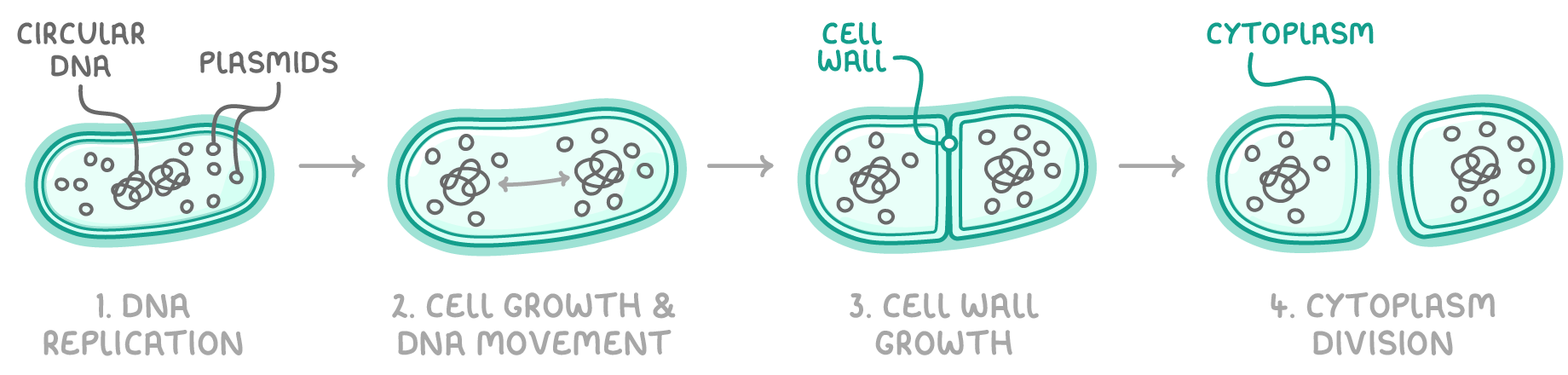
- Bacteria are prokaryotic cells, and they reproduce by a simple type of cell division called binary fission.
- Instead of a nucleus, a bacterium has a single loop of circular DNA floating in its cytoplasm.
- It may also carry one or more small rings of DNA called plasmids.
The stages of binary fission
- The bacterium copies its circular DNA, and copies any plasmids it has.
- The cell grows larger, and the copies of the circular DNA move to opposite ends (the two "poles") of the cell.
- The cytoplasm starts to divide and new cell walls begin to form across the middle.
- The cytoplasm divides completely and the cell splits in two, producing two daughter cells.
Each daughter cell receives one copy of the circular DNA, and a variable number of copies of any plasmids.
How quickly bacteria divide
- Given the right conditions, bacteria can divide remarkably quickly.
- With enough nutrients and a suitable, warm temperature, some bacteria such as E. coli can divide as often as once every 20 minutes.
- If conditions turn unfavourable - too little food, or the wrong temperature - the bacteria stop dividing and eventually begin to die.
Calculating bacterial numbers after a time
- The mean division time is the average time for one bacterium to divide into two.
- If you know it, you can work out how many bacteria a single cell produces in a given period, in two steps:
- Number of divisions = total time ÷ mean division time (both in the same units).
- Number of bacteria = 2 raised to the power of the number of divisions - because each cell splits into two every division.
Writing large counts in standard form
- Standard form writes a number as a value between 1 and 10 multiplied by a power of 10.
- Move the decimal point so the first part lies between 1 and 10, then count the places it moved to get the power of 10.
- Very large bacterial counts are usually written this way to keep them manageable, and rounded to 2 significant figures for an exam answer.
Worked example - Bacteria after 5 hours
One bacterium divides every 20 minutes and has enough nutrients at a suitable temperature for 5 hours. Calculate the number of bacteria produced, giving your answer in standard form to 2 significant figures.
Step 1 - Convert to the same units
5 hours = 5 × 60 = 300 minutes
Step 2 - Number of divisions
300 ÷ 20 = 15
Step 3 - Number of bacteria
215 = 32,768
Step 4 - Give it in standard form
Move the decimal point four places to the left:
32,768 = 3.2768 × 10⁴
Rounded to 2 significant figures, the number of bacteria is:
3.3 × 10⁴
TermDefinition
Binary fission
Mean division time