Reproduction - exam practice
Reproduction
Question 1 of 10
The diagram shows some of the stages involved in the making of a human foetus.
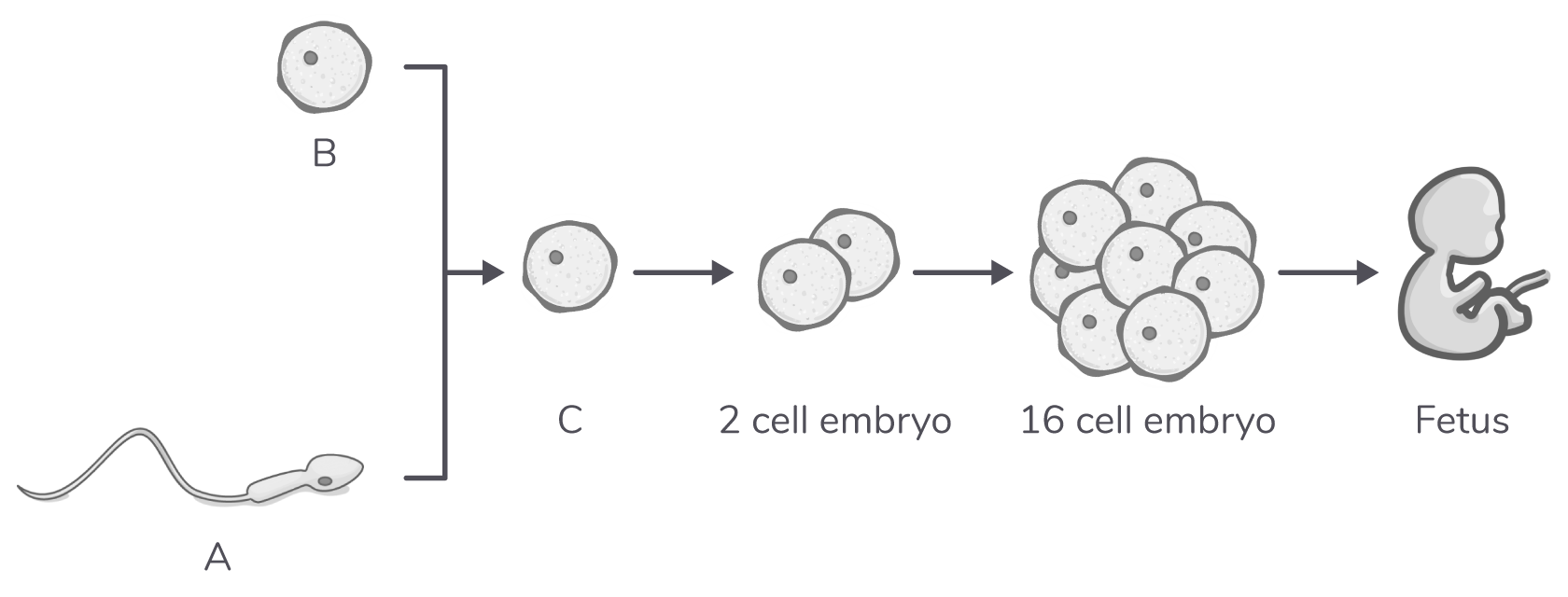
Name the structures labelled A, B and C.
C divides into two cells in 15 hours.
The cells continue to divide to form an embryo.
What is the name of the type of cell division by which the zygote divides?
Calculate the amount of time it takes the zygote to form an embryo with 16 cells.
Scientists measured the mass of DNA contained in structure C.
The mass of DNA was 0.0064 nanograms.
Calculate the mass of DNA in structure A.
Use the diagram and your own knowledge to describe the processes that take place in the formation of a foetus from a sperm cell and an egg cell.
Gametes are needed for human sexual reproduction.
Name the two human gametes.
Name and describe the type of cell division that produces gametes.
Which process results in the production of a zygote?
State the number of chromosomes in:
A human skin cell.
A human gamete.
A human zygote.
Some organisms can reproduce by sexual and asexual reproduction.
Examples include fungi, certain plants like strawberries, and the malaria parasite.
Give three advantages of asexual reproduction.
Give one advantage of sexual reproduction.
A gardener wants to produce a new variety of strawberry.
Explain why sexual reproduction could produce a new variety of strawberry.
Two cats reproduce by sexual reproduction and have a litter of kittens.
In sexual reproduction the male and female gametes join together.
What is the name for this process?
Which one of these statements about asexual reproduction is incorrect?
Which one of these statements about sexual reproduction is incorrect?
When the kittens grow up they will look similar to their parents but they will not be identical to either parent.
Explain why:
- The kittens will look similar to their parents
- The kittens will not be identical to either of their parents.
Complete the passage about reproduction in humans.
During sexual intercourse the male’s is inserted into the female's vagina.
The male gametes, known as , are released from the male urethra into the vagina and swim to the female gamete, called the , through a tube called the .
Each gamete has the haploid number of chromosomes, which is 23 in humans.
The gametes join in a process called .
The single cell produced is called a , contains the number of chromosomes, and becomes implanted in the wall of the .
This cell divides by into an embryo. Each cell in the embryo contains chromosomes.
In sexual reproduction, a sperm cell fuses with an egg cell to form a new zygote.
The zygote undergoes cell division and develops into an embryo.
What type of cell division produces an embryo from a zygote?
How many cells are there in the embryo after 5 cell divisions?
Sexual reproduction requires meiosis to occur.
Define the term 'meiosis'.
Explain why meiosis is essential to the survival of endangered species.
Describe how cell division by meiosis is different from cell division by mitosis.
The diagram shows how the mass of DNA (m) changed during cell division in one cell.

Name the type of cell division taking place in this cell.
The diagram shows the nucleus of the cell at the start of this type of cell division.
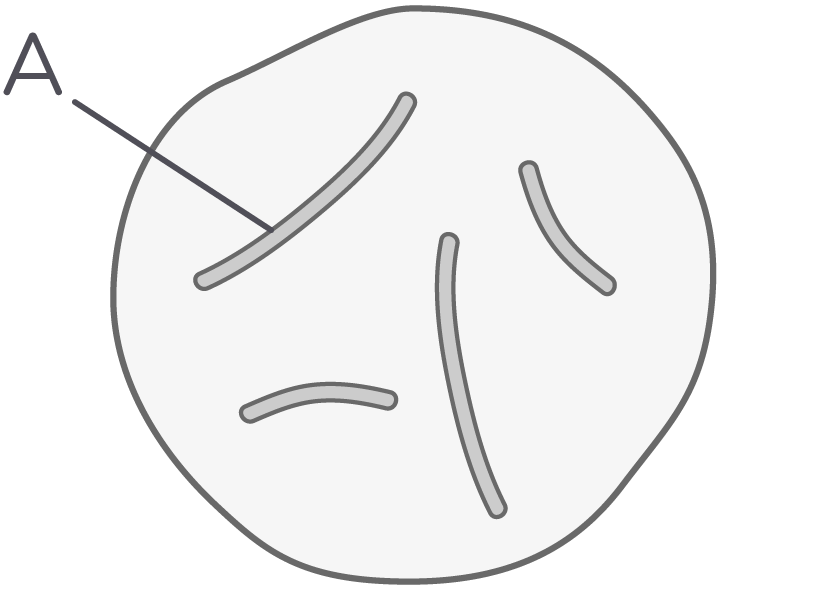
Name structure A.
Before this type of cell division can happen, the DNA in the nucleus is duplicated.
The nucleus then divides twice to form four nuclei.
Complete the diagram below to show the appearance of the nucleus of one of the four daughter cells.
A woman saved tomato seeds from a tomato she ate.
She planted the seeds in her garden.
The tomato plant she grew produced tomatoes.
The tomatoes from the new plant did not taste like the original tomato the woman ate.
Explain why.
The woman was told that tomato plants can be reproduced so that the tomatoes from the new plants will taste the same as the tomatoes from the parent plants.
Give one method she can use to reproduce tomato plants in this way.
Explain why the method you have suggested will produce tomatoes that taste the same as the tomatoes from the parent plants.
Mitosis and meiosis are two different types of cell division.
Compare these two types of cell division.