Brain & Eyes - exam practice
Brain & Eyes
Question 1 of 8
Short-sightedness is a very common eye condition where you cannot see objects clearly if they are far away.
In order to see a clear image, the light rays must enter the eye and focus on one structure in the eye.
Name the structure.
Explain why a short-sighted person has difficulty seeing distant objects clearly.
Short-sightedness can be corrected by wearing glasses or contact lenses.
Describe how glasses and contact lenses can correct short-sightedness.
A student has devised the hypothesis 'People with blue eyes are more likely to be short-sighted than people with green eyes'.
Design an experiment to test this hypothesis.
A girl is reading a book in her garden.
The girl looks up from her book, to look at a bird in the distance.
What process happens in the girl's eye when she looks from the book to the distant bird?
The girl's vision of the bird is not clear, it appears blurry to her.
Suggest which common eye defect the girl suffers from.
The girl starts reading her book again.
Explain how the girl’s eye adjusts to form a clear image of the book.
The diagram below shows the structure of the human eye.
Label parts A-H.
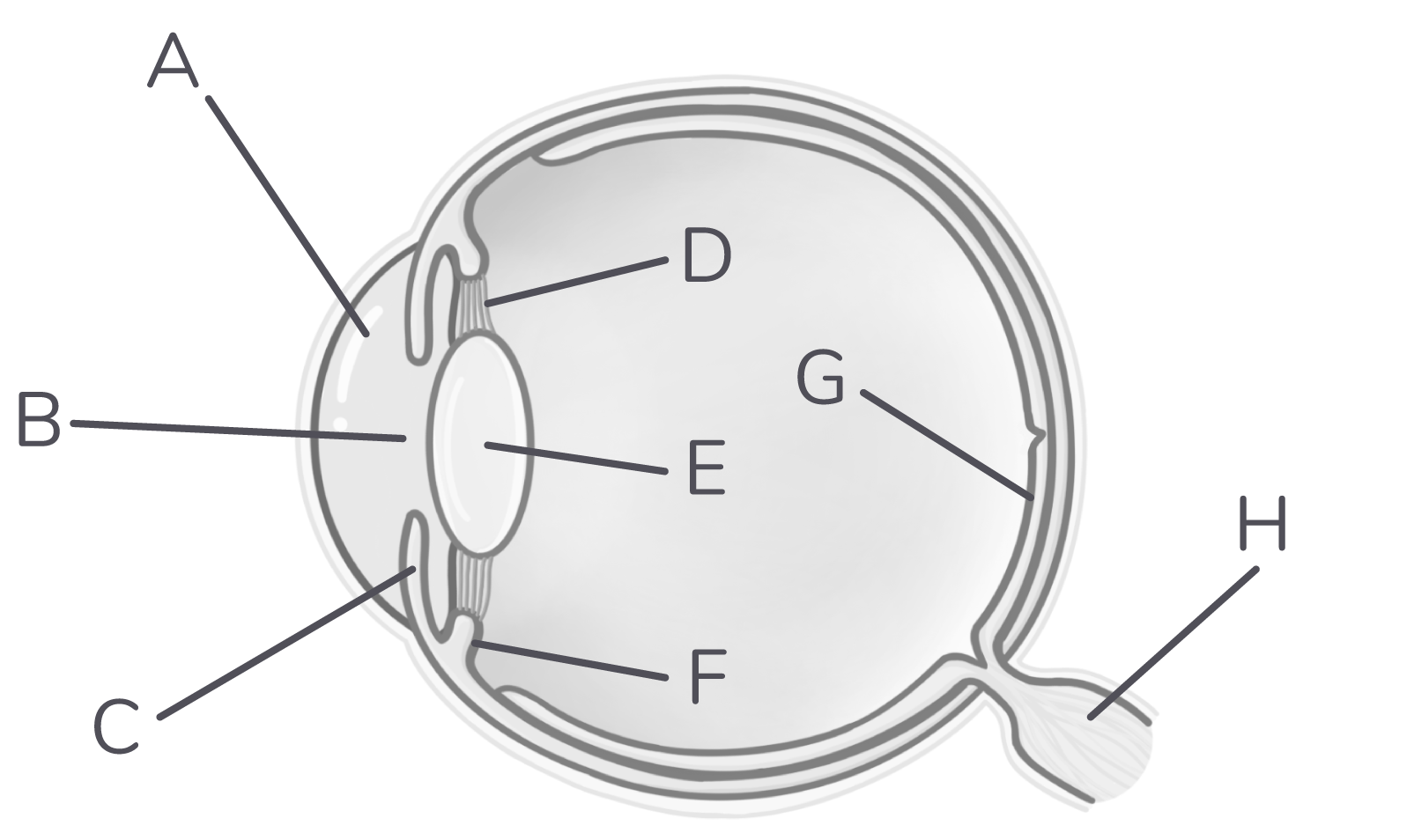
State which part of the eye performs the following functions:
Carries impulses to the brain.
Focuses light onto the back of the eye.
Detects light and colour.
A boy was in a well lit room when there was a power cut and the room went dark.
Diagram A shows one of the boy’s eyes in the well lit room and diagram B shows the boy's eye after the power cut.
Explain how this change happens.
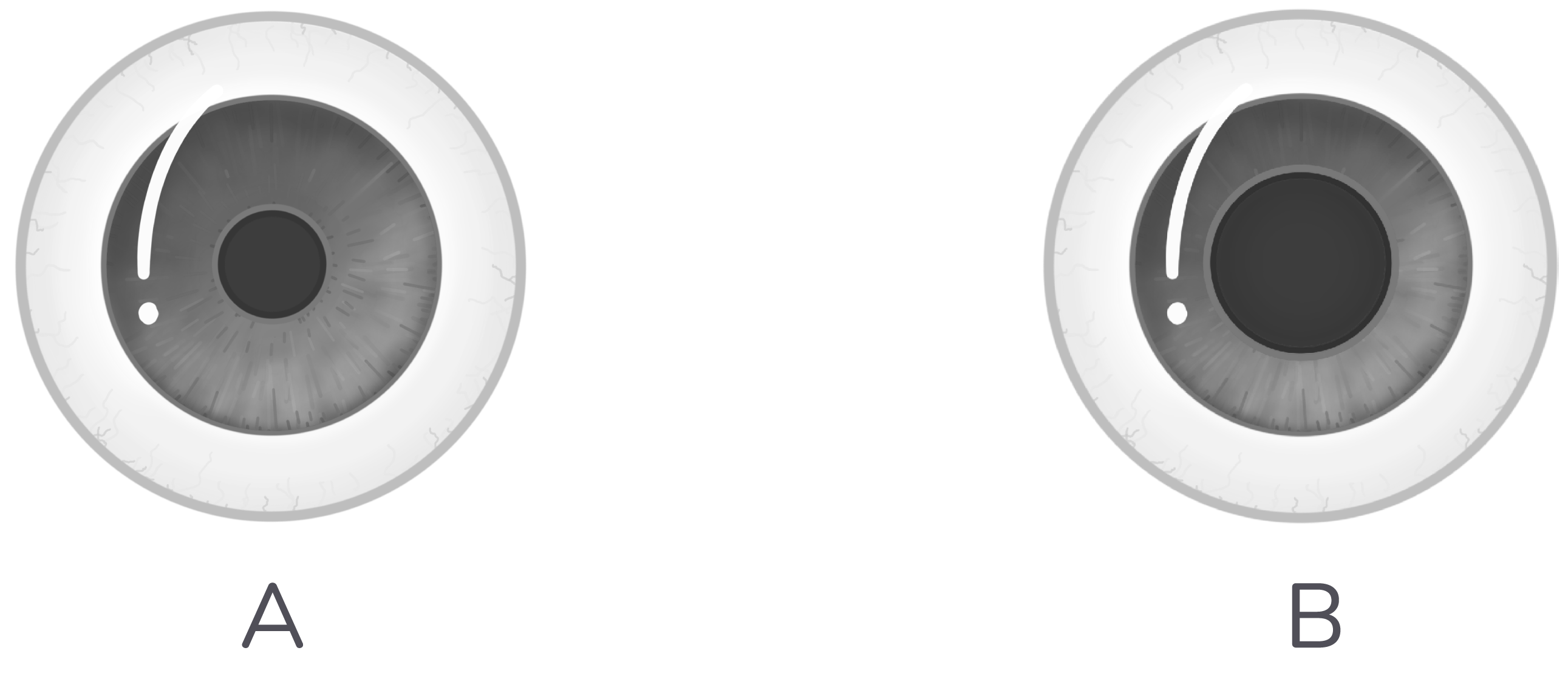
The diameter of the boy's pupils changed with the light intensity.
What is this an example of?
Suggest why blinking of the eyes is coordinated by nerves and not hormones.
The optic nerve carries information from the eye to the occipital lobe of the brain.
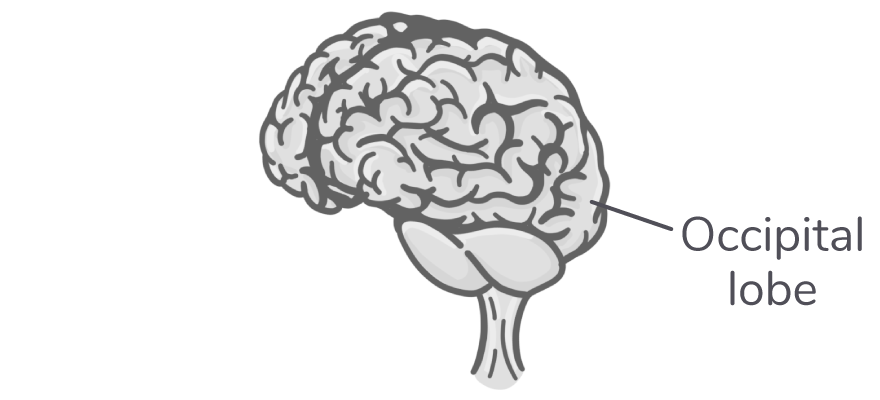
Which part of the brain contains the occipital lobe?
Describe how information travels from light receptors in the retina to the brain.
State the sense most likely to be affected if the occipital lobe is damaged.
Eye tests can sometimes detect brain tumours.
State one other way that brain tumours can be detected.
Describe why a brain tumour is difficult to treat.
The diagram below shows the human brain.
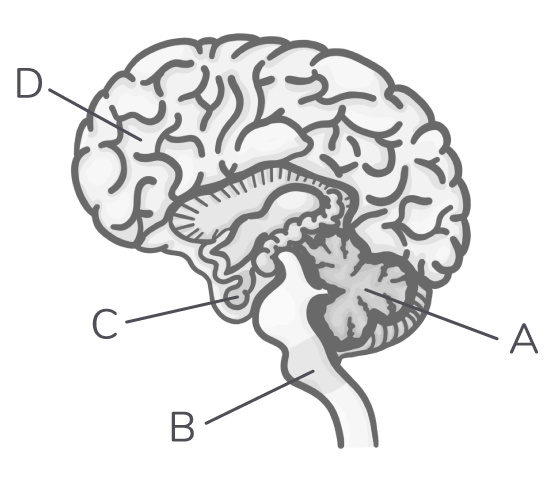
Give the letter from the diagram above, and the name of the part of the brain responsible for:
Unconscious activities such as your heartbeat and breathing
Coordination and balance
Memory and language
When someone goes for a run, their body temperature increases.
Name the part of the brain that monitors a person's body temperature, and explain how body temperature is monitored by the brain.
A cataract is a cloudy area in the lens of your eye.
Cataracts are common as you get older.
Suggest how a cataract would affect the ability to see clearly.
In the UK, there are 11 million people over 65 years old.
It is estimated that 30% of people over the age of 65 have a cataract.
Calculate the number of people in the UK over the age of 65 who develop a cataract.
The eye can respond to changes in light intensity.
Where in the eye are the cells that detect the change in light and cause this response?
Explain the changes that take place in the pupil as a person moves from a bright area into a dark area.
Investigating brain function may involve a variety of different techniques:
- Recording of the brain externally using EEG.
- Scanning the brain using CAT and MRI.
- Case studies of humans with accidental damage.
- Deliberate damage during experiments with animals.
Evaluate the reasons why understanding of brain function has increased but also why there are still many challenges surrounding research and treatment of the brain.
One way that scientists can study the brain is to use patients with brain damage.
Suggest why there are concerns about using patients with brain damage.
A functional MRI (fMRI) scan shows which parts of the brain are activated when certain tasks are carried out such as those related to language, memory and movement.
Whilst in most MRI scanners the person being scanned needs to stay completely still, a functional MRI (fMRI) scanner allows the person to move while the scanner makes images of the brain activity.
Suggest how the fMRI scanner could help to find out more about the brain damage a person has.