2.9 - Cardiovascular Disease
Coronary heart disease
- The coronary arteries branch from the base of the aorta and run over the surface of the heart, supplying the heart muscle itself with oxygen-rich blood so it can keep contracting.
- Coronary heart disease is what happens when these arteries become blocked.
How the arteries become blocked
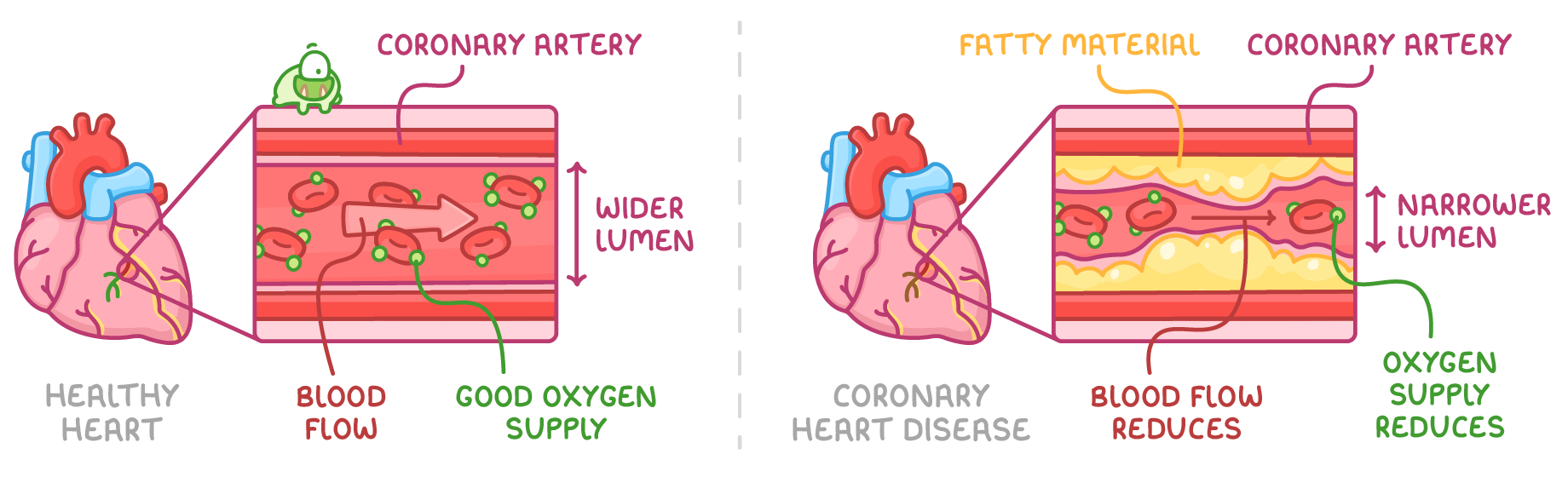
- Over time, layers of fatty material build up on the inside walls of the coronary arteries.
- This narrows the space inside them (the lumen), so blood flow through the arteries is restricted and less oxygen reaches the heart muscle.
- The heart muscle needs a constant supply of oxygen to respire and keep working, so this lack of oxygen puts the heart under strain.
Heart attacks and strokes
- The fatty deposits can harden and damage the artery wall. A piece breaking off can trigger a blood clot.
- If a clot blocks a coronary artery completely, the heart muscle beyond the blockage is cut off from blood altogether, causing a heart attack - part of the heart muscle is starved of oxygen and its cells die.
- The same kind of blockage can happen in the blood vessels supplying the brain. There it cuts off oxygen to the brain cells, which die, resulting in a stroke, with reduced brain function.
- A number of risk factors, including smoking, raise a person's chance of developing the disease.
Risk factors for cardiovascular disease
- Coronary heart disease has no single cause - instead, a number of risk factors raise a person's chance of developing it.
- A risk factor is something linked to a greater likelihood of getting a disease, without guaranteeing it.
Lifestyle (controllable) risk factors
- A diet high in saturated fat and salt
- Smoking
- Stress
- Drinking too much alcohol
- A lack of exercise
How some of these raise the risk:
- Too much saturated fat raises the level of cholesterol in the blood.
- High cholesterol and high blood pressure both encourage fatty deposits to form in the arteries.
- Smoking raises blood pressure and damages the artery walls.
Fixed risk factors
- Getting older
- Being male rather than female
- Inheriting certain genes
Lowering the risk
Reducing the controllable factors lowers the risk of the disease:
- Eating a diet low in saturated fat and salt
- Exercising regularly
- Not smoking
TermDefinition
Coronary artery
Coronary heart disease
Risk factor