2.1 - Leaf Structure
The leaf's tissues
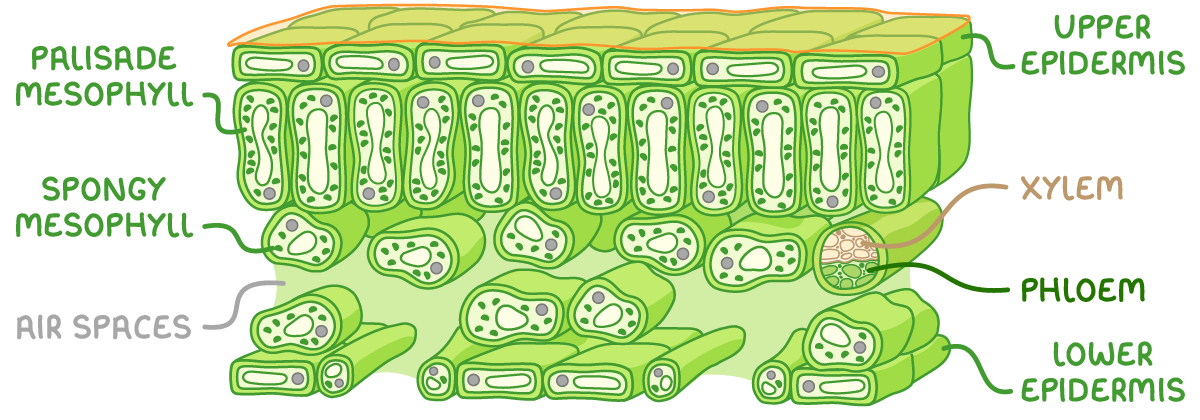
A leaf is a plant organ, built from several different tissues, each suited to a particular job.
Epidermis
- A thin layer of cells covering the top and bottom of the leaf.
- The upper epidermis is transparent, so light passes straight through it to the cells below.
- Apart from the guard cells around the stomata (pores), the epidermal cells contain no chloroplasts.
Palisade mesophyll
- Sits just under the upper epidermis.
- A layer of tall cells packed with chloroplasts.
- Because it's near the top of the leaf, it receives the most light - so this is where most photosynthesis happens.
Spongy mesophyll
- Sits below the palisade layer.
- A looser layer of more rounded cells with large air spaces between them.
- The air spaces let gases such as carbon dioxide and oxygen diffuse easily to and from the cells.
Vascular bundles
- Run through the leaf and make up the vein. They contain two transport tissues:
- Xylem - Delivers water and dissolved mineral ions to the leaf.
- Phloem - Carries away the sugars made in photosynthesis.
- The vascular bundles also help to support and hold the leaf together.
TermDefinition
Palisade mesophyll
Spongy mesophyll
Xylem
Phloem