2.3 - Rate of Photosynthesis
Limiting factors in photosynthesis
- The rate of photosynthesis isn't fixed - it rises and falls with the conditions around the plant.
- A limiting factor is the factor in shortest supply at that moment, so it's the one holding the rate back.
- Increasing the limiting factor raises the rate; increasing any other factor makes no difference until the limiting one is raised.
- Which factor is limiting depends on the surroundings:
- At night - Light is limiting
- A cold winter day - Temperature is often limiting
- Warm and bright - Carbon dioxide is usually limiting
The three environmental factors
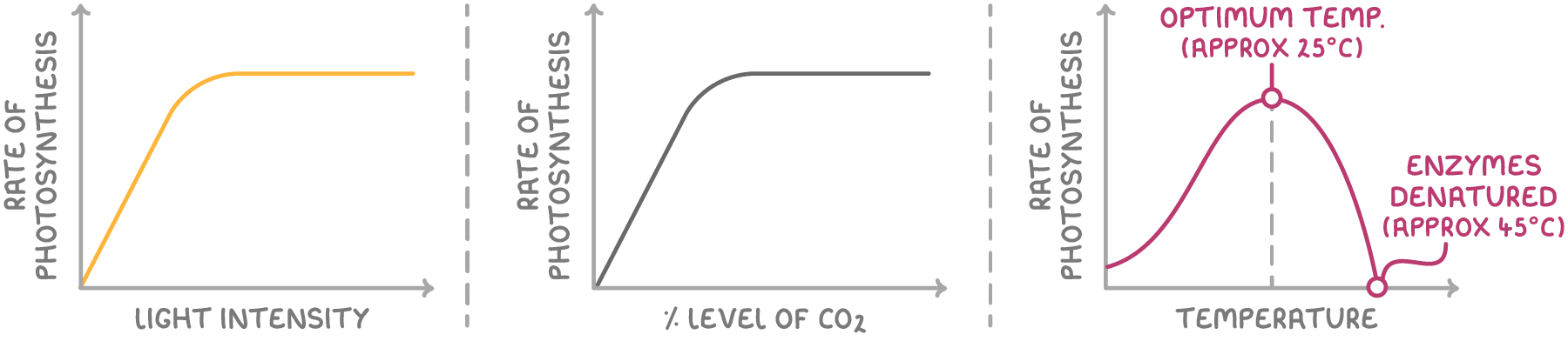
- Light intensity - Provides the energy for photosynthesis. Raising it from low increases the rate steadily, but only up to a point. Beyond that, more light makes no difference because temperature or carbon dioxide has become limiting instead. The rate-against-light-intensity graph climbs, then levels off at a plateau.
- Carbon dioxide concentration - A raw material of photosynthesis. Increasing it raises the rate up to a point, then the graph flattens - showing light or temperature is now limiting. Same rise-then-plateau shape as the light graph.
- Temperature - Affects the enzymes that control photosynthesis:
- In the cold, enzymes work slowly, so the rate is slow - this is usually why temperature is limiting.
- As temperature rises, the rate increases up to an optimum at around 25°C.
- Above the optimum the rate falls sharply, and by around 45°C the enzymes are denatured (their shape is destroyed) and the rate drops to zero.
- The rate-against-temperature graph therefore rises to a peak then drops steeply - unlike the light and carbon dioxide graphs, which plateau.
The amount of chlorophyll can also limit the rate
- Chlorophyll is the pigment that absorbs the light, so less chlorophyll means a reduced rate.
- Things that can damage chloroplasts or stop the plant making enough chlorophyll include:
- Disease - e.g. infection with tobacco mosaic virus
- Environmental stress - e.g. a shortage of nutrients
- With less chlorophyll, the plant can't absorb as much light, slowing photosynthesis.
Interpreting graphs with more than one limiting factor
- A single graph can show more than one factor limiting photosynthesis at once.
- Reading it tells you which factor is holding the rate back in each region of the graph.
Reading one line
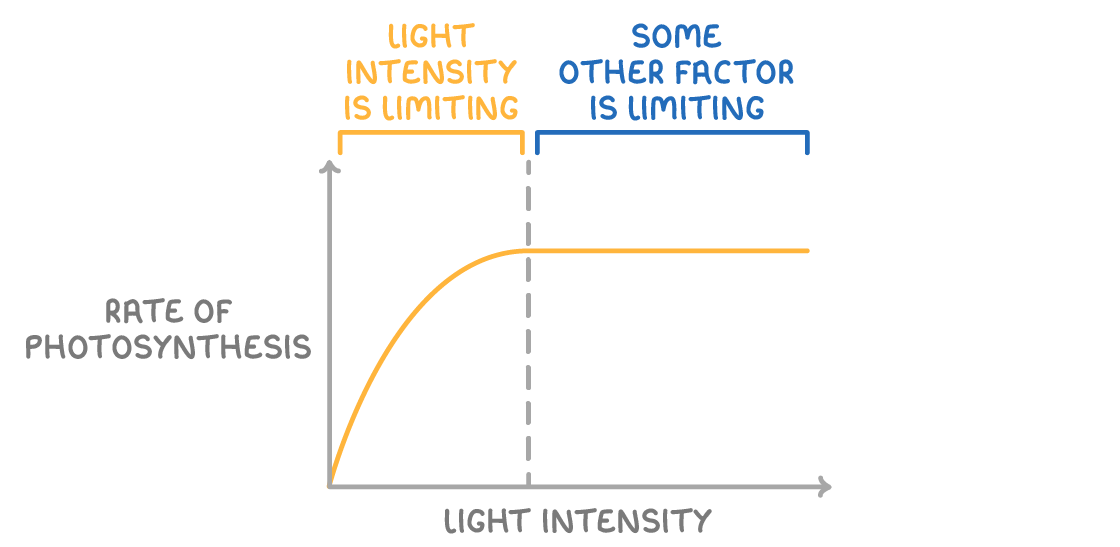
- Where a line is still rising, the factor on the horizontal axis is the limiting factor there.
- Where a line has levelled off (plateaued), some other factor has become limiting instead.
Comparing two lines - Temperature
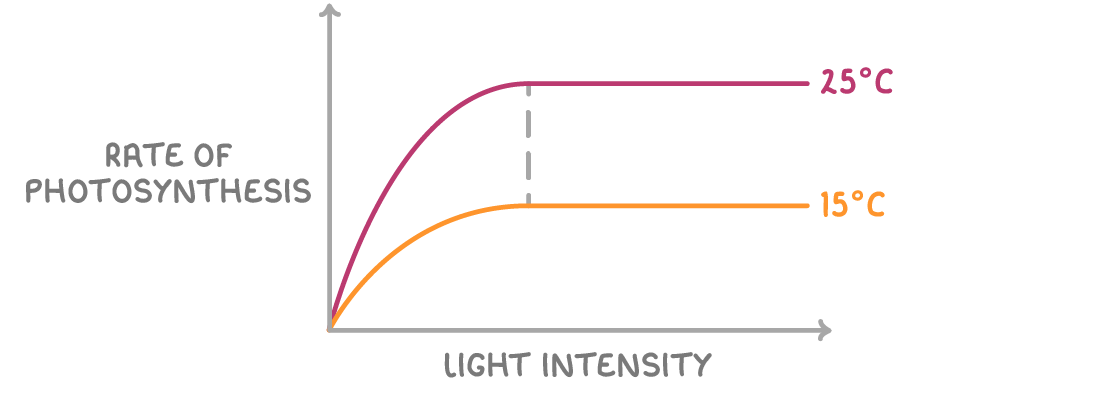
- Plot rate of photosynthesis against light intensity as two lines at two different temperatures, 15°C and 25°C.
- At low light intensity both lines rise together as light is increased - light is the limiting factor for both.
- Each line then levels off when light stops being limiting.
- The 25°C line levels off at a higher rate than the 15°C line.
- This shows temperature was the limiting factor for the cooler line: once light was plentiful, the 15°C plant couldn't go as fast because its lower temperature held it back.
Comparing two lines - Carbon dioxide
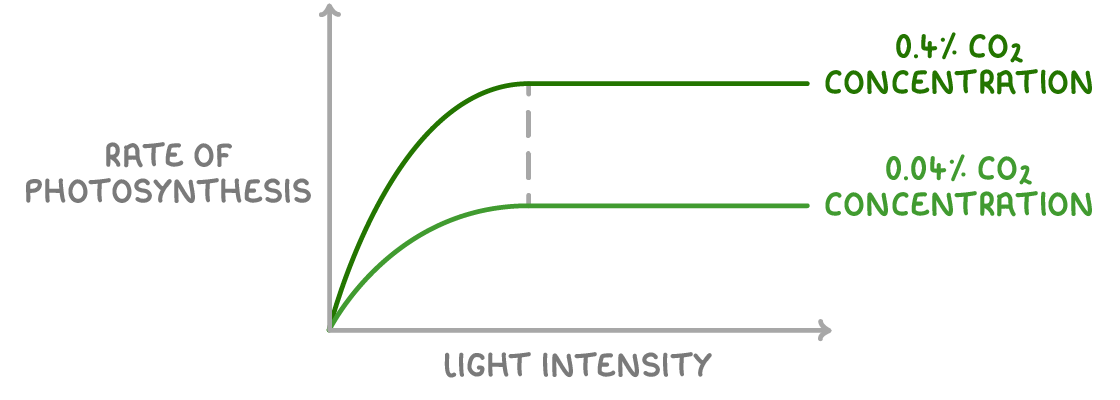
- Plot rate against light intensity as two lines at the same temperature but two different carbon dioxide concentrations, 0.4% and 0.04%.
- Both lines rise, then level off when light is no longer limiting.
- The line at the higher CO2 concentration (0.4%) levels off higher, so carbon dioxide was the limiting factor for the 0.04% line.
- Here the limiting factor can't be temperature, because both lines were at the same temperature.
The general method
- Find where a line is still rising - the factor on the horizontal axis is limiting there.
- Find where it has levelled off - another factor has become limiting.
- Compare the heights of the plateaus to spot which factor differs between the lines - that is the one limiting the lower line.
Controlling greenhouse conditions for maximum yield
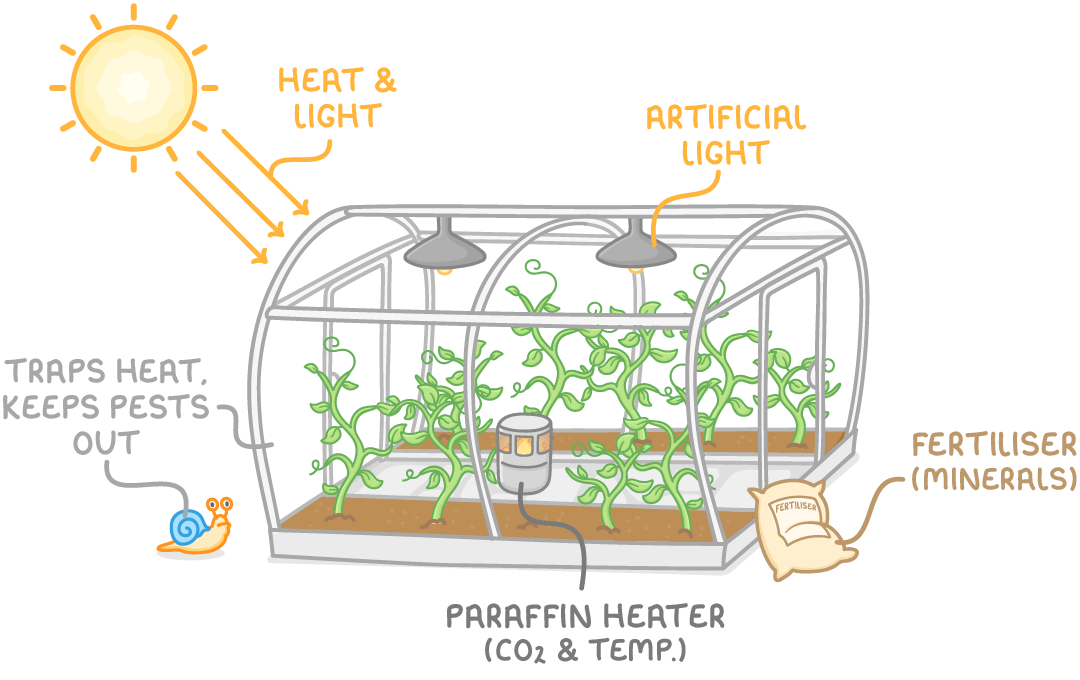
- A greenhouse lets a grower control the factors that limit photosynthesis, so none of them holds the rate back.
- The aim is to keep every limiting factor at or near its ideal level at the same time.
- Crops then grow faster and can be harvested more often.
Controlling each factor
- Temperature - The greenhouse traps the Sun's heat so it doesn't fall low enough to limit the rate:
- In winter, a heater keeps it at the ideal level.
- In summer, when it might climb past the optimum and start to denature the enzymes, shades and ventilation cool it down.
- Light - Light is always needed, so growers often add artificial lighting after sunset to give plants more time photosynthesising.
- Carbon dioxide - Can be raised above the level in ordinary air. A paraffin heater raises both temperature and carbon dioxide, because burning paraffin gives off carbon dioxide as a by-product.
- Pests and disease - Keeping plants enclosed makes them easier to protect.
- Minerals - Fertiliser can be added to the soil for healthy growth.
Striking the economic balance
- All of this costs money, so there is a balance to strike.
- A grower aims to supply just enough heat, light, and carbon dioxide to keep conditions ideal for a fast rate - but no more.
- Spending on extra heat or light beyond what raises the crop is simply wasted.
- Get the balance right and the faster-grown, more frequent crop earns more than the cost of maintaining the conditions - so the grower makes a profit.
TermDefinition
Limiting factor
Optimum temperature
Denatured
Chlorophyll