6.3 - Evidence for Evolution
Evidence for evolution
- The theory of evolution by natural selection says species have changed over time and share common ancestors.
- When first proposed there was little to confirm it, but a great deal of evidence has built up since, so the theory is now widely accepted.
- Three independent lines of evidence support it: inheritance genetics, the fossil record, and present-day change.
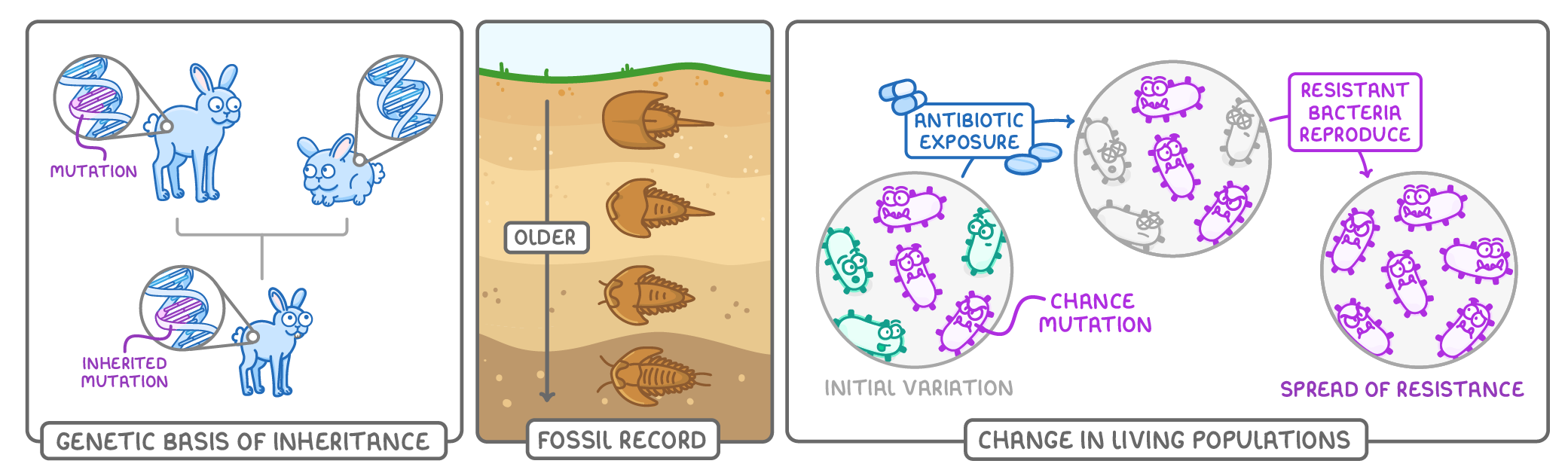
Genetic basis of inheritance
- When the theory was first proposed, there was no explanation for where new characteristics came from or how they were passed on.
- It's now known that:
- Characteristics are controlled by genes.
- New variations arise from mutations changing the genetic material.
- These variations are passed from parents to offspring in their genes.
- This supplied the mechanism the original theory was missing, showing how beneficial characteristics can be inherited and become more common over generations.
The fossil record
- Fossils are the preserved traces or remains of organisms that lived long ago, most commonly found in rocks.
- Deeper rock layers generally hold the older fossils.
- Arranging fossils of different ages in order shows how organisms gradually changed over very long periods, and which forms appeared and disappeared.
- This gives direct evidence that life has not stayed the same but has evolved.
Change observed in the present day
- Bacteria evolve quickly because they reproduce rapidly, and populations have been seen to develop resistance to antibiotics:
- A chance mutation gives some bacteria an advantage when antibiotics are present.
- Those bacteria survive and reproduce.
- The resistant form spreads through the population.
- The same present-day change is seen in other organisms - rats becoming resistant to the poison warfarin, and insects becoming resistant to pesticides.
- These are examples of natural selection happening now, in observable time, not only in the distant past.
Together, the genetic basis of inheritance, the fossil record, and change in living populations all support the conclusion that organisms have evolved and that present-day species are descended from common ancestors.
TermDefinition
FossilThe remains or traces of organisms that lived millions of years ago, most often preserved in rocks.
MutationA random change in an organism's genetic material (DNA).
Key points to remember
How were these notes?