3.7 - Transport in Plants
Transport tissues in plants - Xylem and phloem
- Plants must move substances around the plant body, over distances too great to rely on substances spreading on their own.
- Water and dissolved mineral ions are taken in by the roots and carried up through the stem to the leaves and the rest of the plant above ground.
- Sugars are made in the leaves by photosynthesis and carried out to every part of the plant that needs them, to be used or stored.
- To do this, plants have two special transport tissues, each carrying a different load:
- Xylem - Carries water and the mineral ions dissolved in it, moving them upwards from the roots.
- Phloem - Carries the food the plant has made (dissolved sugars and amino acids) away from the leaves to wherever it's needed.
- The two tissues run side by side through the plant but are completely separate, differing in what they're made of and how they work.
Comparing xylem and phloem
| Feature | Xylem | Phloem |
|---|---|---|
| Made of | Dead cells | Living cells |
| Carries | Water and dissolved mineral ions | Dissolved sugars (mainly sucrose) and amino acids |
| Direction of transport | One way, upwards only | Up and down (both directions) |
| Structure of the tubes | Hollow tubes strengthened with lignin, no contents | Cells with contents, joined by sieve plates |
Xylem
- Xylem is one of the two transport tissues in a plant.
- It carries water and the mineral ions dissolved in that water from the roots, up through the stem, and out to the leaves.
- Water and minerals only ever travel upwards.
- Xylem also helps to support the plant - its columns of strengthened tubes give the stem and leaves rigidity.
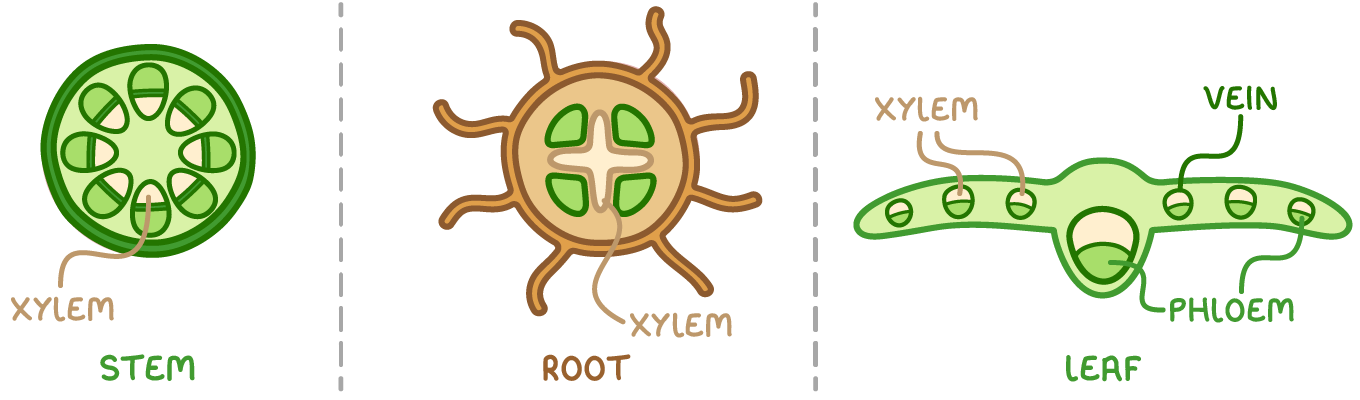
Position in a cross-section
- Near the outside of a stem
- In the centre of a root
- In the veins of a leaf, alongside the phloem
How xylem is adapted to its job
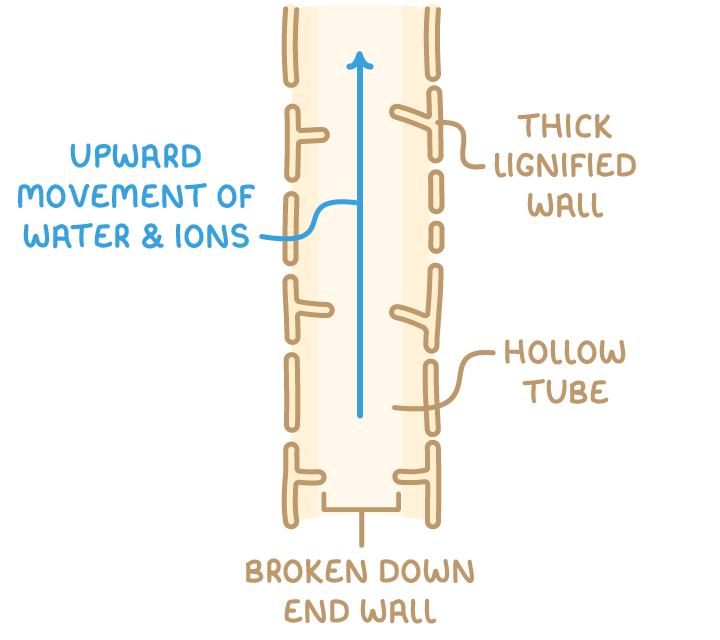
- Each xylem vessel is made of dead cells joined end to end.
- The end walls are broken down, so the cells form a long, continuous hollow tube with nothing inside to block the flow.
- The thick side walls are strengthened with a tough material called lignin.
- The lignin makes the tubes strong and stiff, which:
- Lets them withstand the changes in pressure as water is pulled through them
- Gives the whole plant support
Phloem
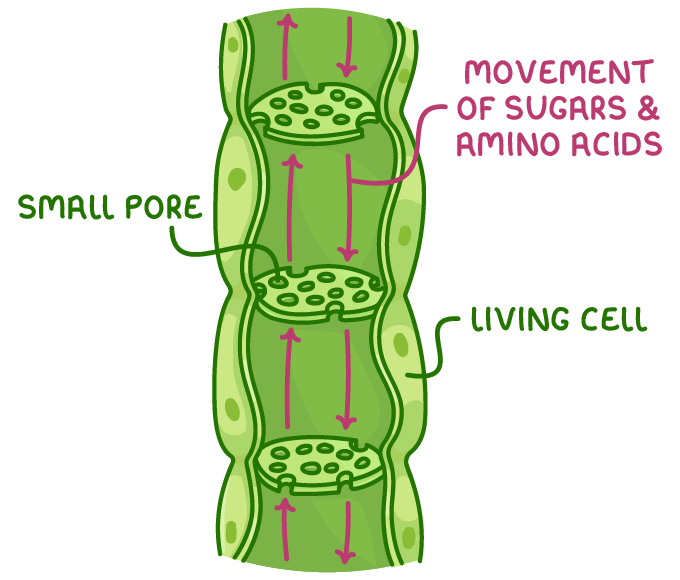
- Phloem is the second transport tissue in a plant. Unlike xylem, it is made of living cells.
- The cells are long and joined end to end into tubes.
- There are small pores in the walls between the cells, so that the cell sap - the watery mixture of dissolved substances being carried - can flow from one cell to the next.
What phloem carries
- Phloem carries the food the plant has made:
- Dissolved sugars, mainly sucrose
- Amino acids
- These move from the leaves, where they are made, to the rest of the plant:
- Some goes to growing parts to be used straight away
- Some goes to storage parts to be kept
Translocation
- The transport of sugars and amino acids through the phloem is called translocation.
- Unlike the one-way flow in the xylem, translocation can move substances in both directions through the plant.
Root hair cells take up water and mineral ions
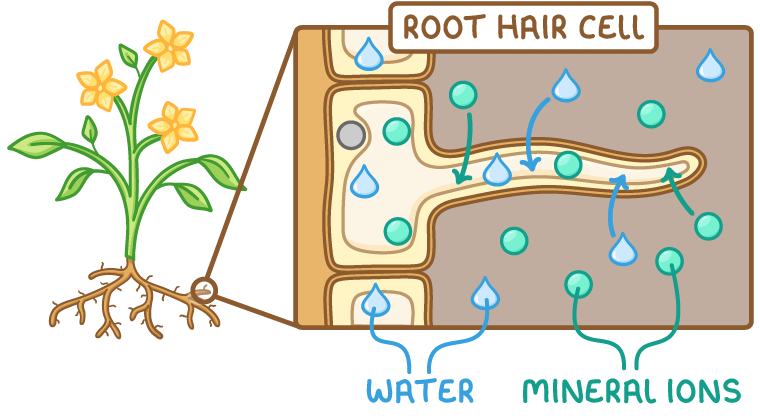
- Plant roots take in water and dissolved mineral ions from the soil.
- Root hair cells on the surface of the root are adapted to do this efficiently.
- Each root hair cell grows out into a long, thin "hair" that sticks out into the soil, and a single root branch is covered in millions of them.
- Together the hairs give the root a very large surface area, which speeds up the absorption of water and minerals.
- Plants need mineral ions for healthy growth.
How each substance is absorbed
- Water - Absorbed into the root hair cells by osmosis, because the soil water is more dilute than the solution inside the cells.
- Mineral ions - Usually more concentrated inside the root hair cells than in the soil, so they can't be drawn in by diffusion. They're taken up against the concentration gradient by active transport, which uses energy released by respiration.
The pathway of water through the plant
- After water is absorbed by the root hair cells, it follows a set pathway through the plant to the leaves.
- From the root hair cells, water passes inwards through the root cortex cells - the layers of cells between the surface of the root and its centre - until it reaches the xylem.
- It then travels up the plant inside the xylem vessels, through the stem and into the leaf, where it passes into the mesophyll cells.
Order of the journey
- Root hair cells
- Root cortex cells
- Xylem
- Mesophyll cells of the leaf
Showing the route with dye
- Stand a cut stem, such as a stick of celery, in water containing a coloured dye.
- As water moves up the plant, the dye stains the xylem, marking the path the water has taken up the stem and into the leaves.
TermDefinition
XylemA plant transport tissue that carries water and dissolved mineral ions from the roots to the stems and leaves.
PhloemA plant transport tissue made of living cells that carries dissolved sugars and amino acids around the plant.
LigninA tough material that strengthens the walls of xylem vessels to provide support.
TranslocationThe transport of dissolved sugars and amino acids through the phloem.
Key points to remember
How were these notes?