3.5 - Osmosis
What osmosis is
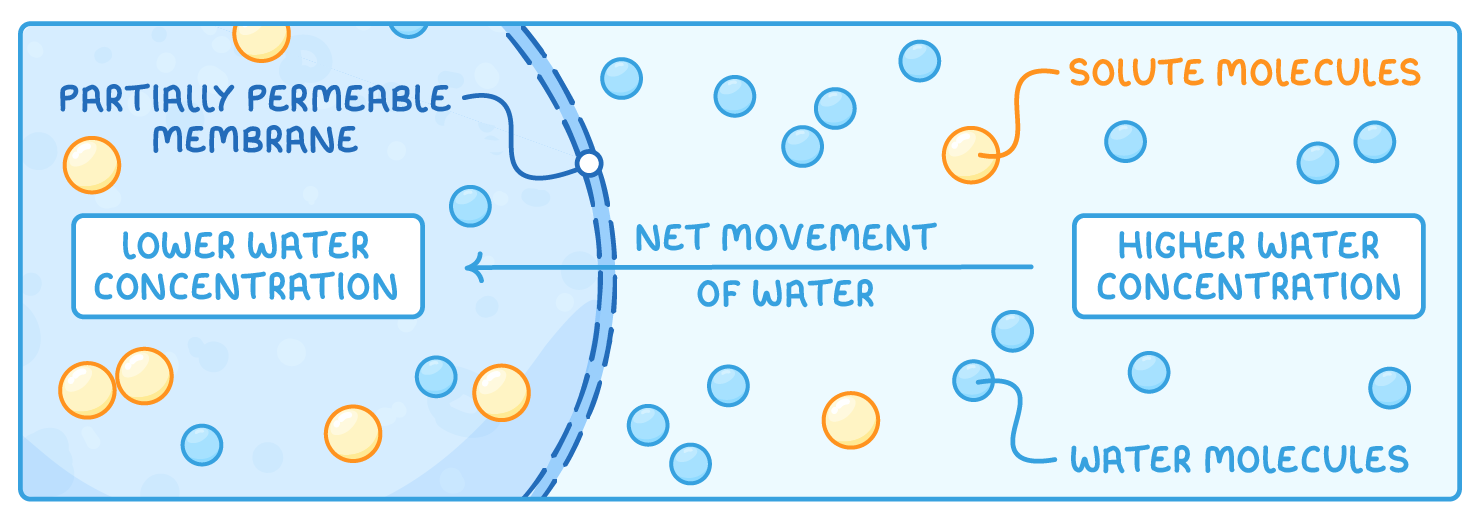
- Osmosis is the net movement of water molecules across a partially permeable (also called selectively permeable) membrane.
- Water moves from a region of higher water concentration to a region of lower water concentration - i.e. from a more dilute solution to a more concentrated one.
- The same thing stated in terms of the dissolved solute: water moves from a lower solute concentration to a higher solute concentration.
- Osmosis is a special case of diffusion - the diffusion of water - so, like any diffusion, it is passive and needs no energy from respiration.
Partially permeable membranes
- A partially permeable membrane has very small holes in it - so small that only tiny molecules such as water can pass through, while bigger molecules such as sucrose cannot.
- A cell membrane is a partially permeable membrane.
The net flow of water
- Water molecules actually pass both ways through the membrane, because they move about randomly all the time.
- Overall there is a steady net flow from the dilute side (many water molecules) to the concentrated side (fewer water molecules).
- The effect is to even up the concentrations on the two sides: the more concentrated solution gradually becomes more dilute.
The effect of osmosis on plant cells
- Whether water moves in or out of a plant cell by osmosis depends on the water concentration of the surrounding solution compared with inside the cell.
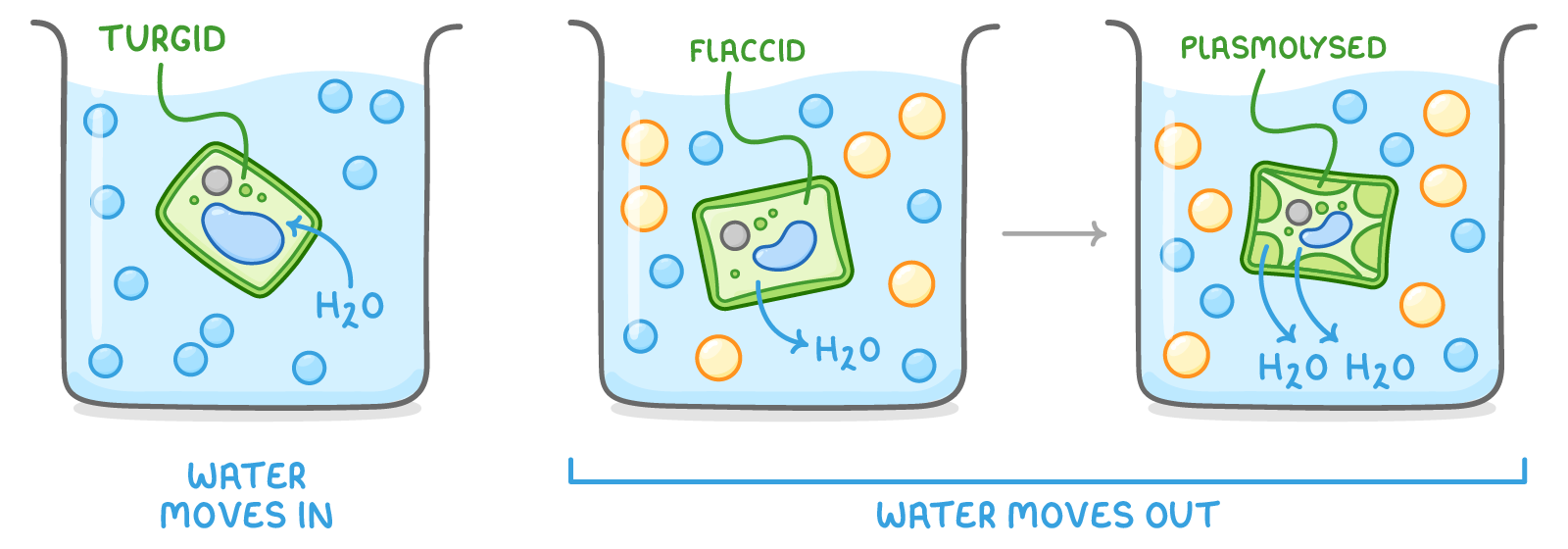
- A plant cell can end up in one of three states: turgid, flaccid, or plasmolysed.
Turgid cells - Water moves in
- When the surrounding solution has a higher water concentration than inside the cell (e.g. a well-watered plant), water moves into the cell by osmosis.
- The cell becomes plump and swollen - it is turgid.
- The water inside presses outwards against the cell wall, creating turgor pressure.
- The cell wall is inelastic (rigid), so it stops the cell expanding too far and limits how much water can enter, preventing damage.
- When all a plant's cells are turgid, the turgor pressure on their walls supports the whole plant and keeps it upright.
Flaccid cells - Water moves out
- When the surrounding solution has a lower water concentration than inside the cell, water moves out of the cell by osmosis.
- The cell loses turgor, becomes limp, and is described as flaccid.
- A plant short of water wilts and droops, though the cell walls stop it collapsing completely.
Plasmolysed cells - Even more water lost
- If even more water is lost, the cytoplasm starts to shrink and the cell membrane pulls away from the cell wall.
- A cell in this condition is said to be plasmolysed, and the process is called plasmolysis.
The effect of osmosis on animal cells
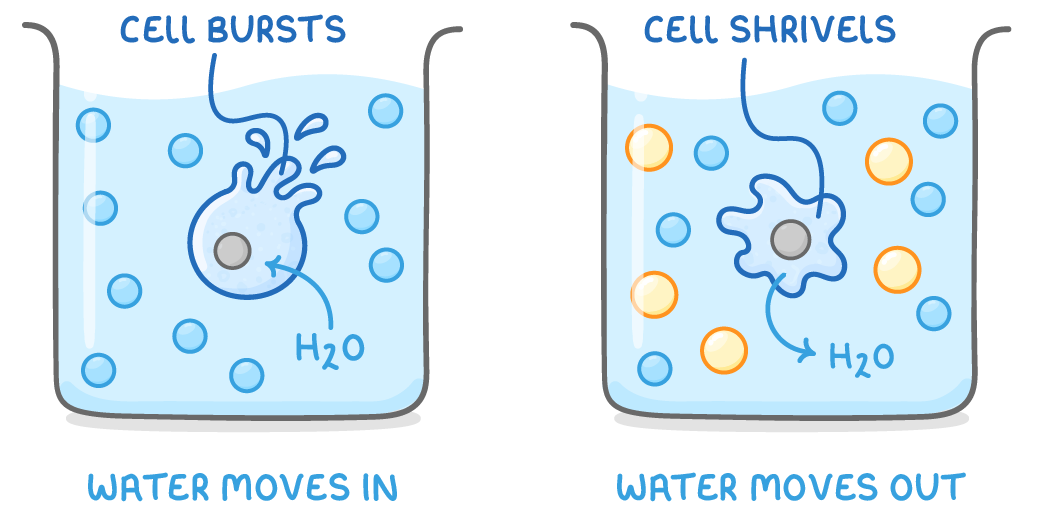
- Animal cells have no cell wall, so nothing resists the pressure of water moving in or out.
- This makes them more affected by the surrounding solution than plant cells.
Water moving in - The cell bursts
- If an animal cell is surrounded by a solution with a higher water concentration than inside the cell, water moves into the cell by osmosis.
- With no cell wall to limit the swelling, the cell can take in so much water that it bursts.
- This bursting is called lysis.
Water moving out - The cell shrivels
- If an animal cell is surrounded by a solution with a lower water concentration than inside the cell, water moves out of the cell by osmosis.
- The cell loses water, shrinks and shrivels up, and can be damaged or die.
- This is why drinking sea water is harmful: its high salt content gives the blood a much lower water concentration than the body's cells, so water is drawn out of the cells and they shrivel.
Osmosis in a potato
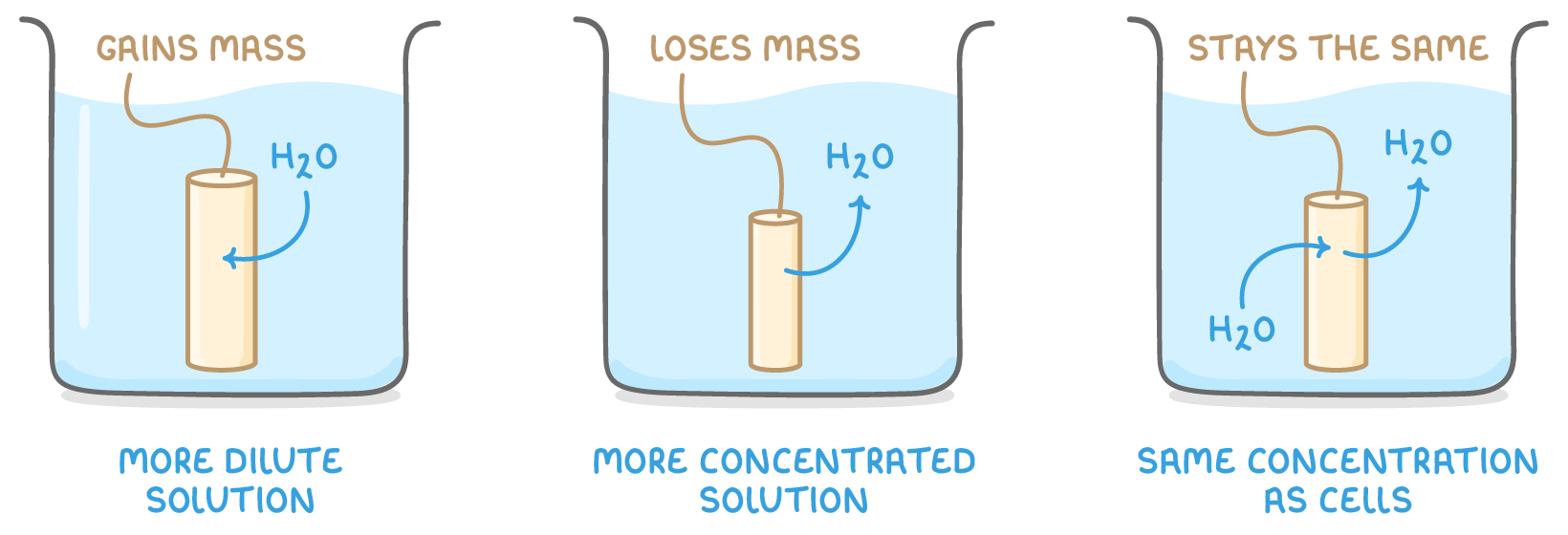
- Osmosis can be shown using pieces of plant tissue, such as cylinders cut from a potato, placed in sugar solutions of different concentrations.
- The cell membranes of potato cells are partially permeable, so water moves into or out of the cells by osmosis.
- The direction of movement depends on how the concentration of the surrounding solution compares with the concentration inside the cells.
How the cylinder responds to each solution
- More dilute solution (higher water concentration outside) - Water is drawn into the cells, so the cylinder gains mass and swells slightly.
- More concentrated solution (lower water concentration outside) - Water is drawn out of the cells, so the cylinder loses mass and shrinks slightly.
- Same concentration as the cells - The cylinder stays roughly the same, because there is no net movement of water.
The change in mass is a direct measure of which way, and how strongly, osmosis has moved the water.
TermDefinition
OsmosisThe net (overall) movement of water molecules across a partially permeable membrane from a region of higher water concentration to a region of lower water concentration.
Partially permeable membraneA membrane that lets small molecules, such as water, pass through but not larger molecules.
TurgidPlump and swollen, usually describing a plant cell that has taken in water by osmosis.
FlaccidDescribes a cell (usually a plant cell) that has lost water by osmosis, so it is limp and lacks turgor.
PlasmolysedThe state of a plant cell when it has lost so much water that the cell membrane pulls away from the cell wall.
Cell lysisThe bursting of an animal cell when it takes in too much water by osmosis.
Key points to remember
How were these notes?