2.9 - Culturing Microorganisms
Calculating the area of a colony or clear zone
- A bacterial colony and a clear zone are both roughly circular, so their size is measured as the area of a circle.
- A clear zone is the region around an antimicrobial-soaked disc where the substance has stopped the bacteria growing, leaving the agar clear.
- The larger the clear zone, the more effective the substance has been against the bacteria.
- Measuring the area turns a rough by-eye comparison into a numerical one, so different colonies or treatments can be compared accurately.
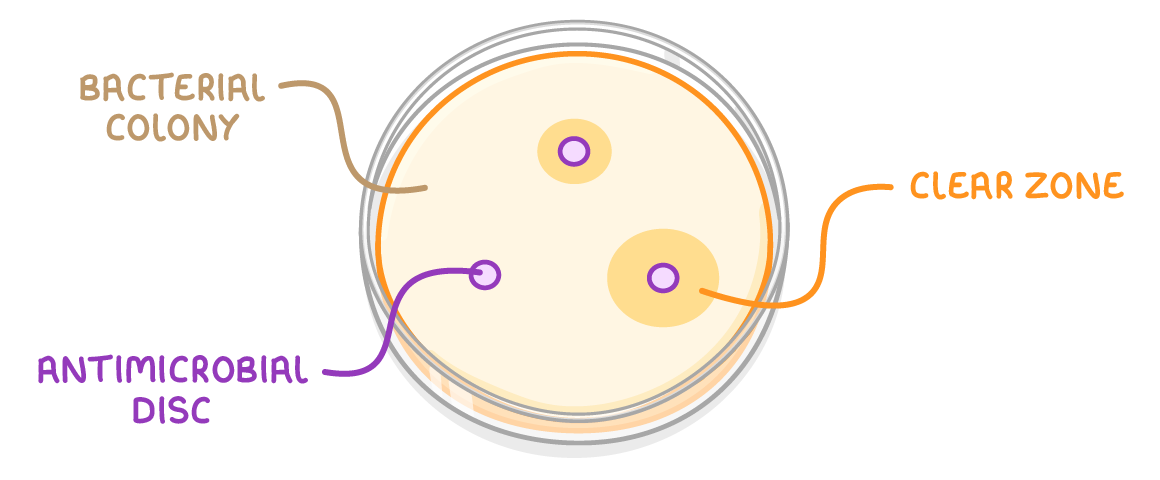
Finding the area
Formula for area of a circle:
Where:
- = Radius, the distance from the centre to the edge, in millimetres (mm) or centimetres (cm)
- = A constant, about 3.14
Find by measuring the diameter across the colony or clear zone and halving it. Measure the diameter through the bottom of the closed Petri dish, without opening it, so the culture is not disturbed. The area comes out in square units, such as square millimetres (mm2) or square centimetres (cm2).
Worked example - Comparing two clear zones
Two antimicrobial discs are tested. Treatment A produces a clear zone 14 mm across; treatment B produces a clear zone 20 mm across. Calculate each area and state which treatment is more effective.
Step 1 - Find each radius
Treatment A: radius = 14 ÷ 2 = 7 mm
Treatment B: radius = 20 ÷ 2 = 10 mm
Step 2 - Apply the formula
Treatment A:
Treatment B:
Step 3 - Interpretation
Treatment B's clear zone (about 314 mm2) is roughly twice the area of treatment A's (about 154 mm2), so treatment B is the more effective of the two.
TermDefinition
Clear zoneThe region around an antimicrobial-soaked disc where the substance has stopped the bacteria growing. It is also called the zone of inhibition.
Key points to remember
How were these notes?