7.6 - Anaerobic Respiration in Yeast
The experiment
Aim
To investigate anaerobic respiration in yeast by measuring how fast it gives off carbon dioxide, and to find out how temperature affects that rate.
Background
- Yeast is a single-celled fungus.
- When there is no oxygen, yeast respires anaerobically. It breaks glucose down into ethanol and carbon dioxide (glucose → ethanol + carbon dioxide). This is called fermentation.
- You can't see respiration happening, but you can measure how quickly the carbon dioxide comes off. You can count the gas bubbles, collect the gas in a gas syringe, or bubble it through limewater.
- So in this practical you measure how fast yeast gives off carbon dioxide at different temperatures. The faster the gas comes off, the faster the rate of anaerobic respiration.
Variables
- Independent variable - The temperature of the water bath, for example 20, 30, 40, and 50 °C.
- Dependent variable - The rate at which carbon dioxide is given off, in bubbles per minute or volume of gas per minute.
- Control variables - The volume and concentration of the yeast suspension and of the glucose solution, the layer of oil, the starting pH, and the time.
Method
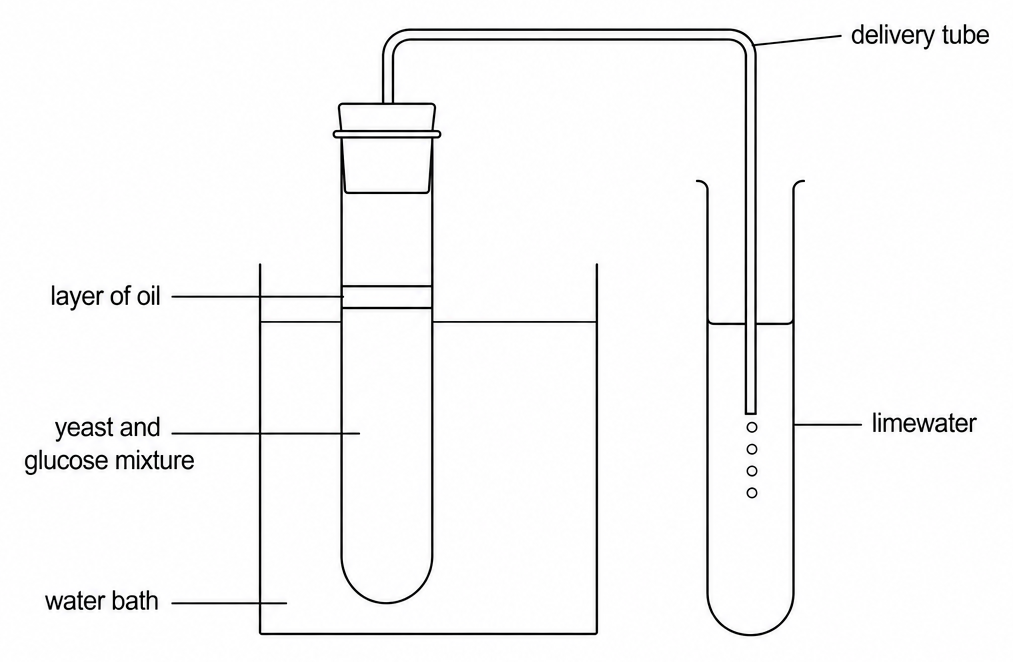
- Mix the yeast and glucose - Mix a set volume of yeast suspension with a set volume of glucose solution in a boiling tube.
- Add a layer of oil - Gently pour a thin layer of oil on top of the mixture.
- Fit the delivery tube - Fit a bung with a delivery tube leading into a gas syringe, under water so the bubbles can be counted, or into a test tube of limewater.
- Warm the tube - Stand it in a water bath at the first temperature, and leave it for a few minutes.
- Measure the gas - Count the bubbles given off in 2 minutes, read the gas volume, or time how long the limewater takes to turn cloudy.
- Repeat at other temperatures - And repeat the whole experiment to find a mean.
Safety
- Limewater is an irritant - Wear eye protection and wash off any splashes.
- Hot water bath - At the higher temperatures it can scald, so lift tubes in and out with a test-tube holder.
- Always give the gas a way out - Never bung the tube without the delivery tube in place.
Worked example - Rate of respiration in yeast
A student counted the carbon dioxide bubbles that yeast gave off in 2 minutes at four temperatures.
| Temperature (°C) | Bubbles in 2 min |
|---|---|
| 20 | 24 |
| 30 | 60 |
| 40 | 96 |
| 50 | 40 |
Turn these counts into rates in bubbles per minute, and describe the trend.
Step 1 - Write the equation for the rate
The rate is the number of bubbles each minute, so divide the count by the time.
Step 2 - Turn the count at 20 °C into a rate
At 20 °C the yeast gave off 24 bubbles in 2 minutes.
Step 3 - Find the rate at the other temperatures
- At 30 °C, the rate is 60 ÷ 2 = 30 bubbles per minute.
- At 40 °C, the rate is 96 ÷ 2 = 48 bubbles per minute.
- At 50 °C, the rate is 40 ÷ 2 = 20 bubbles per minute.
Step 4 - Describe and explain the trend
- As the temperature rises from 20 to 40 °C, the rate increases. Respiration is controlled by enzymes, which work faster when it's warmer.
- Above 40 °C the rate drops sharply, to only 20 bubbles per minute at 50 °C. The higher temperature denatures the yeast's enzymes. Their active sites change shape, so they can no longer break the glucose down.
- The rate is fastest at about 40 °C, which is the optimum temperature.
Common exam questions
Question 1
Why is a layer of oil floated on top of the mixture?
To keep oxygen out, so the yeast respires anaerobically rather than aerobically.
Question 2
How could you show that the gas given off is carbon dioxide?
Bubble it through limewater. Carbon dioxide turns limewater from clear to cloudy (milky).
Question 3
Why is the tube left in the water bath for a few minutes before counting starts?
So the mixture reaches the temperature being tested before the reading is taken. Otherwise the rate would still be changing as it warmed up.
Question 4
Why must the tube never be bunged without a way out for the gas?
The carbon dioxide builds up pressure in a sealed tube. The delivery tube is what lets it escape.