6.2 - Natural Selection & Evolution
Natural selection
- Within any population, individuals show genetic variation - they have different combinations of alleles (different versions of their genes).
- New alleles arise by mutation. Occasionally a new allele gives an individual a characteristic that makes it better adapted to its environment.
The struggle for survival
- Organisms tend to produce more offspring than the environment can support.
- Resources such as food, water, space, and mates are limited, so not all offspring survive - individuals compete with one another and also face pressures such as predation and disease.
- These environmental factors that decide which individuals survive are called selection pressures, and the result is a struggle for survival.
How natural selection works
- Individuals whose characteristics make them better adapted to the conditions have a better chance of surviving the struggle.
- Because they are more likely to survive, they are also more likely to reproduce successfully, passing on the alleles for their helpful characteristics to the next generation.
- Less well-adapted individuals are less likely to survive and reproduce, so they pass on their alleles less often.
- This process - better-adapted individuals surviving and reproducing more - is called natural selection, sometimes described as "survival of the fittest".
- Over many generations, alleles for beneficial characteristics become more common while less helpful ones become rarer, so the characteristics of the population gradually change.
The three essential parts
- Variation between the phenotypes, or traits, in a population
- Differential survival of the better-adapted individuals
- Differential reproductive success that passes their alleles on
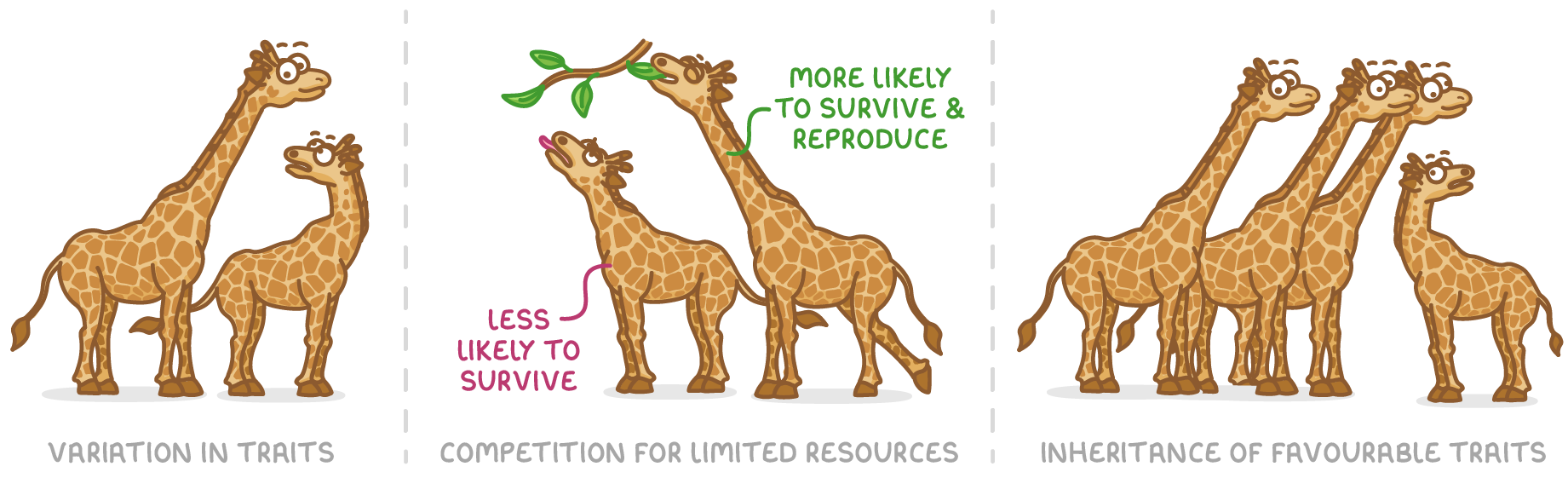
Giraffes with longer necks reach more food, survive, and pass on their alleles.
Example - Fast-running grey squirrels
- In a population of grey squirrels, some can run faster than others.
- When predators are a selection pressure, the faster squirrels are more likely to escape, survive, and breed.
- The alleles for fast running are passed on more often and become more common in later generations.
Evolution
- Evolution is the change in the inherited characteristics of a population over time, brought about by natural selection.
- As beneficial alleles are passed on and become more common generation after generation, the make-up of the population gradually shifts.
- Over very long timescales, these accumulated changes can be large.
All species share a common origin
- The theory of evolution by natural selection states that all of today's species evolved from the simple life forms that first developed on Earth more than three billion years ago.
- The present-day variety of living things is the result of this slow, continuing change acting on many different lineages.
How new species form
- A population can change by natural selection until it becomes so different from another population of the same species that the two can no longer interbreed to produce fertile offspring.
- At that point, the two groups have become separate species.
- In this way, the gradual change of a population over time can eventually give rise to an entirely new species.
Speciation
- Speciation is the formation of a new species.
- It happens when two populations of the same species become so different that they can no longer interbreed to produce fertile offspring.
- Two things work together to bring it about:
- Isolation - Splits a species into separate groups that no longer mix
- Natural selection - Then drives the separated groups apart
Isolation splits the population
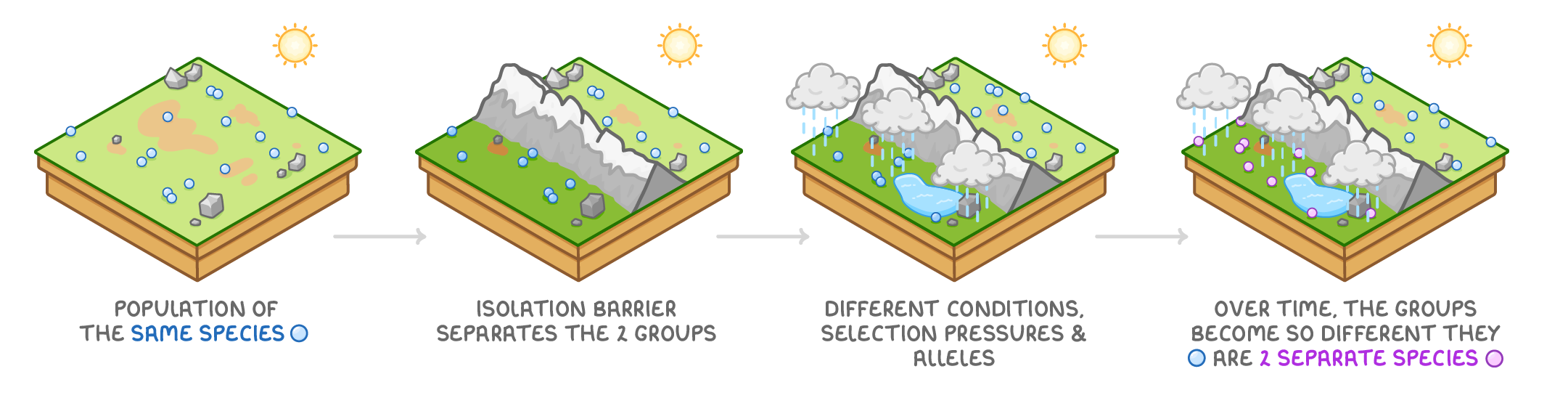
A population first becomes split by an isolation barrier - something that keeps the two groups apart so they can no longer breed with each other.
There are three kinds of isolation barrier:
- Geographical barrier - A physical separation, such as a mountain range, a stretch of sea, a river, a flood, or an earthquake
- Ecological barrier - Groups come to occupy different niches within the same area, e.g. a different habitat or an area with different abiotic conditions such as pH or salinity
- Behavioural barrier - A difference in behaviour that makes the groups less likely to breed together, e.g. a sub-population that begins to mate or lay its eggs in a different place
Natural selection drives the groups apart
- Once isolated, the two groups experience different conditions and selection pressures.
- Different mutations arise in each group, producing different new alleles.
- Natural selection acts differently on the two groups, so different characteristics become more common in each.
- Over many generations the two groups diverge further and further.
- Eventually they become so different that, even if brought back together, they could no longer interbreed to produce fertile offspring.
- At that point they are two separate species - speciation has occurred.
TermDefinition
Natural selectionThe process in which individuals with characteristics best suited to their environment are more likely to survive, breed, and pass on their genes.
Selection pressureAn environmental factor that affects an individual's chance of surviving and reproducing.
EvolutionThe change in the inherited characteristics of a population over time, brought about by natural selection.
SpeciationThe formation of a new species when two populations can no longer interbreed to produce fertile offspring.
Key points to remember
How were these notes?