5.17 - The Eye - Accommodation
Accommodation - Focusing near and distant objects
- Accommodation is the process of changing the shape of the lens to focus light onto the retina.
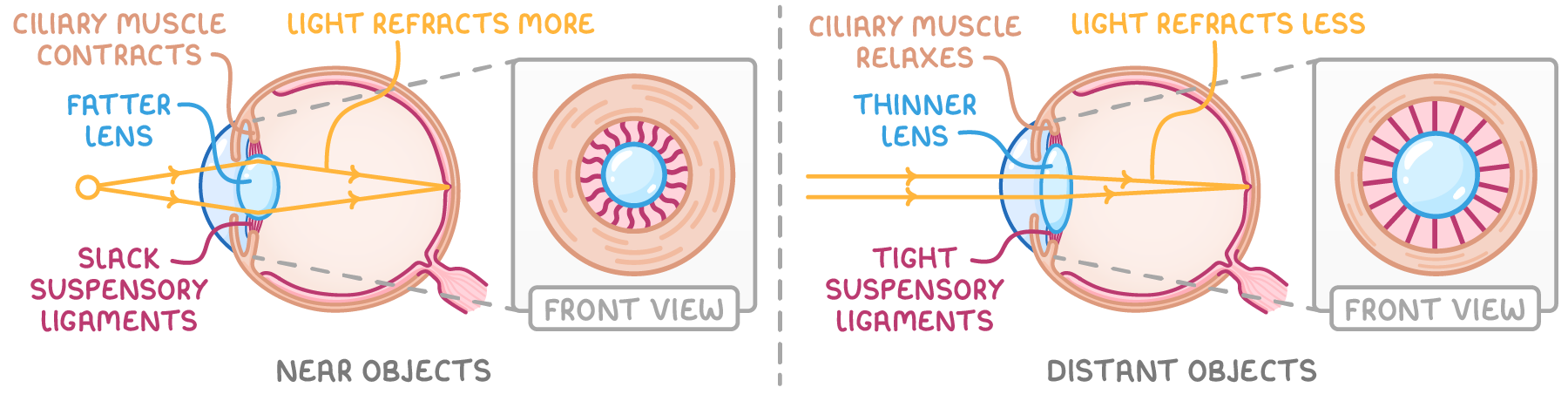
- The lens sits just behind the pupil, held by a ring of suspensory ligaments attached to the ring of ciliary muscle around the inside of the eye.
- Contracting or relaxing the ciliary muscle changes the tension in the suspensory ligaments, which changes how rounded the lens is:
- A fatter, more curved lens refracts (bends) light more strongly.
- A thinner, flatter lens refracts it less.
- Most of the bending of light happens at the cornea at the front of the eye. The lens fine-tunes the focus so the light meets exactly on the retina.
Focusing on a near object
Light entering the eye is spreading out, so it needs to be bent a lot.
- The ciliary muscle contracts.
- This slackens the suspensory ligaments, taking the tension off the lens.
- Freed from that pull, the lens springs into a fatter, more rounded shape.
- It refracts the light by a larger amount, bringing the near object into focus on the retina.
Focusing on a distant object
Light entering the eye is almost parallel, so it needs less bending.
- The ciliary muscle relaxes.
- The suspensory ligaments pull tight.
- This tension stretches the lens into a thinner, flatter shape.
- It refracts the light by a smaller amount, just enough to bring the distant object into focus on the retina.
TermDefinition
AccommodationThe process of changing the shape of the lens to focus light onto the retina.
Key points to remember
How were these notes?