6.5 - Fossils
Fossils and the fossil record
- Fossils are the remains, or traces, of organisms that lived millions of years ago, most often preserved in rocks.
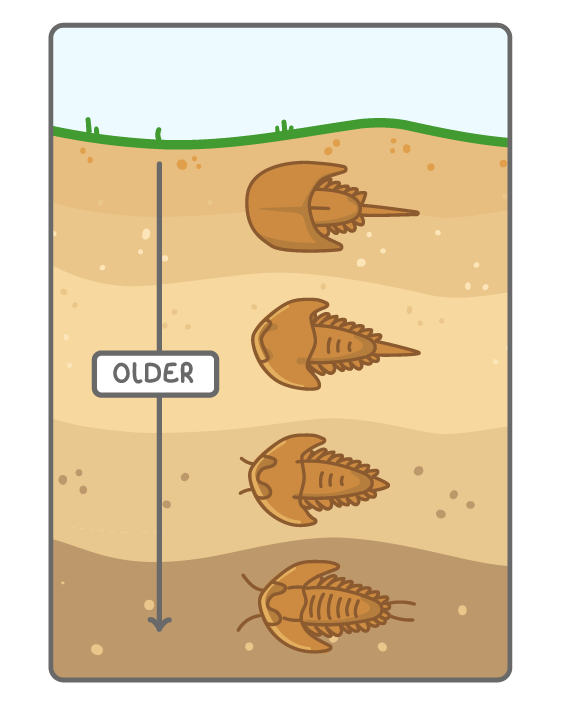
- Arranging fossils in order of age shows the gradual changes from one form to the next, revealing how much or how little different organisms have changed as life developed on Earth.
- Generally, the deeper the rock a fossil is found in, the older the fossil.
- Rocks can be dated to when they formed, so the age of a fossil can be estimated fairly accurately.
The three ways fossils form
- Gradual replacement by minerals - Hard parts such as bones, teeth, and shells decay only slowly, so they last a long time once buried. As they decay, they are gradually replaced by minerals, forming a rock-like substance with the same shape as the original part. The surrounding sediment turns to rock too, but the fossil stays distinct inside it until dug up.
- Casts and impressions - When an organism is buried in a soft material such as clay, the clay hardens and the organism decays away, leaving a cast in its shape. Features such as footprints, burrows, and rootlet traces leave their own impressions as the material hardens around them.
- Preservation where decay cannot happen - Decay is carried out by microorganisms, so where they cannot survive the whole organism stays intact:
- In amber (hardened tree resin) and tar pits - no oxygen or moisture
- In glaciers - too cold
- In peat bogs - too acidic
Why the fossil record is incomplete
- The fossil record is not complete, which is one reason scientists cannot be certain how life on Earth first began.
- Many of the earliest organisms were soft-bodied, and soft tissue tends to decay away completely, so very early life left few traces.
- The few fossils that did form so long ago have largely been destroyed since - for example by geological activity such as the movement of tectonic plates crushing fossils already set in the rock.
TermDefinition
FossilThe remains or traces of organisms that lived millions of years ago, most often preserved in rocks.
Key points to remember
How were these notes?